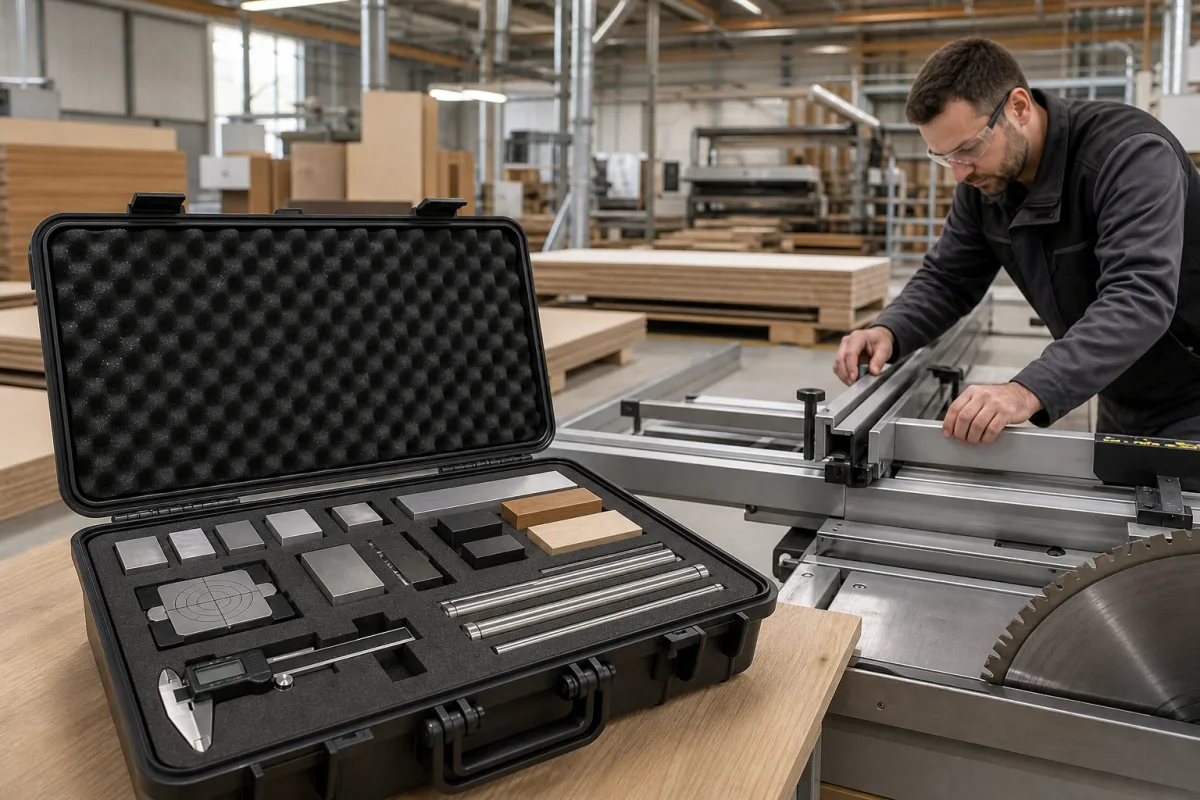
Dimensional calibration kit (gauge block and micrometer inspection sets)
Dimensional calibration kits · gauge block sets and micrometer inspection sets, tolerance grade, block material and thermal expansion
A dimensional calibration kit is a cased set of length standards — gauge blocks, with an optical parallel in micrometer inspection sets — used to check and adjust calipers, micrometers, height gauges and machine settings against known lengths. Ask three things first: which tolerance grade the blocks meet and under which standard, whether the blocks are steel, ceramic or carbide, and which sizes the set contains for the instruments you check.
Cased sets of dimensional length standards: gauge block sets, micrometer inspection sets with an optical parallel, and the accessories that travel with them. Electrical, temperature and pressure references — multifunction calibrators, dry-block calibrators and deadweight testers, and kits built from them — are covered on the Calibration equipment page. RF and microwave network-analyser calibration kits and hardness test-block sets are different products and are outside this page.
CNFX editorial research · Sources checked October 12, 2026 · 3 sources
Choose the tolerance grade and the set composition
NIST's Gage Block Handbook describes four tolerance grades in the US standard: 0.5, 1, 2 and 3, with grades 0.5 and 1 used as calibration masters and grades 2 and 3 for measurement and gauging. Its metric table lists, for blocks under 25 mm, ±0.03 µm for grade 0.5, ±0.05 µm for grade 1, +0.10/−0.05 µm for grade 2 and +0.30/−0.15 µm for grade 3; under 100 mm the grade 0.5 and grade 1 limits widen to ±0.10 and ±0.15 µm. [1]
The handbook adds that the standard allows a further tolerance for measurement uncertainty, and that the ASME and Federal standards recommend recalibration annually for grades 0.5 and 1 and monthly to semi-annually for grades 2 and 3. Gauge blocks are defined internationally by ISO 3650, which NIST describes as similar in spirit to the ANSI standard but different in detail. [1]
A micrometer inspection kit is built around the instrument it checks. Mitutoyo's metric set 516-106-10 holds ten grade 0 steel blocks — 2.5, 5.1, 7.7, 10.3, 12.9, 15, 17.6, 20.2, 22.8 and 25 mm — for testing accuracy through the measuring stroke of an outside micrometer, plus an optical parallel (t = 12 mm) for testing the flatness and parallelism of the contact faces. It is listed to EN ISO 3650, for use with EN ISO 3611, DIN 863 (1999) and VDI/VDE/DGQ 2618, delivered in a wooden case with an inspection certificate for the blocks, at a mass of 1,000 g. [2]
Editorial calculation: the Mitutoyo sizes step by 2.6 mm (5.1 − 2.5) except 12.9 to 15 mm (2.1 mm), so a 0–25 mm micrometer is checked at ten points, eight of them not whole millimetres. [2] General sets instead build any length from a few blocks: NIST notes that the wringing layer between blocks is about 25 nm and is defined as part of each block's length. [1]
Give the supplier the instruments to be checked and their ranges, the grade and standard required (ISO 3650, ASME or JIS), block material, set sizes or number of pieces, whether an optical parallel or holders are needed, and whether you need an inspection certificate or an accredited calibration certificate.
02
Choose steel, ceramic or carbide blocks and control temperature
NIST gives gauge block steel an expansion coefficient of 11.5 × 10⁻⁶/°C, so a 100 mm block grows 1.15 µm when its temperature rises 1 °C; to change a 500 mm block by 0.25 µm, a temperature change of only 0.043 °C is needed. The reference temperature for dimensional measurement is 20 °C. [1]
NIST's table of coefficients at 20 °C lists 11.5 for steel blocks under 25 mm, 9.2 for zirconia ceramic blocks, 8.4 for chrome carbide, 4.5 for tungsten carbide, 6.3 for granite and 24 for aluminium (all × 10⁻⁶/°C). It says steel "has always been the material of choice" because when block and steel workpiece are at the same temperature, their expansion cancels, and the difference in expansion between part and gauge is what matters. [1]
Misumi's catalogue for a zircon-ceramic block set lists (9.5 ± 1) × 10⁻⁶/K expansion, hardness of HV 1300 against HV 800 for steel, specific gravity 6 against 7.8, and heat conductivity 2.5 against 76 W/m·K; it describes ceramic blocks as rust-free and non-magnetic. Its 32-piece grade 0 set weighs 950 g and its 47-piece set 2.25 kg. [3] Editorial note: NIST's 9.2 and Misumi's 9.5 ± 1 for zirconia overlap; ask for the value the maker certifies for your blocks.
For steel blocks, NIST recommends a preservative coating to prevent rust when the work area exceeds 50% relative humidity, and finishing solvent and alcohol cleaning hours ahead of use because cleaning disturbs the blocks' thermal state. [1] Editorial calculation: a 100 mm steel block carried from a 20 °C store onto a 30 °C shop floor grows 11.5 × 10⁻⁶ × 100 mm × 10 = 0.0115 mm. [1]
03
Micrometer inspection set, ceramic block sets or master blocks
The table sets published kits side by side; each row comes from the source cited. No supplier card has been confirmed for this product yet.
Ask each supplier for the grade table it certifies to, the material, and the size list of the set.
Explore company information and manufacturing capabilities, then discuss the scope of your project with a relevant supplier.
Share this page
Compiled and source-reviewed by the CNFX editorial team.
Each manufacturer above links to the page on that company's own website where the product is listed, with the date we checked it. How we source and review
· Page last updated 13 October 2026
Buyer questions
What is in a micrometer inspection kit?
Mitutoyo's set 516-106-10 holds ten grade 0 steel gauge blocks from 2.5 to 25 mm and a 12 mm optical parallel for checking face flatness and parallelism. [2]
How much does a steel gauge block grow with temperature?
NIST gives 11.5 × 10⁻⁶/°C, so a 100 mm block grows 1.15 µm per °C. [1]
How do ceramic blocks differ from steel?
Misumi lists HV 1300 against HV 800 for steel, (9.5 ± 1) × 10⁻⁶/K expansion and much lower heat conductivity; NIST lists zirconia at 9.2 × 10⁻⁶/°C. [3][1]
Sources and what still needs a direct check
Sources checked 2026-10-12. NIST Monograph 180 is the US national metrology institute's handbook on gauge blocks; Mitutoyo and Misumi describe sets they sell. Ask for the grade table and certificate that apply to the exact set you buy.