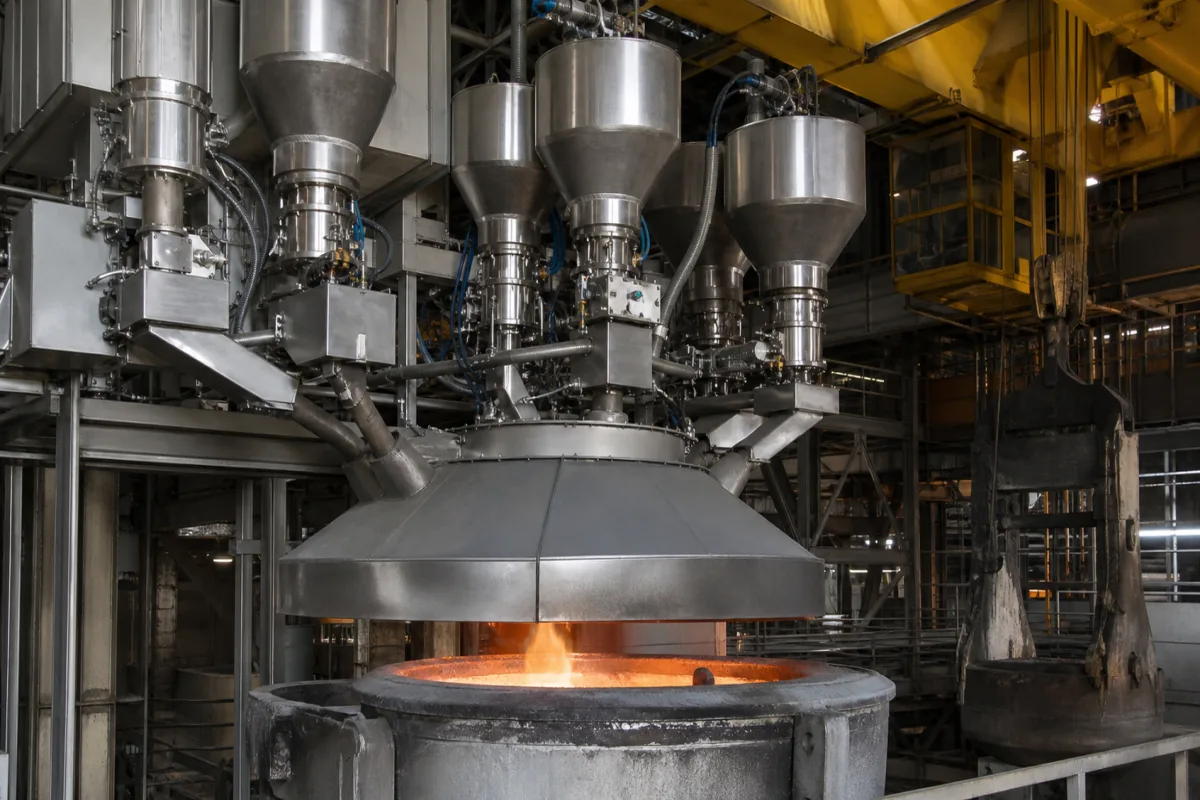
Ladle alloy addition station: bins, vibratory feeders and a weigh hopper that batch ferroalloys into the ladle, and what decides how much of the addition is recovered
Secondary metallurgy and foundry melt shops · storage bins, feeders and a weigh hopper that make up an alloy batch and drop it through a chute into the ladle
The alloy addition station is the equipment above or beside the ladle that turns a chemistry correction into kilograms of ferroalloy in the steel: bins hold ferrosilicon, ferromanganese, graphite and other additions, feeders meter them into a weigh hopper, and a chute or delivery vessel puts the finished batch into the ladle. How much of what is weighed ends up dissolved in the steel depends on when and where the batch goes in, through slag or into a stirred open eye, and on knowing how much steel is in the ladle.
Alloy addition and inoculant addition stations for steel and foundry ladles: storage bins for ferroalloys, graphite and inoculants, vibratory feeders, weigh hoppers and batch weighing, chutes and delivery vessels, their control, and the addition point (during tap, at a ladle metallurgy station, through the argon open eye). Melting furnaces are covered on the Induction melting furnace page and the Non-ferrous metal induction melting furnace page; tilt drives for ladles and furnaces on the Geared tilting mechanism page; ladle vessels on the Refractory-lined steel ladle page; magnesium treatment vessels on the Magnesium treatment ladle page; argon and nitrogen metering to porous plugs on the Gas control system for molten metal treatment page; powder feeders on the Powder feeder with loss-in-weight control page; and melt analysis on the Molten metal composition analyzer page. Ferroalloys themselves have their own pages, such as Ferromanganese.
CNFX editorial research · Sources checked October 13, 2026 · 4 sources
Manganese recovery from 65 to 95 %: adding in the furnace, at tap or at a ladle metallurgy furnace
A US Department of Energy project run by Missouri University of Science and Technology (final report 2012) compared manganese recovery in seven steel foundries, its own laboratory and plant trials at a ladle metallurgy furnace (LMF) in a wrought steel plant. The report notes that wrought steel producers make all alloy additions to the ladle, during tap or at a ladle metallurgy station or ladle furnace, rather than to the melting furnace. [1]
The report traces poor or erratic recovery to oxidation of the alloy, with ferroalloy recovery depending on dissolution rate, alloy density and the dissolved oxygen in the steel, and names furnace slag, slag carry-over and air entrainment during tapping, and air carried in by the additions as oxygen sources. In arc furnaces, additions with the charge gave low recovery and additions in the ladle high recovery. [1]
Editorial calculation from the recoveries in the table: raising manganese by 0.10 % in 100 t of steel needs 100 kg of manganese in the steel, which means about 105 kg of manganese in the batch at the LMF's 95 % recovery and about 154 kg at foundry A's 65 %. The ferroalloy mass is larger again by the alloy's manganese content, which the supplier's certificate gives.
Tell the station supplier where additions will be made (during tap, at a ladle furnace or both), the alloys and their lump sizes, the largest and smallest batch, and how many alloys go into one batch.
02
Dropping the batch into the argon open eye: eye area and mixing time against gas flow
In secondary metallurgy, alloys are added through the open eye that the argon plume breaks in the slag. Ramasetti and co-authors (University of Oulu with Outokumpu and Northeastern University, Metals 2019) modelled an argon-stirred industrial ladle and checked the model against measurements: raising argon flow from 100 to 500 NL/min enlarged the time-averaged open eye from 0.66 to 2.36 m² and shortened the 95 % mixing time of a nickel tracer from 139 to 96 s. [2]
For the station, the eye area is the target the chute has to hit: Editorial calculation: at 100 NL/min the 0.66 m² eye corresponds to a circle about 0.92 m across, against about 1.73 m for 2.36 m² at 500 NL/min, so a fixed chute outlet aimed over the porous plug has less room for error at low stirring rates. [2] The DOE report lists induction stirring after the addition among the factors it observed in induction furnace practice, and lack of intense stirring as a cause of less homogeneous chemistry in arc furnace foundries. [1]
Give the ladle size, the porous plug position, the argon flow used during additions and the chute or delivery position, so the outlet can be placed over the eye.
03
Weigh hopper, feeder and the steel weight the batch is calculated from
General Kinematics describes the station layout for foundries: alloy bins receive and store ferrosilicon, graphite or other additions, vibratory feeders transfer them to a main weigh unit for batch make-up, and finished batches go to the charge area by delivery barrel and monorail or hoist; bins are fed by feeders with electromechanical or pneumatic drives, and an integrated SCADA system controls the weighing. Its inoculant systems add the batch into the ladle before pouring, using individual bins and feeders and weighing rollovers. [3]
The batch weight is only half of the calculation; the other half is the steel it goes into. A 1989 patent for a weighing ladle transfer car states that the weight of molten metal must be known to make proper alloy additions to the ladle, that improper ladle additions can lead to scrapping or rejecting a heat of up to 300 tons, and that full ladles can weigh over 300 tons. It attributes inaccurate weights of earlier cars to spilled metal, shock loading and horizontal loads from crane handling. [4]
Practice changes matter as much as the hardware. In the DOE project's induction furnace trial at a 2,000 lb foundry, rewriting melting practice to keep alloys out of the charge, sample consistently and avoid adding through slag cut the standard deviation of final manganese from 0.097 to 0.031 and the average from 0.69 to 0.57 % against a 0.4–0.6 % specification, raising the specification-range-to-standard-deviation ratio from 2.1 to 6.4; the report puts this at a 20 % decrease in manganese alloys for the same grade. The report treats a ratio of 4.0 or more as putting 95.5 % of heats within specification. [1]
Specify the weighing range of the hopper against the smallest batch, how the steel weight in the ladle is measured (ladle car, crane scale or calculation), and whether batch weights and addition times are logged for each heat.
04
What an alloy station enquiry needs
Paste it into your enquiry below or into an email to a maker, then replace every bracket.
Ladle: [steel or iron; heat size; ladle diameter; porous plug position]
Additions: [alloys and inoculants; lump size; number of bins; bin volume]
Batches: [smallest and largest batch; alloys per batch; batches per heat]
Addition point: [during tap; ladle furnace; open eye; chute or delivery vessel]
Weighing: [hopper range; feeder type; steel weight source]
Control: [recipe calculation; logging per heat; interface to plant system]
Explore company information and manufacturing capabilities, then discuss the scope of your project with a relevant supplier.
Share this page
Compiled and source-reviewed by the CNFX editorial team.
Each manufacturer above links to the page on that company's own website where the product is listed, with the date we checked it. How we source and review
· Page last updated 13 October 2026
Buyer questions
How much manganese from an addition ends up in the steel?
In a US DOE study, recovery ranged from 65 % in one induction furnace foundry to 95 % at a ladle metallurgy furnace in a wrought steel plant. [1]
Why add alloys through the open eye of an argon-stirred ladle?
The eye is the gap the gas plume opens in the slag; one modelled ladle's eye grew from 0.66 to 2.36 m² as argon rose from 100 to 500 NL/min, and the 95 % mixing time fell from 139 to 96 s. [2]
What does an alloy addition station consist of?
General Kinematics describes alloy bins, vibratory feeders into a main weigh unit, and delivery of the batch by barrel and monorail or hoist, under SCADA control. [3]
Why does the ladle need to be weighed?
A ladle transfer car patent states that the molten metal weight must be known to make proper alloy additions, and that improper additions can scrap a heat of up to 300 tons. [4]
Sources and what still needs a direct check
Sources checked 2026-10-13. Recovery figures and practice changes come from a US DOE final report by Missouri S&T; open-eye area and mixing time from a peer-reviewed modelling study in Metals; station layout from General Kinematics' product page; the role of steel weight from a US patent for a weighing ladle transfer car.