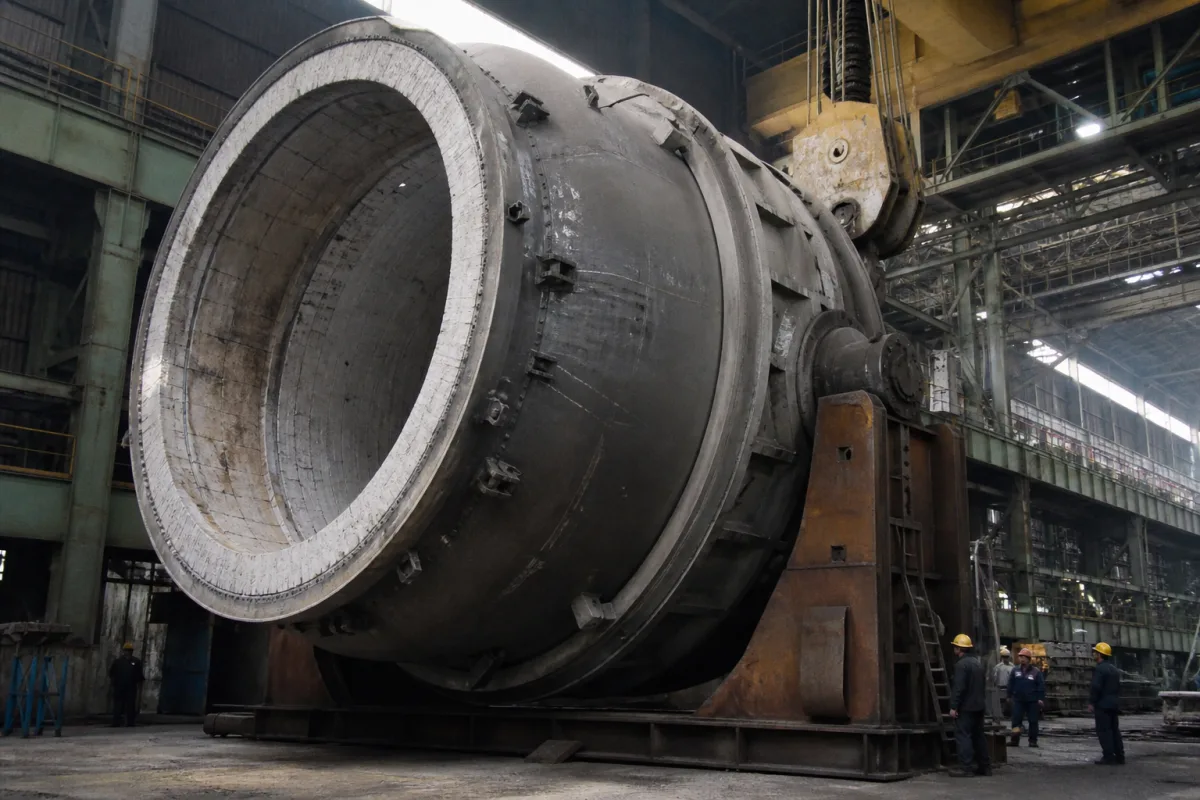
Basic oxygen furnace (BOF/BOPF) vessels · refractory-lined pear-shaped converters up to 400 tons, top-lance and bottom-tuyere (Q-BOP) blowing, 70/30 hot metal and scrap charges, 25–45 minute cycles, and open or closed hood primary emission capture
A basic oxygen furnace (BOF, or basic oxygen process furnace) vessel is the refractory-lined converter in which high-purity oxygen is blown into molten blast-furnace iron, scrap and fluxes to burn out carbon and impurities and make steel, without external heat. Ask three things first: what heat size and cycle the shop needs, whether oxygen is blown from a top lance or through bottom tuyeres, and how the vessel mouth fits the primary hood and gas cleaning system.
BOF/BOPF converter vessels for integrated steelmaking, top-blown and bottom-blown, including shell, trunnion ring and refractory lining, with their interfaces to lances, hoods and tapping. Electric arc furnaces, ladles (separate product pages), argon oxygen decarburisation vessels and blast furnaces are outside this page except where compared.
CNFX editorial research · Sources checked October 12, 2026 · 4 sources
EPA's AP-42 Section 12.5 explains that in the basic oxygen process molten blast-furnace iron and scrap (70% hot metal and 30% scrap in AP-42's figures), are refined by lancing or injecting high-purity oxygen; the exothermic reactions melt the scrap and raise the metal to tapping temperature with no external heat. Steelmaking is done in large refractory-lined, pear-shaped furnaces of up to 363 Mg (400 tons). Conventional BOFs blow oxygen through a water-cooled top lance; the Quelle Basic Oxygen Process (Q-BOP) injects it through tuyeres in the furnace bottom. AP-42 lists the steps of “a typical BOF cycle” (scrap charge, hot metal charge, oxygen blow, temperature and chemistry testing, alloy additions and reblows, tapping and slagging) and says the full furnace cycle “typically ranges from 25 to 45 minutes”. [1] The integrated iron and steel NESHAP defines a basic oxygen process furnace as any refractory-lined vessel in which high-purity oxygen is blown under pressure through a bath of molten iron, scrap and fluxes, including top- and bottom-blown furnaces but not argon oxygen decarburisation furnaces; the primary oxygen blow uses a lance from the top or tuyeres in the bottom and/or sides. [2]
Editorial calculation: at 25–45 minutes per heat, one vessel can make about 1,440 / 45 = 32 to 1,440 / 25 = 57 heats a day at most, before relining and maintenance stops. Shop scheduling and refractory campaigns reduce the real number; ask the supplier for the design heat size and cycle.
The lining, not the shell, sets how often the vessel comes out of service. A 2012 study from "Dunărea de Jos" University of Galați on a converter lined with dolomite blocks coated the lining with the vessel's own slag after each tap: with the steel tapped and the slag retained, the converter was tilted to the blowing position and nitrogen was blown through the lowered oxygen lance at 10–12 bar and 450–500 Nm³/min for 3 minutes. Over two years, lining life rose from about 370 to about 800 heats per campaign, refractory consumption fell from 5.25 kg/t to under 3.00 kg/t, and converter refractory cost fell by 0.24 $/t. A variant with magnesia bricks in the trunnion ring area and charging mouth also reached about 800 heats and cut consumption to under 2.45 kg/t, but the higher brick price limited the cost saving to 0.02 $/t. [4]
Editorial calculation: going from about 370 to about 800 heats is a factor of about 2.2, so a shop that relines after each campaign needs about 46% of the relines for the same number of heats (370 ÷ 800 ≈ 0.46). Ask the vessel and refractory suppliers for the lining zoning and the slag-coating or gunning practice their campaign figure assumes. [4]
Give the supplier the heat size and tapping weight, hot metal and scrap ratio, blowing method (top lance, bottom tuyeres or combined), oxygen flow and lance system, vessel dimensions and specific volume, shell and trunnion ring design and materials, tilting drive, refractory lining design and expected campaign, tap-hole arrangement, hood interface and cooling, and the standards and inspection plan for fabrication.
02
Plan the hood and emission control
AP-42 explains that BOFs have a primary hood directly over the open mouth to capture emissions during the oxygen blow: a closed hood (off-gas or O.G. system) fits snugly against the mouth and ducts particulate and CO to a wet scrubber, with CO flared at the stack, while an open, combustion-type hood draws in dilution air and burns the CO in the hood. Charging and tapping emissions are captured by charging hoods, tapside enclosures or full furnace enclosures. Its emission factors for top-blown melting and refining are 14.25 kg/Mg of steel uncontrolled, 0.065 kg/Mg with an open hood and ESP, 0.045 with an open hood and scrubber and 0.0034 with a closed hood and scrubber; Q-BOF refining controlled by scrubber is 0.028 kg/Mg. [1] The NESHAP defines the primary emission control system as the capture and collection equipment, for example an open hood with an electrostatic precipitator or a closed hood with a scrubber. [2]
Editorial calculation: for a 250-tonne heat, uncontrolled top-blown refining would release about 250 × 14.25 ≈ 3,560 kg of particulate, against about 250 × 0.0034 ≈ 0.85 kg with a closed hood and scrubber. The heat size is an assumed example; the AP-42 factors date from the 1980s, so design to current permit limits.
03
Specify the trunnion ring, suspension and tilt drive with the vessel
SMS group's release on China Steel Corporation's order for three 160-ton converters at its Kaohsiung No. 1 steelmaking plant lists the scope as converter vessels, trunnion rings, a lamella-type vessel suspension system, tilt drives with their electrical and automation systems, and supervision of erection and commissioning. The trunnion rings, 9 m in diameter, were to be shipped in one piece to cut installation time. [3]
The release states that the lamella suspension, the larger vessel-to-ring air gap and the fine-grained steels let the converters cope with alternating thermal stress in operation. These items sit alongside the shell, lining and hood interfaces described above. [3][1]
Item in the SMS order
Stated detail
Converter size
160 t, three vessels
Trunnion ring
9 m diameter, shipped in one piece
Vessel suspension
Maintenance-free lamella type; vessel arranged unrestrained in the ring
Thermal stress measures
Larger air gap between vessel and ring; high-strength fine-grained structural steels
Tilt drive
Frequency-controlled three-phase drives for positioning under changing dynamic loads
Stated aim of the upgrade
Higher converter availability, less maintenance
State heat size, vessel volume and the shop's crane and transport limits, and ask for the suspension type, the vessel-to-ring gap, shell steel grade and tilt drive rating, and whether the ring can be shipped in one piece.
04
Top-lance and bottom-tuyere vessels under open or closed hoods
Types include conventional top-blown BOFs with a water-cooled lance and bottom-blown Q-BOP vessels with tuyeres, served by open combustion-type hoods or closed (O.G.) hoods. [1][2]
05
Shell, lining zones, lance or tuyeres, trunnion ring and tap hole
Zones that may receive a different brick grade, e.g. magnesia instead of dolomite. [4]
Brick type per zone; campaign target.
06
Heat size, charge mix, blowing method, cycle and particulate for a BOF vessel order
AP-42 supplies the capacity, charge, cycle and particulate rows, and the 9 m ring belongs to SMS's single order for 160 t converters; the quotation should restate each row for your own heat size.
Explore company information and manufacturing capabilities, then discuss the scope of your project with a relevant supplier.
Share this page
Compiled and source-reviewed by the CNFX editorial team.
Each manufacturer above links to the page on that company's own website where the product is listed, with the date we checked it. How we source and review
· Page last updated 13 October 2026
Buyer questions
How big are basic oxygen furnaces?
AP-42 describes refractory-lined, pear-shaped furnaces of up to 363 Mg (400 tons). [1]
What is the difference between BOF and Q-BOP?
Conventional BOFs blow oxygen through a water-cooled top lance; Q-BOP injects it through tuyeres in the furnace bottom. [1]
How are BOF emissions captured?
By a primary hood over the mouth, either closed (to a wet scrubber, with CO flared) or open (combusting CO in the hood). [1]
What does a converter order include besides the vessel?
In SMS group's order from China Steel for three 160 t converters, the scope covered vessels, 9 m trunnion rings, lamella suspension, tilt drives with automation, and erection supervision. [3]
How many heats does a BOF lining last?
In one 2012 Galați study, own-slag coating with nitrogen through the lance raised lining life from about 370 to about 800 heats per campaign and cut refractory use from 5.25 to under 3.00 kg/t. [4]
Sources and what still needs a direct check
Sources checked 2026-10-12. EPA AP-42 Section 12.5 (cited from an Internet Archive copy of the epa.gov file) and the eCFR text of 40 CFR 63 Subpart FFFFF are US Environmental Protection Agency documents; AP-42 factors are dated averages. SMS group describes a converter order; a 2012 Galați University study reports lining campaign results.