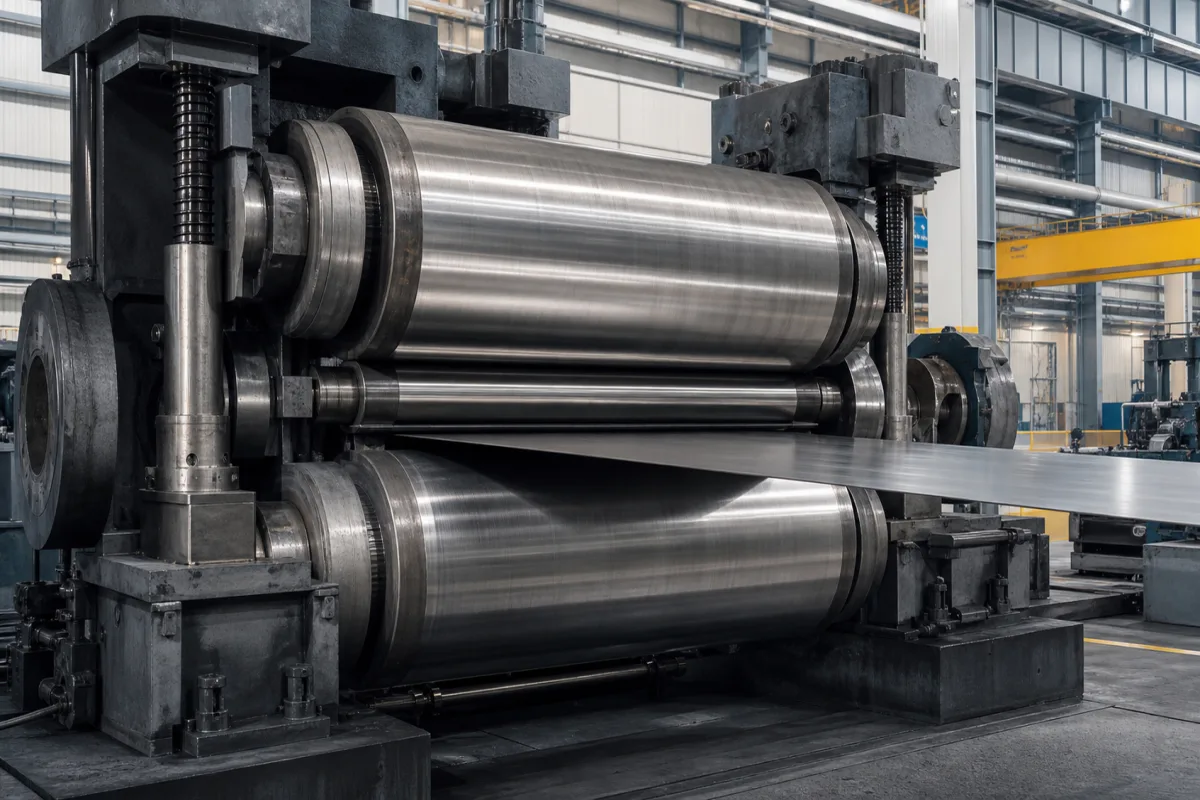
Rolls that brace the work rolls in four-high plate, hot strip and cold rolling stands · Barrel and neck dimensions, scrap diameter, Shore D hardness at the surface and at scrap diameter, forged 3% Cr and 5% Cr steels, solid, sleeved and controlled-deflection designs, chocks and guaranteed tonnage
A backup roll (back-up or support roll) is the large-diameter roll in a four-high or cluster rolling-mill stand against which a smaller work roll is braced, so that the rolling force passes from the strip through the work roll into the backup roll, its neck bearings and the mill housing, limiting how far the work roll bends. Ask three things first: which mill and stand the roll is for and what its drawing fixes (barrel, neck and total length, chocks and fittings), what hardness the barrel must hold from new diameter down to scrap diameter, and which steel, process and guaranteed tonnage the supplier will commit to.
Backup (support) rolls for flat-product rolling mills: forged and sleeved rolls for plate mills, hot strip mills, Steckel mills and cold rolling mills, with the neck fittings delivered on the roll. Work rolls (see heavy-duty rolling mill work roll), complete mill stands (see heavy-duty rolling mill stand), chock and bearing assemblies supplied separately, and rolls for long-product mills are outside this page except where compared.
CNFX editorial research · Sources checked October 11, 2026 · 5 sources
Fix the roll size from the stand drawing and the scrap diameter
Steel Authority of India (SAIL) purchase specifications for roll-shop items give each backup roll as barrel diameter × barrel length × total length with a scrap diameter and a weight, tied to a drawing number. Examples: a single-stand four-high cold reversing silicon-steel mill roll of 1,220 mm × 1,270 mm × 3,715 mm, scrap 1,105 mm, 17.5 t; five-stand tandem cold mill rolls of 1,425 mm × 1,420 mm × 4,047 mm, scrap 1,295 mm, 25.5 t; hot strip mill finishing rolls of 1,310 mm × 1,700 mm × 4,715 mm, scrap 1,180 mm, 25 t; hot strip mill-II rolls of 1,550 (+0.5/−0) mm × 2,230 mm × 5,934 mm, scrap 1,400 mm, about 47.6 t; and a new 4.3 m wide plate mill roll of 2,200 (+0.5/−0) mm × 4,300 mm × 9,860 mm, scrap 2,000 mm, about 170,200 kg. [1]
The plate-mill specification also asks for run-out, roundness and concentricity within 0.05 mm throughout the roll and a barrel surface finish of 0.80 micron (min.), and individual specifications state what must be fitted to the necks before delivery: thrust rings shrunk on the neck of an older plate-mill roll; pins, lock plates with socket-head bolts and rest buttons on the hot strip mill-II rolls; pins and neck keys on the new plate-mill roll. [1]
Editorial calculation: the usable radial layer is half the difference between new and scrap diameter — (2,200 − 2,000)/2 = 100 mm for the plate-mill roll, (1,550 − 1,400)/2 = 75 mm for the hot strip mill-II rolls and (1,220 − 1,105)/2 = 57.5 mm for the cold reversing mill roll — and the hardness requirement must hold through that layer. [1]
Give the supplier the mill, stand and position (top or bottom), the roll drawing with barrel diameter and tolerance, barrel length, total length, neck diameters and tapers, scrap diameter, weight, run-out and roundness, surface finish, neck fittings to be assembled, chock and bearing interface, and the quantity per year.
02
Set the hardness profile, steel and guaranteed tonnage
The SAIL specifications give barrel and neck hardness in Shore D (JIS) with Leeb equivalents and a floor at scrap diameter: 55–60 Shore D barrel and 40–45 neck for hot strip mill finishing and roughing rolls, at least 50 Shore D at scrap; 65–70 barrel and 40–45 neck for cold mill rolls, at least 60 at scrap; 65–71 barrel and 37–43 neck for hot strip mill-II rolls, at least 60 at scrap; and 53–58 barrel and 47–52 neck for the new plate-mill roll, at least 50 at scrap. In the same documents the indefinite chill double-poured work rolls of the hot strip mill are specified at 80–85 Shore D, so the backup roll is the softer, tougher partner. [1]
All the SAIL backup rolls are alloy forged vacuum-degassed steel. Minimum alloy contents range from Cr 1.5%, Mo 0.30% and V 0.10% on the older plate-mill roll to Cr 3.0% with Mo, Ni and V on the cold-mill rolls; the new plate-mill roll is given an indicative C 0.38–0.48%, Cr 2.5–3.6%, Mo 0.50–0.80%, V 0.08–0.15%, Ni 0.60% max, P and S 0.025% max and retained austenite 4% max. Each item also carries a minimum guaranteed tonnage, from 100,000 t for the cold reversing mill roll to 4,000,000 t for the new plate-mill roll (written 1,00,000 MT and 40,00,000 MT in the document). [1]
Sidenor describes its forged backup rolls as made from vacuum-degassed steel forged in hydraulic presses for a high degree of reduction, offered in 3% Cr and 5% Cr forged steel for continuous hot strip mills, Steckel mills and cold rolling mills, and states that their structural homogeneity allows higher hardness together with toughness and performance above cast backup rolls. [2][3]
State the barrel hardness range, neck hardness range, minimum hardness at scrap diameter (Shore D and Leeb), the steel and its limits on S, P and retained austenite, melting, degassing and forging route, heat treatment, ultrasonic and hardness inspection reports, and the guaranteed tonnage and how it will be measured.
03
Choose the roll design for the mill
In a four-high stand two work rolls are braced against backup or support rolls; Google Patents US4480459A describes a stand in which the support rolls are controlled-deflection rolls — a shell turning about a stationary beam on hydraulic support elements whose force is set individually or in groups — and notes this helps thickness and flatness control, for example on cold-rolled aluminium foil, while a simplified version uses one solid support roll. [4]
US5001820A describes a sleeved roll in which a sleeve is shrink- or expansion-fitted over a roll core supported by bearings, and notes that such variable-crown rolls can serve as work, intermediate or backup rolls; it identifies the risk that the sleeve shifts axially on the core under rolling-force deflection and leaves the roll eccentric, which makes thickness across the strip uneven. [5]
Editorial note: solid forged rolls are what the SAIL specifications buy for plate, hot strip and cold mills [1]; ask a supplier quoting a sleeved or controlled-deflection roll for the fit, the means of preventing sleeve shift and the hydraulic service it needs.
Name the mill type (plate, hot strip roughing or finishing, Steckel, tandem cold, reversing cold, temper or skin-pass), whether the roll is solid forged, sleeved or controlled-deflection, and any crown or profile on the barrel.
04
Know the backup roll parts and fittings
This is a functional reference built from the sources cited; it is not one maker's design.
Part
Role
Fix in the order
Barrel
Carries the work roll contact; ground and reground down to scrap diameter. [1]
Diameter, length, hardness, finish.
Necks
Run in the chock bearings; softer than the barrel. [1]
Diameters, tapers, neck hardness.
Neck fittings
Thrust rings, pins, keys, lock plates and rest buttons fitted before delivery. [1]
Drawing numbers and fitting method.
Chock assembly
Holds the bearing; seals, water barriers and labyrinths are bought as spares. [1]
Rotates on hydraulic support elements about a fixed beam. [4]
Element groups, hydraulic supply.
05
Fill the specification fields with values for your mill
A backup roll quotation needs values from your stand drawing and rolling programme. The table explains each field, gives published values where a reviewed source states them, and says what to obtain from the supplier.
Field
What it means and published values
Ask the supplier for
Roll diameter (mm)
New barrel diameter; 1,220 to 2,200 mm in the SAIL items. [1]
Diameter, tolerance, scrap diameter.
Roll body length (mm)
Barrel length; 1,270 to 4,300 mm in the same items. [1]
Explore company information and manufacturing capabilities, then discuss the scope of your project with a relevant supplier.
Share this page
Compiled and source-reviewed by the CNFX editorial team.
Published product pages show what a company offers, not tested performance. Confirm the legal seller, forge, inspection reports and scope for your order. How we source and review
· Page last updated 13 October 2026
Buyer questions
Why is a backup roll softer than the work roll it supports?
In SAIL's hot strip mill specifications the forged backup rolls are 55–60 Shore D while the cast iron work rolls are 80–85 Shore D. [1]
What is the scrap diameter of a backup roll?
The diameter at which the roll is retired after regrinding; specifications set a minimum barrel hardness that must still be met there. [1]
What steels are backup rolls forged from?
Vacuum-degassed alloy steels, offered as 3% Cr and 5% Cr forged grades by one maker. [2][1]
What is a controlled-deflection backup roll?
A roll whose shell turns on hydraulic support elements around a fixed beam, so the support force can be adjusted across the width. [4]
Sources and what still needs a direct check
Sources checked 2026-10-11. The SAIL document is one steelmaker's purchase specifications for its own mills; Sidenor's pages describe one roll maker's products; the patents describe designs, not current products. Values for your stand must come from your drawing and the supplier offered.