Industry-Verified Manufacturing Data (2026)

Trunnion Ring

Based on aggregated insights from multiple verified factory profiles within the CNFX directory, the standard Trunnion Ring used in the Basic Metal Manufacturing sector typically supports operational capacities ranging from standard industrial configurations to heavy-duty production requirements.

Technical Definition & Core Assembly

A canonical Trunnion Ring is characterized by the integration of Ring Body and Mounting Flange. In industrial production environments, manufacturers listed on CNFX commonly emphasize Forged or Cast Alloy Steel construction to support stable, high-cycle operation across diverse manufacturing scenarios.

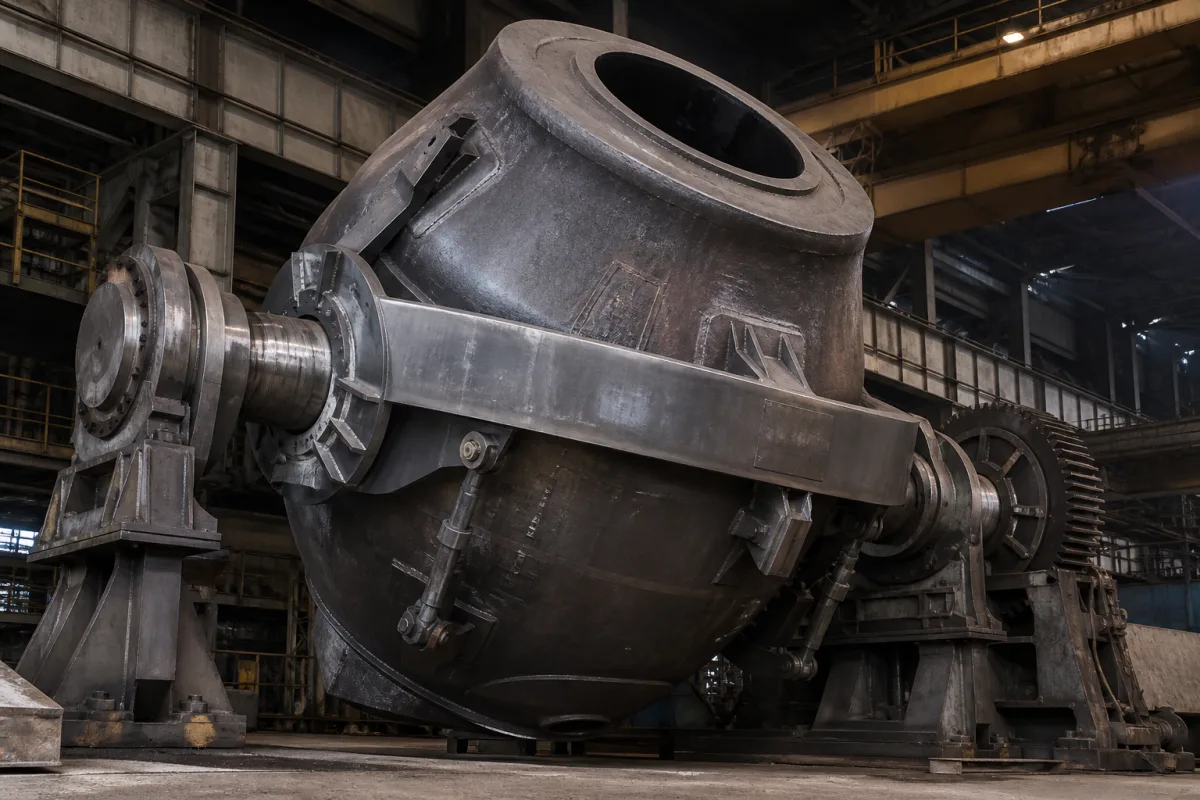
A heavy-duty structural ring that supports and enables the rotation of a Basic Oxygen Furnace vessel.
Product Specifications

Technical details and manufacturing context for Trunnion Ring

Definition
The trunnion ring is a critical load-bearing component of a Basic Oxygen Furnace (BOF) vessel assembly. It is a large, robust ring structure mounted to the vessel shell that interfaces with the trunnion pins or bearings on the furnace tilting mechanism. Its primary function is to transfer the immense weight of the vessel (including its refractory lining and molten metal charge) to the supporting structure while allowing the vessel to be tilted for charging, refining, and tapping operations.
Working Principle
The trunnion ring is rigidly attached to the BOF vessel shell. It rotates on fixed trunnion pins or within large bearings that are part of the stationary furnace support structure. Hydraulic or electric drives apply torque to the ring (often via a gear attached to it), causing the entire vessel to tilt around its horizontal axis. The ring must withstand high static loads, dynamic stresses during tilting, and thermal stresses from the hot vessel.
Common Materials
Forged or Cast Alloy Steel
Technical Parameters
  • Outer diameter, a critical dimension defining the ring's size and the vessel's mounting interface. (mm) Standard Spec
Components / BOM
  • Ring Body
    The main structural element, designed to handle bending moments and compressive loads.
    Material: Forged or Cast Alloy Steel
  • Mounting Flange
    The interface surface with bolt holes for attaching the ring to the BOF vessel shell.
    Material: Alloy Steel
  • Gear Teeth Segment (if applicable)
    Machined teeth on the ring's outer circumference to engage with the drive pinion for tilting.
    Material: Hardened Alloy Steel
  • Bearing Surface
    The machined surface that contacts the trunnion pins or bearing pads, allowing rotation.
    Material: Hardened Alloy Steel
Engineering Reasoning
Radial load capacity: 15-25 MN, Axial load capacity: 8-12 MN, Temperature range: 200-450°C, Rotational speed: 0.1-0.5 rpm
Yield strength threshold: 355 MPa (S355 structural steel), Fatigue limit: 180 MPa at 10^7 cycles, Critical crack length: 50 mm (fracture mechanics), Creep deformation limit: 1% strain at 400°C after 100,000 hours
Design Rationale: High-cycle fatigue from cyclic thermal stresses (ΔT=300°C) during BOF tilting operations, combined with stress concentration at weld joints (Kt=2.5-3.0) and creep deformation at elevated temperatures following Arrhenius equation with activation energy Q=270 kJ/mol
Risk Mitigation (FMEA)
Trigger Thermal gradient-induced stress exceeding yield strength (σ_thermal = αEΔT = 12×10^-6 × 210 GPa × 300°C = 756 MPa)
Mode: Crack initiation and propagation at heat-affected zones of circumferential welds
Strategy: Post-weld heat treatment (PWHT) at 600°C for 2 hours to relieve residual stresses, plus ultrasonic phased array inspection every 5000 cycles
Trigger Misalignment-induced moment loading (M = F × e where e > 5 mm offset)
Mode: Bearing raceway spalling and roller element brinelling
Strategy: Laser alignment system with 0.05 mm tolerance monitoring and tapered roller bearings with C0 clearance (ISO 199:2014)

Industry Taxonomies & Aliases

Commonly used trade names and technical identifiers for Trunnion Ring.

Applied To / Applications

This component is essential for the following industrial systems and equipment:

Industrial Ecosystem & Supply Chain DNA

Complementary Systems
Downstream Applications
Specialized Tooling

Application Fit & Sizing Matrix

Operational Limits
pressure: Atmospheric to 0.5 bar (7.25 psi) differential pressure
other spec: Max vessel weight: 300-500 metric tons, Rotation speed: 0.1-1.0 RPM, Slurry concentration: N/A (structural component)
temperature: Ambient to 400°C (752°F) continuous, 500°C (932°F) peak
Media Compatibility
✓ Molten steel/slag environment ✓ Industrial cooling water systems ✓ High-temperature lubricants (graphite-based)
Unsuitable: Chloride-rich environments (risk of stress corrosion cracking)
Sizing Data Required
  • Vessel weight and center of gravity
  • Required rotation angle and torque
  • Foundation/structural interface dimensions

Reliability & Engineering Risk Analysis

Failure Mode & Root Cause
Fatigue cracking
Cause: Cyclic loading from rotational motion and uneven load distribution, exacerbated by stress concentrations at bolt holes or weld seams.
Wear and material loss
Cause: Fretting and abrasive wear at contact surfaces with rollers or bearings, often due to misalignment, inadequate lubrication, or contamination.
Maintenance Indicators
  • Visible cracks or spalling on the ring surface, especially near stress points
  • Abnormal noise (grinding, clicking) during rotation, indicating excessive clearance or contact issues
Engineering Tips
  • Implement regular alignment checks and laser alignment for trunnion support structures to minimize uneven loading and stress concentrations.
  • Establish a proactive lubrication schedule with high-temperature, extreme-pressure grease, and monitor for contamination to reduce wear at bearing contact surfaces.

Compliance & Manufacturing Standards

Reference Standards
ISO 9001:2015 Quality Management Systems ASTM A370 Standard Test Methods and Definitions for Mechanical Testing of Steel Products CE Marking (EU Machinery Directive 2006/42/EC)
Manufacturing Precision
  • Bore Diameter: +/-0.025mm
  • Flatness: 0.05mm per 100mm diameter
Quality Inspection
  • Dye Penetrant Testing (PT) for surface defects
  • Ultrasonic Testing (UT) for internal discontinuities

Factories Producing Trunnion Ring

Verified manufacturers with capability to produce this product in China

✓ 96% Supplier Capability Match Found

S Sourcing Manager from Australia Feb 01, 2026
★★★★★
"The technical documentation for this Trunnion Ring is very thorough, especially regarding technical reliability."
Technical Specifications Verified
P Procurement Specialist from Singapore Jan 29, 2026
★★★★☆
"Reliable performance in harsh Basic Metal Manufacturing environments. No issues with the Trunnion Ring so far. (Delivery took slightly longer than expected, but technical support was excellent.)"
Technical Specifications Verified
T Technical Director from Germany Jan 26, 2026
★★★★★
"Testing the Trunnion Ring now; the technical reliability results are within 1% of the laboratory datasheet."
Technical Specifications Verified
Verification Protocol

“Feedback is collected from verified sourcing managers during RFQ (Request for Quote) and factory evaluation processes on CNFX. These reports represent historical performance data and technical audit summaries from our B2B manufacturing network.”

7 sourcing managers are analyzing this specification now. Last inquiry for Trunnion Ring from Mexico (57m ago).

Supply Chain Compatible Machinery & Devices

Electromagnetic Induction Heater

Industrial heating device using electromagnetic induction for metal processing

Explore Specs →
Vacuum Induction Melting Furnace

Industrial furnace for melting metals under vacuum using electromagnetic induction

Explore Specs →
Electroslag Remelting Furnace

Secondary refining furnace for high-quality metal ingots

Explore Specs →
Molten Metal Flow Control Valve

Precision valve for regulating molten metal flow in casting and pouring operations.

Explore Specs →

Frequently Asked Questions

What is the primary function of a trunnion ring in Basic Oxygen Furnace operations?

The trunnion ring provides structural support and enables the controlled rotation of the BOF vessel during the steelmaking process, allowing for precise pouring and maintenance positioning.

What materials are typically used for manufacturing trunnion rings?

Trunnion rings are manufactured from high-strength forged or cast alloy steel to withstand extreme thermal stresses, mechanical loads, and corrosive environments in basic metal manufacturing.

What are the key components of a trunnion ring assembly?

Key components include the ring body for structural integrity, bearing surface for smooth rotation, mounting flange for secure attachment, and gear teeth segments (if applicable) for drive system engagement.

Can I contact factories directly on CNFX?

CNFX is an open directory, not a transaction platform. Each factory profile provides direct contact information and production details to help you initiate direct inquiries with Chinese suppliers.

Get Quote for Trunnion Ring

Request technical pricing, lead times, or customized specifications for Trunnion Ring directly from verified manufacturing units.

Your business information is encrypted and only shared with verified Trunnion Ring suppliers.

Thank you! Your message has been sent. We'll respond within 1–3 business days.

Need to Manufacture Trunnion Ring?

Connect with verified factories specializing in this product category

Add Your Factory Contact Us
Previous Product
Treatment Ladle
Next Product
Tundish