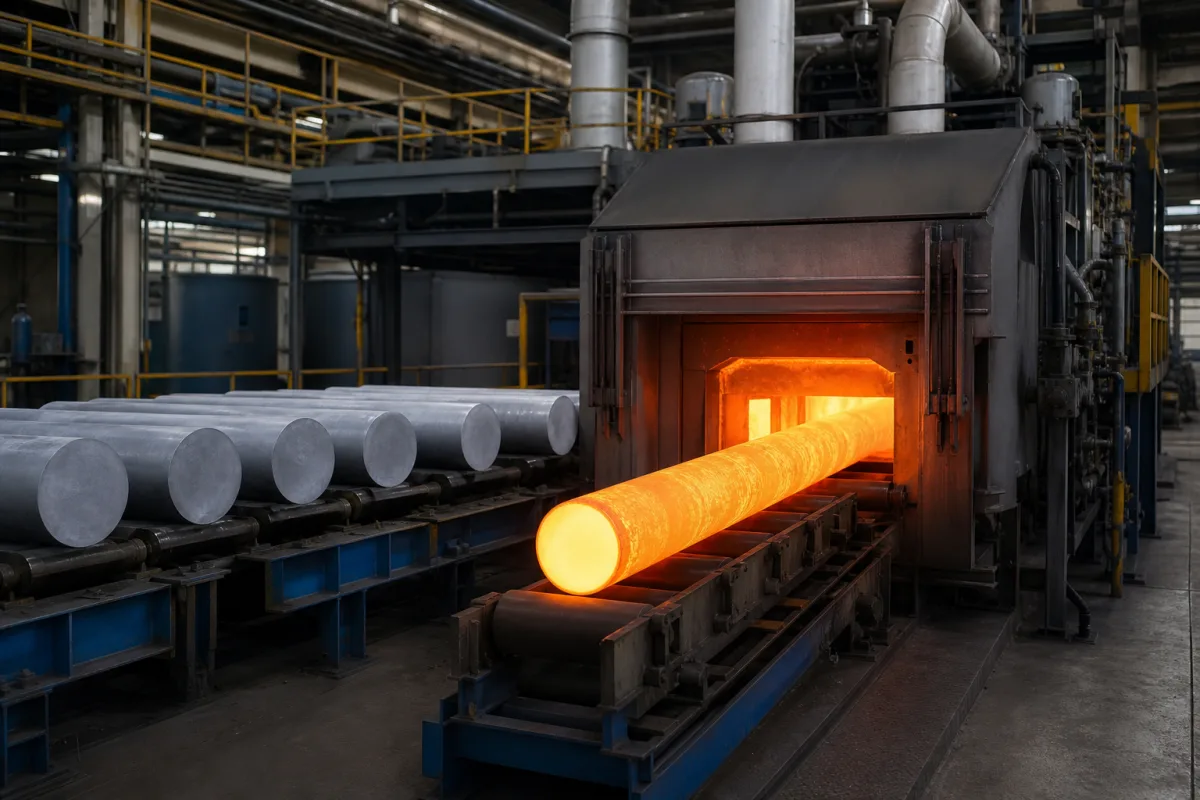
Convection and gas-fired billet heater for aluminium extrusion billets: energy per pound, hot-gas jets and billet handling
Fuel-fired and hot-air convection furnaces that bring aluminium extrusion billets to about 850 °F (454 °C) · 1,872 Btu/lb for chain flame-impingement heaters against 252 Btu/lb for a jet-convection design, slot nozzles that stop billets warping, and crosswise rolling that cuts heat loss and floor space
Before an aluminium billet can be pushed through an extrusion die it must be heated right through, to around 450 °C, and delivered to the press one at a time. Induction is one way to do it; the other is a furnace that plays flames or hot gas on the billet. Fuel-fired and hot-air convection heaters differ less in temperature than in how much of the fuel ends up in the metal, how evenly the gas reaches the billet's surface, and how the billets travel through the furnace.
Fuel-fired (gas or oil) and hot-air convection billet heaters and preheating furnaces for aluminium extrusion billets and logs: flame-impingement, slot-nozzle and jet-convection designs, their energy use per unit mass and their billet transport. Induction billet heaters and other induction heating systems are covered on the Induction heater page, which this page compares only for energy; fluid-heated process rolls are on the Fluid-heated roll system page.
CNFX editorial research · Sources checked October 12, 2026 · 4 sources
Energy per pound of billet: 1,872, 936 and 252 Btu/lb against a 187.2 Btu/lb minimum
Oliver Machinery's patent US 4,125,365 for a roll-through billet heater sets out the arithmetic: heating an 8 in diameter billet from 70 °F to 850 °F needs 187.2 Btu/lb, and the efficiency of each heater type follows from how much it actually uses. [1]
Editorial conversion: 1 Btu/lb = 2.326 kJ/kg, and 1 kWh = 3,600 kJ, so 187.2 Btu/lb is about 435 kJ/kg or 121 kWh per tonne; 850 °F is about 454 °C. The patent reaches its 75 % with air-foil jet slots sized for a 5,000 ft velocity and 60 kW heating elements. [1]
The same patent explains where flame furnaces lose energy: with gas- and oil-fired direct or indirect impingement furnaces, heat is lost in the exhaust and through the need for combustion air make-up, and chain conveyors running out through the exit carry heat away by conduction and stop the exit from being closed with an insulated door. [1]
For comparison with induction, a European Community demonstration project built a 50 Hz induction preheater for aluminium billets heated to 450 °C and measured savings of 26 to 33 % of the input of conventional single-layer coil heaters, or 59 to 76 kWh per tonne. [4] Editorial calculation, assuming each percentage pairs with the kWh figure at the same end of its range: the conventional induction heaters then used about 227 to 230 kWh/t and the new design about 154 to 168 kWh/t, close to Oliver's 163 kWh/t for jet convection and well below either flame-impingement figure.
Ask the heater supplier for guaranteed fuel or electricity use per tonne at your billet diameter, length, alloy and exit temperature, measured from cold charge, and for exhaust temperature and heat recovery.
02
Hot-gas jets and slot nozzles: heat-transfer rate, gas temperatures and keeping billets straight
Friedrich Elhaus's patent US 4,153,236 replaces rows of burners whose flames hit the metal with slot-type nozzles that blow circulated hot gas on light-metal billets, bars and ingots. The nozzle rows sit symmetrically around the billet so that uneven heating does not warp it, with the slots running across the billet's axis. [3]
Elhaus gives the geometry that matters: spacing between adjacent slots of roughly half the billet diameter, so the gas can flow back between them, and slot widths of 1/3 to 1/10 of that spacing, preferably 1/8. With this the patent states mean heat-transfer coefficients of up to about 200 kcal/m²h°C (40.80 Btu/ft²h°F). [3] Editorial conversion: 200 kcal/m²h°C is about 233 W/m²K. The design is meant to suit continuous or stationary operation and, the patent says, a change to a different energy source if one becomes scarce or expensive. [3]
Oliver's US 4,065,249 jets cooler gas into hotter gas: primary gas in the chamber at 1,000 to 1,500 °F, secondary jet gas at 400 to 700 °F, the jets entraining the surrounding hot gas and impinging the mixture on the billet. [2] Editorial conversion: about 538 to 816 °C and 204 to 371 °C.
Ask for the nozzle arrangement around the billet, the gas temperatures in each zone and the measured temperature spread along and around a billet at exit.
03
Rolling billets crosswise through the furnace: conveyor, door and floor space
Earlier billet heaters, US 4,125,365 says, moved billets end to end on chain conveyors that needed large floor space and carried heat out through the exit. [1] The roll-through design turns the billets sideways and lets them roll along support rails. [1]
In US 4,125,365 billets of 6 to 9 in diameter sit in locating notches spaced 10 in apart and are rolled along the rails, which turns them as they travel and evens out the heating; temperature probes control the heating elements to hold billets at, for example, 850 °F or 900 °F, and an unloader raises each billet and rotates it through about 90° for the press. [1] Editorial conversion: 6 to 9 in is about 152 to 229 mm, and 850 to 900 °F about 454 to 482 °C.
Editorial note: the photograph shows long logs on a rack beside the furnace rather than short pre-cut billets; state which the heater must take, since the conveyor, door and furnace length follow from it.
04
What to send for an aluminium extrusion billet heater
Paste it into your enquiry below or into an email to a maker, then replace every bracket.
Billets: [alloy; diameter; length or log length; throughput t/h]
Temperature: [exit temperature; allowed spread; taper if wanted]
Energy: [gas, oil or electric; guaranteed use per tonne; exhaust heat recovery]
Heating: [flame impingement / hot-gas jets / slot nozzles; zones]
Handling: [conveyor type; loading and unloading to the press; door]
Space: [floor area; press layout]
Explore company information and manufacturing capabilities, then discuss the scope of your project with a relevant supplier.
Share this page
Compiled and source-reviewed by the CNFX editorial team.
Each manufacturer above links to the page on that company's own website where the product is listed, with the date we checked it. How we source and review
· Page last updated 13 October 2026
Buyer questions
How much energy does it take to heat an aluminium billet for extrusion?
Oliver Machinery's patent gives 187.2 Btu/lb to take an 8 in billet from 70 °F to 850 °F; its jet-convection heater used 252 Btu/lb. [1]
Why are flame-impingement billet heaters inefficient?
Oliver puts chain flame-impingement heaters at 10 % (1,872 Btu/lb) and pressure flame-impingement at 20 % (936 Btu/lb), with heat lost in exhaust, combustion air make-up and conveyor conduction. [1]
How do slot nozzles heat billets evenly?
Elhaus's US 4,153,236 places slot nozzles symmetrically around the billet to prevent warping and reports heat-transfer coefficients up to about 200 kcal/m²h°C. [3]
How does induction compare?
An EU project's improved induction preheater for aluminium at 450 °C saved 59–76 kWh per tonne against conventional coil heaters. [4]
Sources and what still needs a direct check
Sources checked 2026-10-12. Energy per pound, heater efficiencies and billet handling come from Oliver Machinery's US 4,125,365, and jet gas temperatures from its US 4,065,249; slot-nozzle design and heat-transfer coefficients from Friedrich Elhaus's US 4,153,236; induction comparison from an EU-funded demonstration project recorded on CORDIS.