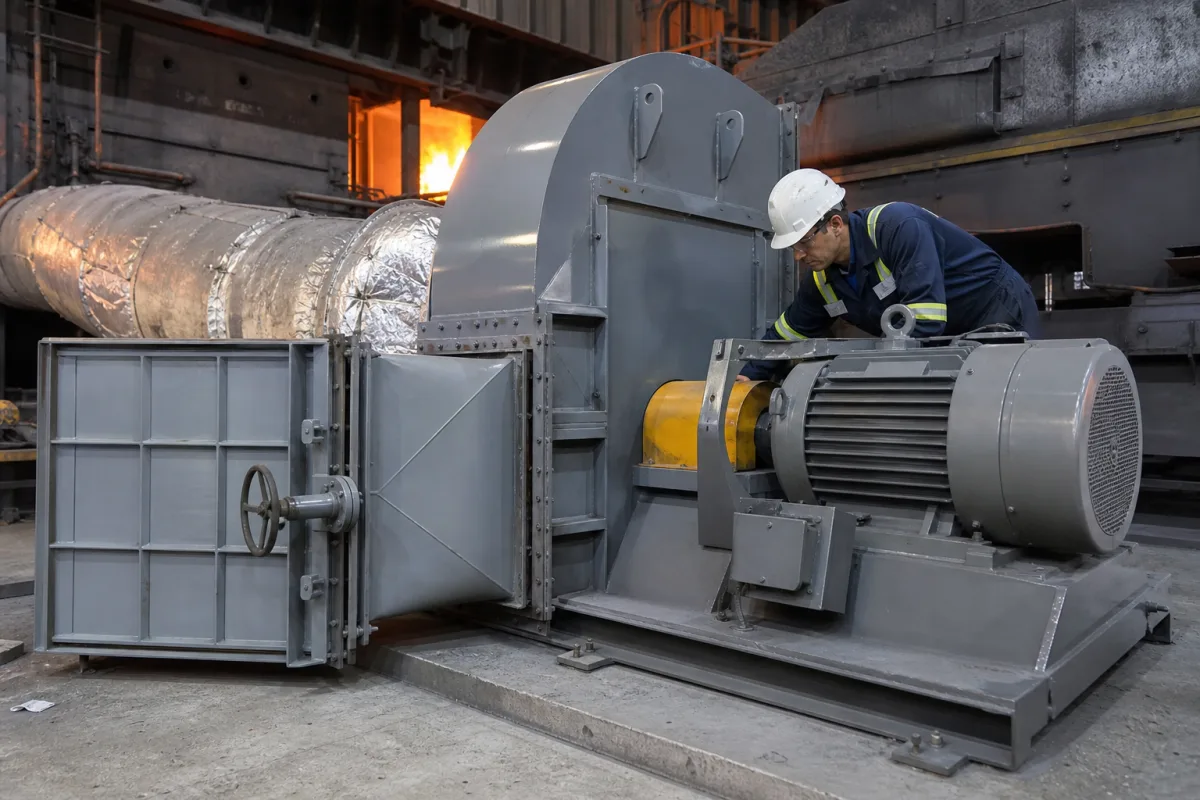
Combustion air blower for industrial furnace burners
Burner air supply for furnaces · Airflow from firing rate and excess air, pressure blower ranges, preheated air and air-fuel ratio checks
A combustion air blower is the high-pressure fan that delivers air to the burners of a furnace, kiln, oven or heater, through a damper or valve train that the burner control can set in ratio with the fuel. Ask three things first: how much air the burners need at high fire, including excess air, what pressure the burners and air train need at the inlet, and whether the blower handles ambient or preheated air.
Centrifugal pressure blowers and forced-draft fans that supply combustion air to burners on industrial furnaces, kilns, ovens, dryers and process heaters, with inlet dampers, filters and drives. General industrial centrifugal fans for ventilation and process air, their ratings, fan laws and field testing are covered on the Centrifugal fan (industrial centrifugal blower) page. Boiler induced-draft fans, burners and air-fuel ratio controllers sold alone are outside this page.
CNFX editorial research · Sources checked October 12, 2026 · 4 sources
Size the airflow from the firing rate and excess air
The US Department of Energy's process heating tip sheet on burner air-to-fuel ratios states that for natural gas, propane and fuel oils about one cubic foot of air is needed to release about 100 Btu in complete combustion. It gives about 10% to 20% excess combustion air at high fire as the operating level of high-temperature direct-fired furnaces, radiant tubes and boilers, to prevent carbon monoxide and soot, and gives 2% to 3% oxygen in the flue gas with only 10 to 50 ppm of combustibles as indicating ideal operating conditions. [1]
Editorial calculation: a furnace fired at 10 MMBtu/h, the size used in DOE's preheated-air example, needs about 10,000,000 / 100 = 100,000 ft³/h of stoichiometric air, or about 1,667 CFM; with 20% excess air that becomes about 2,000 CFM (roughly 3,400 m³/h). [1][2] Size the blower for the high-fire air of all burners it serves, plus the margin the burner maker requires.
DOE notes that drying ovens that evaporate moisture or solvents need large amounts of excess air to dilute solvent vapour to non-combustible levels, and that cutting excess air there can create an explosion hazard; it also warns that efficiency falls considerably when air is well above or below the theoretical requirement. [1] Editorial note: on solvent ovens the blower may be sized by the dilution air, not by combustion, so give the supplier the solvent load as well as the firing rate.
Give the supplier the burner type, number and firing rate, fuel, excess air at high and low fire, required air pressure at the burner inlet including the air valve train, air temperature (ambient or preheated), altitude, turndown method (damper, inlet vanes or variable-speed drive), installation indoors or outdoors, and the electrical supply.
02
Pick the pressure blower and allow for air temperature
Cincinnati Fan's pressure blower range spans models from 1,200 CFM at 30 in. wg to 180,000 CFM at 36 in. wg; its Model PB cast-aluminium blower covers up to 4,500 CFM and 20 in. wg, the fabricated steel PBS up to 4,462 CFM and 20 in. wg, and the HP-II up to 7,000 CFM and 78 in. wg. [3]
The Model PB page lists combustion air among its applications, with eight housing sizes, radial self-cleaning wheels, round inlets and discharges for pipe or duct, AMCA Type B spark resistance as standard, direct-drive Arrangement 8 with a shaft and coupling guard or belt-driven Arrangement 9, and standard air-stream temperatures to 150° with optional high-temperature construction to 400° (scale as listed by the maker). [4] Editorial calculation: 20 in. wg is about 20 × 249 ≈ 5.0 kPa. [4]
DOE's preheated combustion air tip sheet describes recuperators and regenerators that transfer exhaust heat to the incoming combustion air; in its example, preheating air to 800 °F on a 1,600 °F furnace firing 10 MMBtu/h saves 22% of fuel. [2] Editorial calculation: if a blower has to move air already heated to 800 °F rather than 70 °F, the same mass flow occupies (800 + 460) / (70 + 460) ≈ 2.4 times the volume, so state whether the blower sits on the cold side of the preheater and what temperature it will see.
03
A forced-draft fan maker, and the curve, wheel and damper data to ask for
The linked maker lists forced-draft blowers for burner systems among its industrial fan applications. Ask for the performance curve at your air temperature and altitude, the wheel type and material, the drive arrangement and the inlet damper or variable-speed option.
04
Impeller, housing and inlet, motor drive, inlet damper, air preheater and flue O2 check
Component
Role
Fix in the order
Impeller (wheel)
Builds pressure; radial self-cleaning on one range. [4]
1 company lists this product among what they make. Company figures are quoted from each
company's own website; every card states where the relationship came from.
Explore company information and manufacturing capabilities, then discuss the scope of your project with a relevant supplier.
Share this page
Compiled and source-reviewed by the CNFX editorial team.
Each manufacturer above links to the page on that company's own website where the product is listed, with the date we checked it. How we source and review
· Page last updated 13 October 2026
Buyer questions
How much combustion air does a burner need?
DOE's tip sheet gives about 1 ft³ of air per 100 Btu for natural gas, propane and fuel oils, plus about 10% to 20% excess air at high fire for high-temperature furnaces. [1]
What pressure can a combustion air blower deliver?
Cincinnati Fan's cast-aluminium Model PB reaches 20 in. wg and up to 4,500 CFM; its HP-II reaches 78 in. wg. [4][3]
Does preheating combustion air affect the blower?
DOE's example saves 22% fuel with 800 °F air; a blower drawing hot air must handle a larger volume for the same mass flow. [2]
Sources and what still needs a direct check
Sources checked 2026-10-12. The US Department of Energy tip sheets give combustion and preheat guidance; Cincinnati Fan is a blower maker publishing its own ranges.