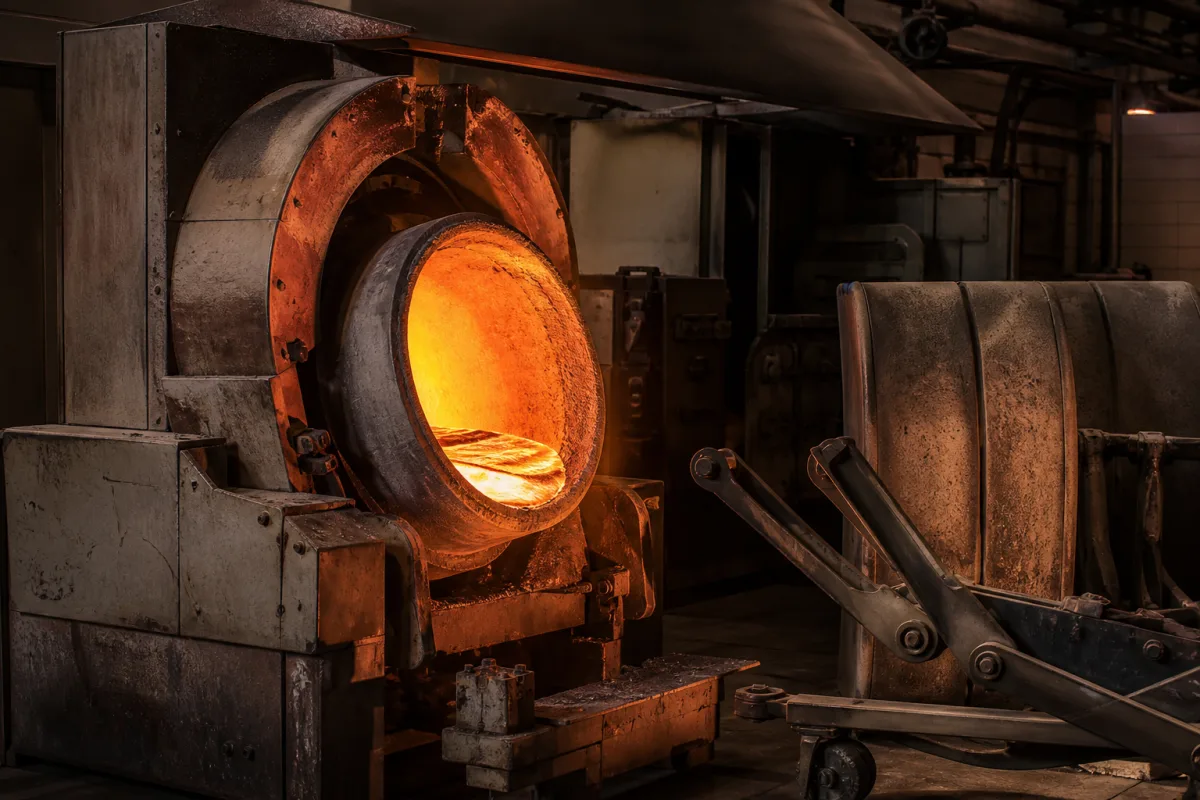
Crucible in oxide ceramic (alumina, magnesia, zirconia)
Oxide ceramic crucibles · alumina, magnesia and stabilised zirconia bodies, dense or controlled-porosity, for melting alloys, precious metals and high-temperature lab work
An oxide ceramic crucible is a vessel pressed or cast from alumina, magnesium oxide or stabilised zirconia that holds a charge while it is melted, calcined or heat-treated. The oxide is chosen to resist the melt and slag chemistry, and the porosity is chosen for the heating method: dense bodies for lab and furnace work, controlled-porosity bodies to survive induction heating. Ask three things first: which oxide and purity suits the melt and the top temperature, whether the crucible is dense or deliberately porous, and what the crucible may add to the melt.
Alumina, magnesia and stabilised zirconia crucibles, from small laboratory crucibles and boats to isostatically pressed crucibles for air and vacuum induction melting of superalloys and precious metals. Graphite-based clay-graphite and silicon carbide melting crucibles for induction furnaces are covered on the Refractory crucible (for induction melting) page. Furnace linings, ladles and complete furnaces are outside this page.
CNFX editorial research · Sources checked October 12, 2026 · 3 sources
Pick the oxide for the melt chemistry and top temperature
Almath describes alumina as a general-purpose material with resistance to acidic and basic slags, usable up to around 1700 °C; magnesia as resistant to basic slags and alkali compounds with a peak temperature similar to alumina, used for vacuum melting of Ni, Co and Fe; and zirconia as resistant to acidic slags, usable above 2000 °C and suited to platinum group metals and superalloys. [1]
Almath's pages give different alumina limits: 1750 °C maximum operating temperature on its alumina material page, continuous operation up to 1600 °C for high-purity alumina in its material comparison, and 1650 °C maximum service temperature for its 130A refractory alumina (above 99.4% Al₂O₃). Its comparison puts zirconia at temperatures approaching 2200 °C depending on the stabilisation system, and states that magnesia has very poor resistance to acidic chemicals. Ask the supplier which limit applies to the exact grade, atmosphere and load. [1]
IPS Ceramics lists a maximum usage temperature of 1450 °C for its 95% alumina crucibles and 1600 °C for 99% alumina, with Al₂O₃ contents of 95% and 99% and SiO₂ of 2.5% and 0.3% in its typical analysis. [2]
Give the supplier the charge (alloy, metal, glass, powder or salt), any slag or flux and whether it is acidic or basic, the peak temperature and hold time, the atmosphere (air, vacuum or inert gas), the heating method (induction, resistance or gas), the heating and cooling rate, and the impurity limits for the melt.
02
Set a dense or a controlled-porosity body for the heating method
Almath states that its induction-melting crucibles use a controlled porosity to retard crack growth during thermal shock, because induction heats the metal rapidly and the crucible from the centre outwards; the porosity blunts the crack tip. They are isostatically pressed for uniform density. [1]
Source of the table: Almath refractory crucibles page. [1] Dense grades sit at the other end: Almath lists 99.5–99.8% alumina at 3.8–3.9 g/cm³ with closed porosity that can be kept below 0.5%, and a water-quench thermal shock value (ΔTc) of 200; its 130A refractory alumina has 13% apparent porosity and 3.30 g/cm³. IPS Ceramics lists open porosity below 0.5% (95% alumina) and below 0.25% (99% alumina) at 3.7 and 3.8 g/cm³. [1][2]
Almath's standard induction crucibles run from 38 mm outer diameter with 7.5 mm walls to 210 mm outer diameter with 15 mm walls. IPS Ceramics lists laboratory alumina crucibles from 1 cm³ to 20 cm³. [1][2]
Editorial calculation: Almath's 100 mm outer-diameter crucible with an 80 mm inner diameter and 185 mm inner height holds π × 40² × 185 ≈ 930,000 mm³, about 0.93 L of internal volume before allowing for freeboard. [1]
Material (Almath induction grades)
Composition
Apparent porosity
Lime-stabilised zirconia
3.75% CaO
24%, 19.5%, 16% or 6.5%
Magnesia-stabilised zirconia
3.5% MgO
21% or 18%
Alumina
97.5% alumina
21%
Magnesium oxide
95% MgO
15%
03
Check what the crucible adds to the melt
NACA Technical Note 4049 (1957) studied a vacuum-induction-melted 55Ni-20Cr-15Co-4Mo-3Ti-3Al alloy and found the crucible ceramic was a major variable: reaction with magnesia or zirconia crucibles introduced small amounts of boron or zirconium into the melt, while heats melted in alumina had less than 0.0004% boron and less than 0.01% zirconium. [3]
In the NACA tests at 1,600 °F and 25,000 psi, 0.19% zirconium derived from a zirconia crucible raised average rupture life from 50 to 140 hours, and the boron that a magnesia crucible contributed to a heat with 0.0010% boron raised it from 50 to 216 hours, compared with the alumina-melted heats. The authors confirmed the effect with controlled boron and zirconium additions to alumina-melted heats. [3]
Editorial calculation: 1,600 °F is about 871 °C. The study shows that crucible pick-up can change alloy properties, so write the permitted impurity pick-up into the order rather than assuming the crucible is inert. [3]
04
Compare the three oxides
Values are as the cited makers and study state them; grades differ, so use them to frame questions rather than as limits.
Explore company information and manufacturing capabilities, then discuss the scope of your project with a relevant supplier.
Share this page
Compiled and source-reviewed by the CNFX editorial team.
Each manufacturer above links to the page on that company's own website where the product is listed, with the date we checked it. How we source and review
· Page last updated 13 October 2026
Buyer questions
Which oxide crucible survives the highest temperature?
Almath states zirconia can be used above 2000 °C, approaching 2200 °C depending on the stabiliser, against 1650–1750 °C for its alumina grades. [1]
Why are induction-melting crucibles porous?
Almath says controlled porosity blunts cracks during the rapid, centre-out heating of induction melting; its induction grades range from 15% to 24% apparent porosity. [1]
Can the crucible change the alloy?
Yes: in NACA TN 4049, zirconium from zirconia and boron from magnesia crucibles raised a nickel alloy's rupture life from 50 hours to 140 and 216 hours. [3]
Sources and what still needs a direct check
Sources checked 2026-10-12. Almath and IPS Ceramics are ceramic crucible makers; their figures are typical values from test pieces. NACA TN 4049 is a 1957 research report on one nickel alloy.