Editorial Technical Reference

Descaling Header/Manifold

This page explains how Descaling Header/Manifold is classified within Basic Metal Manufacturing. Technical values and manufacturer relationships are research references; confirm the current specification and supplier evidence for each order.

Technical Definition & Core Assembly

A hydraulic distribution component that directs high-pressure water to descaling nozzles for removing scale from metal surfaces during hot rolling.
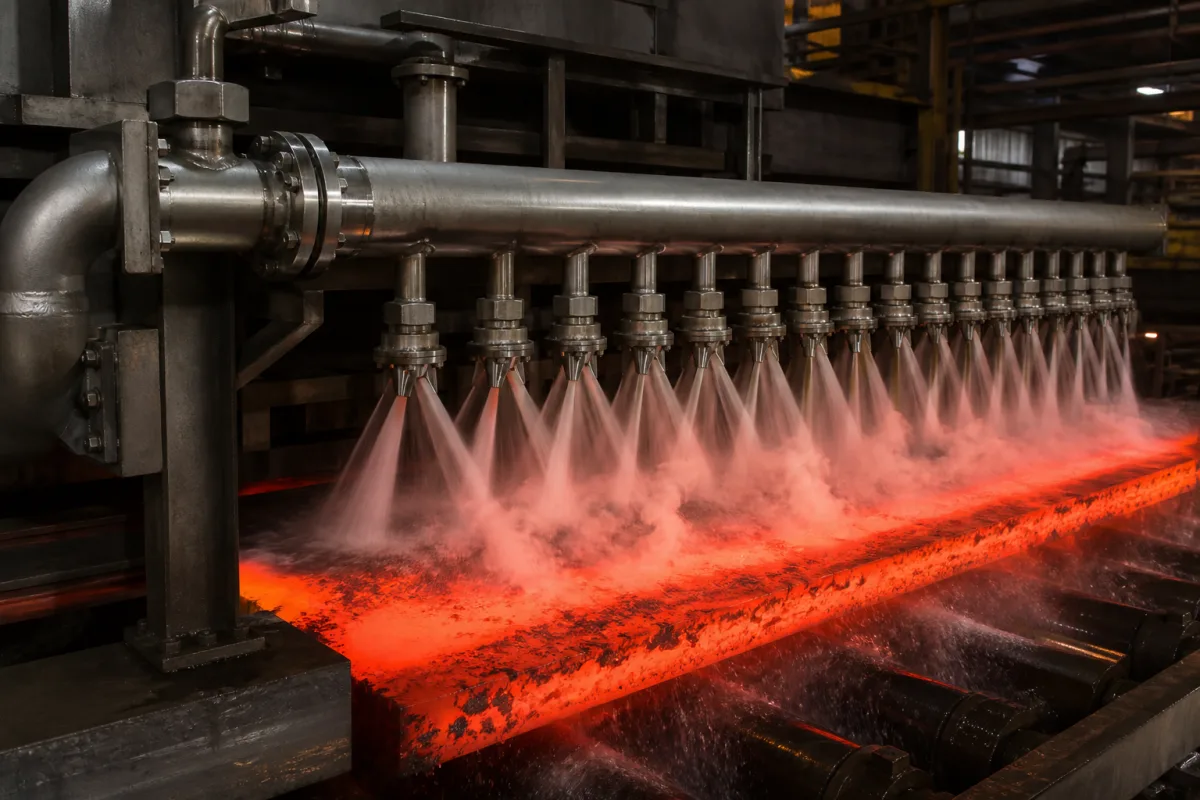
Descaling Header/Manifold in a manufacturing environment
Representative product image. Confirm appearance and specifications with the manufacturer.

Product Specifications

Technical details and manufacturing context for Descaling Header/Manifold

Definition
The Descaling Header/Manifold is a critical component within a Hydraulic Descaling System used in steel and metal manufacturing. It serves as the central distribution point that receives high-pressure water from pumps and evenly distributes it to multiple descaling nozzles arranged along the header. This ensures uniform scale removal from the surface of hot metal slabs, billets, or strips as they pass through the rolling mill, improving surface quality and preventing defects in the final product. The header/manifold is typically constructed from stainless steel (304/316), carbon steel with protective coating, or high-strength alloy steel, depending on the application requirements. It is available in lengths from 500 to 3000 mm, with end connections from DN25 to DN100 (flanged or threaded), and pressure ratings from PN16 to PN40. Operating pressure ranges from 1.0 to 1.6 MPa, with flow rates per nozzle from 50 to 200 L/min. Fluid temperature should be maintained between 10 and 70°C to avoid cavitation, while ambient temperature for storage and operation is -10 to 60°C. The manifold's weight varies from 20 to 150 kg, and surface treatment typically includes zinc plating for corrosion protection. Material grade for carbon steel components is often ASTM A105. These parameters are reference ranges and must be verified for the specific model and application. The manifold is designed to ensure consistent pressure and flow to all nozzles simultaneously, creating a curtain of high-velocity water that impacts the hot metal surface, causing thermal shock and mechanical force that removes oxide scale (mill scale). Proper selection and maintenance are essential for optimal performance and longevity.
Working Principle
High-pressure water (typically 150-400 bar) enters the header/manifold from the pump system. The internal channels and chambers distribute the water flow evenly to multiple outlet ports where descaling nozzles are mounted. The manifold design ensures consistent pressure and flow to all nozzles simultaneously, creating a curtain of high-velocity water that impacts the hot metal surface, causing thermal shock and mechanical force that removes oxide scale (mill scale).
Common Materials
Stainless Steel (304/316), Carbon Steel with protective coating, High-strength alloy steel
Technical Parameters
ParameterTypical rangeNotes & selection driver
Operating Pressure1.0–1.6 MPa
Flow Rate50–200 L/minPer nozzle; depends on nozzle size
Fluid Temperature10–70 °CAbove 70°C may cause cavitation
Ambient Temperature-10–60 °CFor storage and operation
Material GradeASTM A105Carbon steel for high pressureASTM A105
End ConnectionDN25–DN100 mmFlanged or threadedISO 7005
Length500–3000 mmCustomizable per mill width
Weight20–150 kgDepends on size and material
Surface TreatmentZinc platingCorrosion protectionASTM B633
Pressure RatingPN16–PN40 barMatches operating pressureISO 7268

Ranges are indicative industry figures for RFQ preparation, not a supplier commitment. Confirm every value and standard with the legal manufacturer before ordering.

Components / BOM
  • Header Body
    Main pressure vessel that distributes water to nozzles
    Material: Stainless steel or carbon steel
  • Nozzle Ports Part
    Threaded or flanged connections for mounting descaling nozzles
    Material: Stainless steel
  • Inlet Connection Part
    High-pressure connection to pump system
    Material: Forged steel with high-pressure rating
  • Mounting Brackets Part
    Secure the header to the descaling system frame
    Material: Carbon steel
  • Pressure Relief Port Optional Part
    Optional safety feature to prevent overpressure
    Material: Stainless steel

Industry Taxonomies & Aliases

Commonly used trade names and technical identifiers for Descaling Header/Manifold.

Applied To / Applications

This component is essential for the following industrial systems and equipment:

Industrial Ecosystem & Supply Chain Structure

Complementary Systems
Downstream Applications
Specialized Tooling

Application Fit & Sizing Matrix

Operational Limits
pressure: Up to 400 bar (5800 psi) - typical for high-pressure descaling systems
flow rate: 50-500 L/min (13-132 GPM) per header, depending on nozzle count and size
temperature: Ambient to 80°C (176°F) - limited by seal materials and thermal expansion
slurry concentration: Up to 5% solids by weight - higher concentrations risk abrasion and clogging
Media Compatibility
✓ High-pressure water (clean or with descaling additives) ✓ Mild steel descaling solutions with pH 6-8 ✓ Industrial water with anti-corrosion additives
Unsuitable: Highly acidic or caustic solutions (pH <4 or >10) that corrode carbon steel components
Sizing Data Required
  • Total system flow requirement (L/min or GPM)
  • Number and type of descaling nozzles to be supplied
  • Operating pressure at the header inlet (bar or psi)

Reliability & Engineering Risk Analysis

Failure Mode & Root Cause
Corrosion-induced perforation
Cause: Chemical attack from descaling agents (acids, alkalis) or process fluids, exacerbated by high temperatures and stagnant conditions, leading to wall thinning and eventual leaks.
Mechanical fatigue cracking at welds/joints
Cause: Cyclic thermal stresses from descaling cycles (hot/cold fluctuations) and pressure surges, combined with vibration from pumps/valves, causing stress concentration and crack propagation.
Maintenance Indicators
  • Visible weeping or drips at header welds, flange joints, or branch connections, indicating through-wall corrosion or fatigue failure.
  • Audible hammering or vibration noises during descaling cycles, suggesting water hammer, cavitation, or loose internal components from erosion.
Engineering Tips
  • Implement routine ultrasonic thickness testing at high-risk zones (welds, bends, bottom sections) to monitor corrosion rates and schedule proactive replacements before failure.
  • Install pressure surge arrestors and ensure proper air venting to minimize water hammer and cavitation; use expansion loops/joints to absorb thermal stresses.

Indicative industry ranges for design and RFQ preparation. Confirm the exact figures and applicable standard with the manufacturer before specifying.

Compliance & Manufacturing Standards

Applicable Standards
ASME B31.3 (Process Piping) PED 2014/68/EU (Pressure Equipment Directive)

Quoted from the published standard.

Manufacturing Precision
  • Bore Diameter: +/-0.05mm
  • Surface Flatness: 0.08mm per 100mm
Quality Inspection
  • Hydrostatic Pressure Test
  • Dimensional Verification with CMM

Manufacturers of Descaling Header/Manifold

Manufacturer profiles associated with Descaling Header/Manifold.

Sourcing Descaling Header/Manifold from China?
Tell us your specification and target quantity — we will match it against manufacturer records and come back with the factories that fit.
Request manufacturers We manufacture this

Manufacturer listings support early research and capability understanding. They are not certification, ranking, or transaction guarantees.

Share this page
Technical documentation
Request current drawings, revision history, and a signed specification sheet.
Manufacturing capability
Verify equipment lists, process limits, capacity, and representative production evidence.
Inspection readiness
Confirm test methods, calibrated equipment, sampling plans, and traceable reports.
Supplier transparency
Check the legal entity, factory address, ownership, certifications, and direct contacts.

CNFX does not score or rank suppliers. Buyers must verify all claims and documents with the legal manufacturer before ordering.

Supply Chain Compatible Machinery & Devices

Continuous Casting Machine

Industrial machine for solidifying molten metal into continuous billets/blooms/slabs.

Explore Specs →
Vacuum Induction Melting Furnace

Industrial furnace for melting metals under vacuum using electromagnetic induction

Explore Specs →
Electroslag Remelting Furnace

An industrial furnace used in basic metal manufacturing for secondary refining of alloys through the electroslag remelting (ESR) process.

Explore Specs →
Molten Metal Temperature Measurement System

Automated system for continuous temperature monitoring of molten metals during processing.

Explore Specs →

Frequently Asked Questions

What is the operating pressure range for this descaling header/manifold?

The operating pressure range is 1.0 to 1.6 MPa. Always verify the exact pressure rating for your specific model and application with the manufacturer.

What materials are available for the descaling header/manifold?

Available materials include stainless steel (304/316), carbon steel with protective coating, and high-strength alloy steel. For carbon steel, the material grade is often ASTM A105. Confirm the material suitability for your operating conditions with the supplier.

What are the typical flow rates per nozzle?

The flow rate per nozzle is typically 50 to 200 L/min, depending on nozzle size. This is a reference range; the actual flow rate must be confirmed based on the nozzle specifications and system design.

What temperature limits should be observed?

The fluid temperature should be between 10 and 70°C; above 70°C may cause cavitation. The ambient temperature for storage and operation is -10 to 60°C. Always adhere to these limits to ensure proper function and avoid damage.

Data Basis

Editorial classification, named public sources where available, and source-reviewed manufacturer records.

Preliminary Technical Classification
This page supports structured research, RFQ preparation, and supplier evaluation. It does not replace buyer-led supplier qualification, standards review, or technical approval.
Buyer enquiry

Request manufacturing insight for Descaling Header/Manifold

Ask for use case, specification boundaries, supplier type, and RFQ preparation information for this product.

Where it goes
Straight to the CNFX editorial desk, and to the manufacturer if this product is linked to a claimed profile. Nothing is broadcast to a supplier list.
Your details stay here
We do not sell or rent enquiry data, and we do not add you to a mailing list. Used only to answer this request.
No commission, no middleman
CNFX is a directory. We take no cut of any order and never negotiate on a supplier's behalf.
What we don't claim
A listing is not an endorsement. Qualify every supplier and verify every figure yourself before ordering.

Your business information is used only to process this request.

Thank you! Your message has been sent. We'll respond within 1–3 business days.
Sorry, we couldn't send your message. Please try again, or email us at [email protected].

Need to Manufacture Descaling Header/Manifold?

Compare manufacturer profiles with relevant product and process capability.

Previous Product
Work Rolls
Last Product
Get QuotesChat