Industry-Verified Manufacturing Data (2026)

Distribution Launder

Based on aggregated insights from multiple verified factory profiles within the CNFX directory, the standard Distribution Launder used in the Basic Metal Manufacturing sector typically supports operational capacities ranging from standard industrial configurations to heavy-duty production requirements.

Technical Definition & Core Assembly

A canonical Distribution Launder is characterized by the integration of Refractory Lining and Steel Casing. In industrial production environments, manufacturers listed on CNFX commonly emphasize Refractory ceramic construction to support stable, high-cycle operation across diverse manufacturing scenarios.

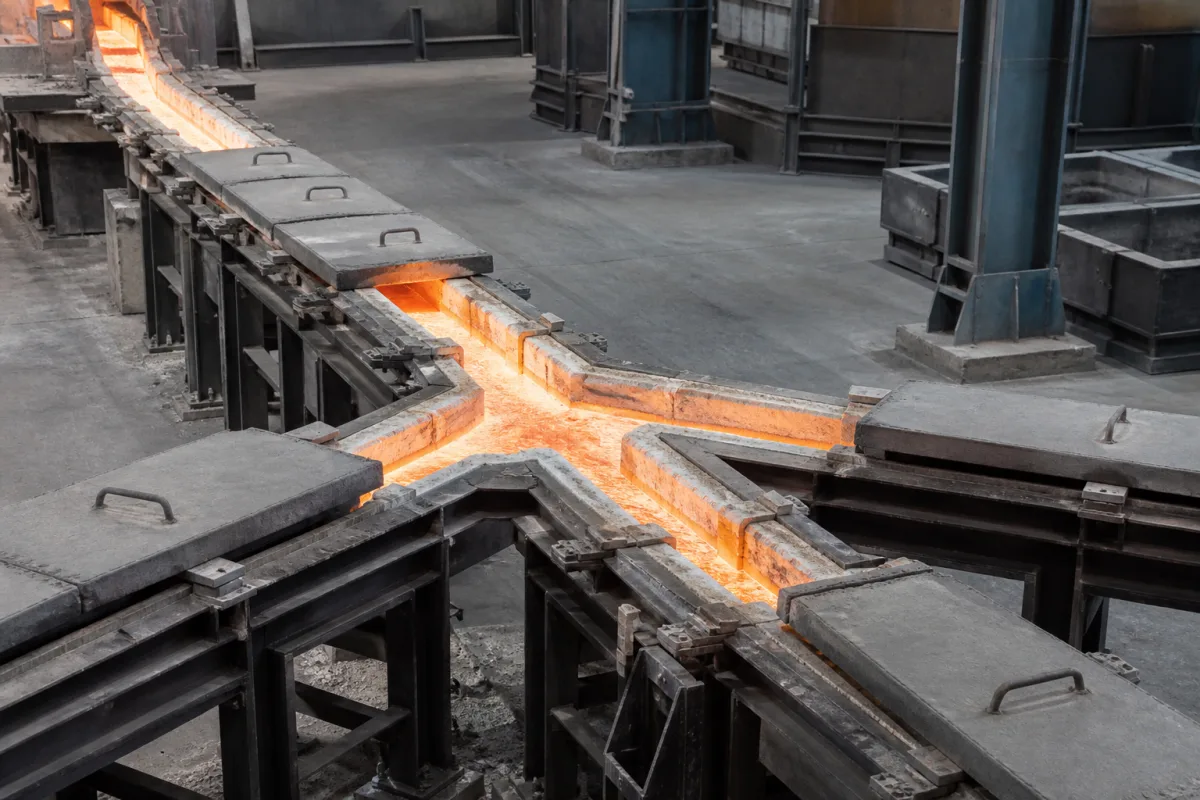
A channel or trough designed to direct and control the flow of molten metal from a furnace or holding vessel to various casting stations or molds within a foundry or metal processing facility.
Product Specifications

Technical details and manufacturing context for Distribution Launder

Definition
The Distribution Launder is a critical component of the Molten Metal Distribution System, serving as the primary conduit that transports molten metal from the source (such as a furnace or holding ladle) to multiple downstream processing points. It ensures controlled, consistent flow while minimizing temperature loss and preventing contamination during transfer. Typically constructed with refractory linings and insulation, it maintains metal quality and facilitates efficient distribution to casting machines, ingot molds, or other processing equipment.
Working Principle
The Distribution Launder operates on gravity flow principles, where molten metal moves from higher elevation sources to lower elevation destinations through a sloped channel. Flow control is achieved through gates, weirs, or tilting mechanisms that regulate metal volume and velocity. Thermal management systems (insulation, heating elements) maintain optimal metal temperature throughout transit to prevent solidification and ensure proper casting conditions.
Common Materials
Refractory ceramic, Steel casing, Insulation materials
Technical Parameters
  • Internal dimensions including width, depth, and length that determine flow capacity and metal volume (mm) Per Request
Components / BOM
  • Refractory Lining
    Provides thermal insulation and protects against molten metal corrosion
    Material: Refractory ceramic
  • Steel Casing
    Structural support and containment for the refractory lining
    Material: Carbon steel
  • Flow Control Gate
    Regulates metal flow rate and volume through the launder
    Material: Refractory or high-temperature alloy
  • Heating Elements
    Maintains optimal metal temperature during transit (if equipped)
    Material: Resistance heating elements
Engineering Reasoning
0.5-2.0 m/s flow velocity, 700-1600°C molten metal temperature, 0.1-0.5 MPa internal pressure
Thermal stress exceeding 250 MPa yield strength at refractory-metal interface, flow velocity exceeding 3.0 m/s causing refractory erosion, temperature exceeding 1650°C causing refractory decomposition
Design Rationale: Thermal fatigue from cyclic heating/cooling (coefficient of thermal expansion mismatch: refractory 5.5×10⁻⁶/°C vs steel 12×10⁻⁶/°C), refractory erosion from turbulent flow (Reynolds number >4000), creep deformation at sustained temperatures >1400°C
Risk Mitigation (FMEA)
Trigger Refractory lining thickness reduction below 25 mm due to erosion
Mode: Molten metal breakthrough causing structural failure and spill
Strategy: Install ultrasonic thickness monitoring with 5 mm resolution and automatic shutdown at 30 mm threshold
Trigger Thermal cycling exceeding 1000 cycles between 700°C and 1550°C
Mode: Crack propagation through refractory lining reaching critical length of 50 mm
Strategy: Implement controlled heating/cooling rate of 100°C/hour maximum with embedded thermocouple feedback control

Industry Taxonomies & Aliases

Commonly used trade names and technical identifiers for Distribution Launder.

Applied To / Applications

This component is essential for the following industrial systems and equipment:

Industrial Ecosystem & Supply Chain DNA

Complementary Systems
Downstream Applications
Specialized Tooling

Application Fit & Sizing Matrix

Operational Limits
pressure: Atmospheric to low-pressure (0-0.5 bar gauge) - primarily gravity-driven flow
flow rate: 0.1-100 tons/hour depending on launder cross-section and slope
temperature: Up to 1600°C (2912°F) for molten metals like aluminum, copper, iron; specific alloys may require lower limits
slurry concentration: Not applicable - designed for molten metals, not slurries
Media Compatibility
✓ Molten aluminum and alloys ✓ Molten copper and brass ✓ Molten iron and steel
Unsuitable: Corrosive molten salts or highly reactive metals (e.g., molten titanium, magnesium without protective atmosphere)
Sizing Data Required
  • Required molten metal flow rate (tons/hour)
  • Launder slope/grade for gravity flow (degrees or % incline)
  • Distance from source furnace to casting stations (meters)

Reliability & Engineering Risk Analysis

Failure Mode & Root Cause
Abrasive erosion
Cause: Continuous flow of slurry containing hard particles (e.g., ore, sand) wearing down launder lining material, particularly at high-velocity impact zones and bends.
Structural fatigue cracking
Cause: Cyclic thermal expansion/contraction from process temperature variations, combined with mechanical vibration from material flow, leading to stress concentration at weld joints or support points.
Maintenance Indicators
  • Visible thinning or localized wear patterns (e.g., shiny metal spots) on launder lining indicating imminent breakthrough
  • Audible change in flow sound (increased rattling or grinding noise) suggesting excessive material buildup or loose internal components
Engineering Tips
  • Install sacrificial wear liners at high-impact areas (e.g., elbows, drop points) using replaceable ceramic or urethane panels to protect primary structure
  • Implement routine laser scanning or ultrasonic thickness testing at critical wear zones to track erosion rates and schedule predictive replacements before failure

Compliance & Manufacturing Standards

Reference Standards
ISO 9001:2015 - Quality Management Systems ASTM A53/A53M-20 - Standard Specification for Pipe, Steel, Black and Hot-Dipped, Zinc-Coated, Welded and Seamless CE Marking - Pressure Equipment Directive (PED) 2014/68/EU
Manufacturing Precision
  • Wall Thickness: +/-10% of nominal thickness
  • Straightness: 1.5mm per meter length
Quality Inspection
  • Hydrostatic Pressure Test
  • Visual and Dimensional Inspection

Factories Producing Distribution Launder

Verified manufacturers with capability to produce this product in China

✓ 94% Supplier Capability Match Found

T Technical Director from United Arab Emirates Jan 10, 2026
★★★★★
"Found 50+ suppliers for Distribution Launder on CNFX, but this spec remains the most cost-effective."
Technical Specifications Verified
P Project Engineer from Australia Jan 07, 2026
★★★★☆
"The technical documentation for this Distribution Launder is very thorough, especially regarding technical reliability. (Delivery took slightly longer than expected, but technical support was excellent.)"
Technical Specifications Verified
S Sourcing Manager from Singapore Jan 04, 2026
★★★★★
"Reliable performance in harsh Basic Metal Manufacturing environments. No issues with the Distribution Launder so far."
Technical Specifications Verified
Verification Protocol

“Feedback is collected from verified sourcing managers during RFQ (Request for Quote) and factory evaluation processes on CNFX. These reports represent historical performance data and technical audit summaries from our B2B manufacturing network.”

13 sourcing managers are analyzing this specification now. Last inquiry for Distribution Launder from Poland (1h ago).

Supply Chain Compatible Machinery & Devices

Vacuum Induction Melting Furnace

Industrial furnace for melting metals under vacuum using electromagnetic induction

Explore Specs →
Electroslag Remelting Furnace

Secondary refining furnace for high-quality metal ingots

Explore Specs →
Molten Metal Flow Control Valve

Precision valve for regulating molten metal flow in casting and pouring operations.

Explore Specs →
Molten Metal Temperature Measurement System

Automated system for continuous temperature monitoring of molten metals during processing.

Explore Specs →

Frequently Asked Questions

What materials are used in distribution launder construction?

Distribution launders typically feature a refractory ceramic lining for heat resistance, a durable steel casing for structural integrity, and insulation materials to maintain molten metal temperature during transfer.

How does a distribution launder improve metal processing efficiency?

Distribution launders provide controlled, consistent flow of molten metal from furnaces to casting stations, reducing spillage, minimizing temperature loss, and enabling precise distribution to multiple molds simultaneously.

What maintenance is required for industrial distribution launders?

Regular inspection of refractory lining for wear, cleaning of flow control gates, monitoring of heating elements, and checking steel casing integrity are essential maintenance procedures to ensure optimal performance and safety.

Can I contact factories directly on CNFX?

CNFX is an open directory, not a transaction platform. Each factory profile provides direct contact information and production details to help you initiate direct inquiries with Chinese suppliers.

Get Quote for Distribution Launder

Request technical pricing, lead times, or customized specifications for Distribution Launder directly from verified manufacturing units.

Your business information is encrypted and only shared with verified Distribution Launder suppliers.

Thank you! Your message has been sent. We'll respond within 1–3 business days.

Need to Manufacture Distribution Launder?

Connect with verified factories specializing in this product category

Add Your Factory Contact Us
Previous Product
Discharge System
Next Product
Downcoiler