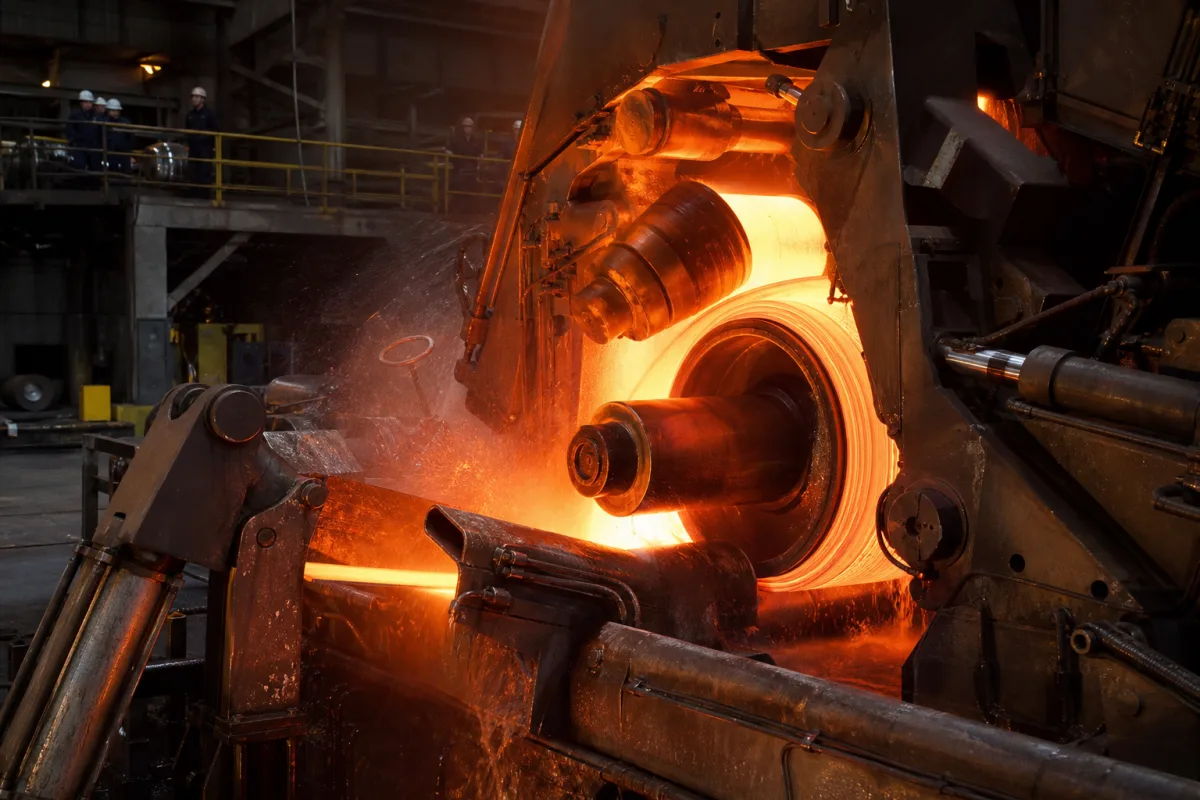
Hot strip mill coilers at the end of the run-out table · Pinch rolls, wrapper rolls and expanding segmented mandrels, coiling tension, coil weight in pounds per inch of width, tail-end positioning, coil stripping, crowned mandrels for flatness, and coil boxes compared
A downcoiler is the coiling machine at the exit of a hot strip mill: after the strip leaves the last finishing stand and is cooled on the run-out table, pinch rolls deflect its head end down a chute to an expanding mandrel, wrapper rolls press the first wraps onto the mandrel, and the mandrel then holds the strip in tension while it winds a coil that is stripped off for transport. Ask three things first: what strip widths, thicknesses, strengths and coil weights it must coil, how the pinch rolls, wrapper rolls and mandrel will be arranged and driven, and how the coil will be finished, stripped and conveyed.
Downcoilers for hot strip mills and Steckel mills: pinch roll units, wrapper rolls, expanding mandrels, coiler drives and coil stripping cars. Coil boxes between roughing and finishing mills, cold-mill tension reels, slitting-line recoilers and coil conveyors sold separately are outside this page except where compared.
CNFX editorial research · Sources checked October 11, 2026 · 6 sources
Set the strip range, coil weight and coiler layout
California Steel Industries' published hot strip mill specifications list a 2.5 million t/y mill rolling carbon steel slabs 7–9 in thick, 24–75 in wide and up to 30 tons, a six-stand four-high finishing mill, five strip cooling banks with laminar top and spray bottom headers, and two downcoilers: No. 1 with three wrapper rolls rated 1,000 PIW (started 1992) and No. 2 with four wrapper rolls rated 1,000 PIW (upgraded 1997). [1]
PIW is coil weight in pounds per inch of strip width. Editorial calculation: at 1,000 PIW a 75 in wide coil weighs up to 75,000 lb (about 34 t) and a 24 in wide coil up to 24,000 lb (about 10.9 t); size the mandrel, coil car and conveyors for the heaviest width you will coil. [1]
US4773245A describes the conventional layout: strip from the last stand passes along the water-cooled run-out table and through a pinch roll unit set at a slight angle that turns the head end down between deflector plates to the mandrel; there are two or more downcoilers, and when the second is used the first pinch rolls open wide so the strip passes through to the second unit. [2]
Give the supplier the strip width and thickness range, steel grades and coiling temperatures, maximum coil weight (or PIW) and outside diameter, inside diameter, strip speed at the coiler, number of coilers and their positions, existing run-out table and foundations, and coil handling downstream.
02
Set the pinch rolls, mandrel and wrapper rolls
The same patent explains the threading sequence: the pinch roll gap is closed to about, and slightly less than, the incoming strip thickness and the rolls turn slightly faster than the strip so that a light tension is set on the head end; the mandrel also runs faster than the strip, and once it grips the head end its motor holds a tension set for the strip width and thickness. Just before the tail leaves the last finishing stand the pinch roll tension is raised to roughly equal the mandrel tension so coiling tension is kept; side guides close on the strip edges once tension is set so the coil builds with straight sides. [2]
Nippon Steel's US11697144B2 describes a coiler with pinch roll, chute, mandrel and wrapper rolls: the wrapper rolls close on the mandrel and turn slightly faster than the strip before the head end arrives, then sandwich and wind it; the mandrel is a four-segment type in which each segment slides radially on a wedge shaft, expands further after a set number of wraps until the expansion force balances the coil's tightening force, and the wrapper rolls then open. It proposes a crowned mandrel whose centre peripheral length exceeds the edges by a ratio of 0.0002–0.012 (preferably 0.002–0.008) to improve the flatness of coiled sheet. [3]
US3763684A describes an older toggle-link mandrel with four segments around the body, collapsed by a central shaft so the coil can be removed, and identifies lubrication of the links as a source of wear and malfunction. US3538729A (Westinghouse) describes a control that counts mandrel revolutions after the strip tail passes a detector so that the tail stops beneath the coil before stripping and cannot unwind on the coil conveyor. [4][5]
State the number and drive of wrapper rolls and their gap and force control, mandrel type (wedge or toggle link), segment count, collapsed and expanded diameter, crown, pinch roll diameter, drive and gap control, coiler motor power and gearbox, tension control, tail positioning and the coil stripper and car.
03
Choose between a downcoiler and a coil box
A downcoiler finishes the strip into a shipping coil after the finishing mill. A coil box is a different machine: US4297865A describes rolling a slab heated to about 2,300 °F into a transfer bar about 1 in thick and temporarily coiling that bar, without a central mandrel, between the roughing and finishing mills so its heat is retained, with the option of running the bar straight through. [6]
Editorial note: if the enquiry is for a coreless coiler between roughing and finishing stands, it is a coil box rather than a downcoiler; ask for its own data.
Say whether the machine coils finished strip after the run-out table (downcoiler) or a transfer bar between roughing and finishing (coil box).
04
Know the downcoiler parts
Part
Role
Fix in the order
Pinch roll unit
Grips the head end, bends it down and holds back tension at the tail. [2]
Remove the coil after the mandrel collapses. [4][5]
Capacity and transfer.
05
Coil weight, strip range and drives to state
Coil weight and width come from California Steel's mill; the patents describe mandrel and tension behaviour without figures, so speed, power and hydraulic rows are yours to fill.
Explore company information and manufacturing capabilities, then discuss the scope of your project with a relevant supplier.
Share this page
Compiled and source-reviewed by the CNFX editorial team.
Published project data show what a mill installed, not your coiler's performance. Confirm the legal seller, design references and scope for your order. How we source and review
· Page last updated 13 October 2026
Buyer questions
What does PIW mean on a downcoiler?
Pounds per inch of width: one mill's two downcoilers are rated 1,000 PIW, which caps coil weight by strip width. [1]
What do wrapper rolls do?
They press the first wraps of strip onto the mandrel and open once the mandrel has expanded and holds tension. [3]
Why must the strip tail be positioned before stripping?
So the tail sits beneath the coil and the coil's weight stops it unwinding on the conveyor. [5]
Is a coil box a downcoiler?
No; a coil box coils the transfer bar between roughing and finishing mills, without a mandrel. [6]
Sources and what still needs a direct check
Sources checked 2026-10-11. California Steel's sheet describes one mill's equipment; the patents describe designs and control methods, not current products. Values for your coiler must come from the supplier offered.