Industry-Verified Manufacturing Data (2026)

Flow Control Device

Based on aggregated insights from multiple verified factory profiles within the CNFX directory, the standard Flow Control Device used in the Basic Metal Manufacturing sector typically supports operational capacities ranging from standard industrial configurations to heavy-duty production requirements.

Technical Definition & Core Assembly

A canonical Flow Control Device is characterized by the integration of Flow Orifice / Nozzle and Gate or Shutter Mechanism. In industrial production environments, manufacturers listed on CNFX commonly emphasize Refractory Ceramics construction to support stable, high-cycle operation across diverse manufacturing scenarios.

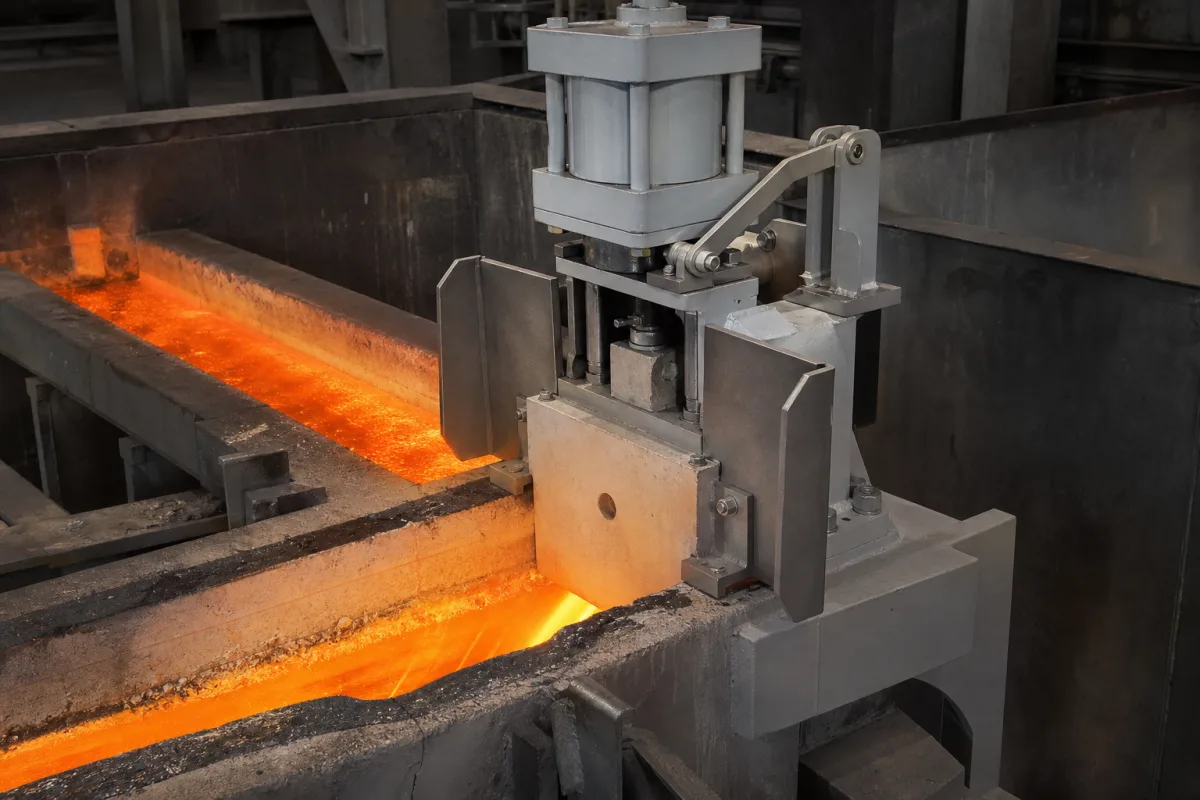
A device used to regulate, direct, or control the flow of molten metal within a distribution system.
Product Specifications

Technical details and manufacturing context for Flow Control Device

Definition
A specialized component within a Molten Metal Distribution System designed to precisely control the rate, direction, and volume of molten metal flow from furnaces or holding vessels to casting stations, molds, or other processing units. It ensures consistent metal delivery, prevents turbulence, and maintains optimal temperature and quality during transfer.
Working Principle
Operates by mechanically altering the flow path or cross-sectional area available to the molten metal stream. This is typically achieved through mechanisms such as sliding gates, rotary valves, stopper rods, or throttling orifices. Actuation can be manual, pneumatic, hydraulic, or electric, responding to control signals to achieve the desired flow rate based on process requirements.
Common Materials
Refractory Ceramics, High-Temperature Alloy Steel
Technical Parameters
  • Nominal bore or orifice diameter, defining the maximum flow capacity. (mm) Standard Spec
Components / BOM
  • Flow Orifice / Nozzle
    Forms the precise opening through which molten metal flows; defines flow characteristics.
    Material: Refractory Ceramic (e.g., Alumina, Zirconia)
  • Gate or Shutter Mechanism
    Moves to open, close, or modulate the flow area of the orifice.
    Material: High-Temperature Alloy Steel (e.g., Tungsten-based)
  • Actuator Assembly
    Provides the force and control to position the gate/shutter as required.
    Material: Steel, Pneumatic/Hydraulic Components
  • Housing / Body
    Contains internal components, provides structural integrity and mounting points, and interfaces with the distribution system.
    Material: Refractory Lined Steel or Cast Iron
Engineering Reasoning
0.5-15.0 bar at 700-1600°C
18.5 bar internal pressure differential at 1650°C
Design Rationale: Thermal creep deformation exceeding 0.2% strain rate in refractory ceramic lining, leading to structural collapse under Bernoulli principle flow acceleration
Risk Mitigation (FMEA)
Trigger Alumina inclusion accumulation exceeding 3.5% volume fraction
Mode: Flow restriction causing 40% pressure drop across device
Strategy: Ceramic filter mesh with 0.8 mm pore size upstream of control device
Trigger Thermal cycling between 700°C and 1550°C exceeding 1200 cycles
Mode: Refractory lining spallation creating 2.5 mm erosion depth
Strategy: Zirconia-based graded thermal barrier coating with 0.8 mm thickness

Industry Taxonomies & Aliases

Commonly used trade names and technical identifiers for Flow Control Device.

Applied To / Applications

This component is essential for the following industrial systems and equipment:

Industrial Ecosystem & Supply Chain DNA

Complementary Systems
Downstream Applications
Specialized Tooling

Application Fit & Sizing Matrix

Operational Limits
pressure: Up to 10 bar
flow rate: 0.1 to 50 L/min
temperature: 600°C to 1600°C
slurry concentration: Up to 40% solids by volume
Media Compatibility
✓ Molten aluminum alloys ✓ Molten copper alloys ✓ Molten zinc alloys
Unsuitable: Highly corrosive molten salts (e.g., chlorides, fluorides)
Sizing Data Required
  • Required flow rate (L/min)
  • Operating temperature (°C)
  • System pressure (bar)

Reliability & Engineering Risk Analysis

Failure Mode & Root Cause
Cavitation
Cause: Rapid pressure drop below vapor pressure causing vapor bubble formation and implosion, leading to pitting and material degradation.
Corrosion and Erosion
Cause: Chemical attack from process fluids combined with abrasive particle impingement, accelerated by improper material selection or flow velocity.
Maintenance Indicators
  • Unusual high-frequency vibration or audible 'hissing/chattering' noise indicating cavitation or flow instability
  • Visible external leakage, corrosion spots, or unexpected pressure/flow deviations from setpoints
Engineering Tips
  • Implement proper sizing and pressure staging to maintain pressure above vapor pressure, and select cavitation-resistant trim materials
  • Use corrosion-resistant alloys matched to process media, install upstream filtration to remove particulates, and maintain optimal flow velocities

Compliance & Manufacturing Standards

Reference Standards
ISO 5208: Industrial valves - Pressure testing of valves ANSI/ISA 75.05.01: Control Valve Sizing Equations DIN EN 12516-1: Industrial valves - Shell design strength - Part 1: Tabulation method for steel valve shells
Manufacturing Precision
  • Bore diameter: +/-0.05mm
  • Surface finish: Ra 0.8 μm maximum
Quality Inspection
  • Hydrostatic pressure test
  • Leakage rate test per ANSI/FCI 70-2

Factories Producing Flow Control Device

Verified manufacturers with capability to produce this product in China

✓ 93% Supplier Capability Match Found

P Procurement Specialist from Germany Jan 11, 2026
★★★★★
"Impressive build quality. Especially the technical reliability is very stable during long-term operation."
Technical Specifications Verified
T Technical Director from Brazil Jan 08, 2026
★★★★★
"As a professional in the Basic Metal Manufacturing sector, I confirm this Flow Control Device meets all ISO standards."
Technical Specifications Verified
P Project Engineer from Canada Jan 05, 2026
★★★★★
"Standard OEM quality for Basic Metal Manufacturing applications. The Flow Control Device arrived with full certification."
Technical Specifications Verified
Verification Protocol

“Feedback is collected from verified sourcing managers during RFQ (Request for Quote) and factory evaluation processes on CNFX. These reports represent historical performance data and technical audit summaries from our B2B manufacturing network.”

15 sourcing managers are analyzing this specification now. Last inquiry for Flow Control Device from Thailand (1h ago).

Supply Chain Compatible Machinery & Devices

Electromagnetic Induction Heater

Industrial heating device using electromagnetic induction for metal processing

Explore Specs →
Vacuum Induction Melting Furnace

Industrial furnace for melting metals under vacuum using electromagnetic induction

Explore Specs →
Electroslag Remelting Furnace

Secondary refining furnace for high-quality metal ingots

Explore Specs →
Molten Metal Flow Control Valve

Precision valve for regulating molten metal flow in casting and pouring operations.

Explore Specs →

Frequently Asked Questions

What materials are used in this flow control device for high-temperature applications?

The device is constructed from refractory ceramics and high-temperature alloy steel to withstand extreme temperatures and corrosive molten metal environments.

How does the gate mechanism regulate molten metal flow in distribution systems?

The gate or shutter mechanism precisely controls flow rates by adjusting the opening size, while the actuator assembly enables automated or manual operation for consistent metal distribution.

What maintenance is required for flow control devices in basic metal manufacturing?

Regular inspection of the flow orifice/nozzle for wear, lubrication of the actuator assembly, and checking the housing for thermal stress cracks ensures optimal performance and longevity.

Can I contact factories directly on CNFX?

CNFX is an open directory, not a transaction platform. Each factory profile provides direct contact information and production details to help you initiate direct inquiries with Chinese suppliers.

Get Quote for Flow Control Device

Request technical pricing, lead times, or customized specifications for Flow Control Device directly from verified manufacturing units.

Your business information is encrypted and only shared with verified Flow Control Device suppliers.

Thank you! Your message has been sent. We'll respond within 1–3 business days.

Need to Manufacture Flow Control Device?

Connect with verified factories specializing in this product category

Add Your Factory Contact Us
Previous Product
Finishing Mill Train
Next Product
Flow Control Device (Slide Gate or Stopper Rod)