Industry-Verified Manufacturing Data (2026)

Finishing Mill Train

Based on aggregated insights from multiple verified factory profiles within the CNFX directory, the standard Finishing Mill Train used in the Basic Metal Manufacturing sector typically supports operational capacities ranging from standard industrial configurations to heavy-duty production requirements.

Technical Definition & Core Assembly

A canonical Finishing Mill Train is characterized by the integration of Work Rolls and Backup Rolls. In industrial production environments, manufacturers listed on CNFX commonly emphasize Alloy Steel construction to support stable, high-cycle operation across diverse manufacturing scenarios.

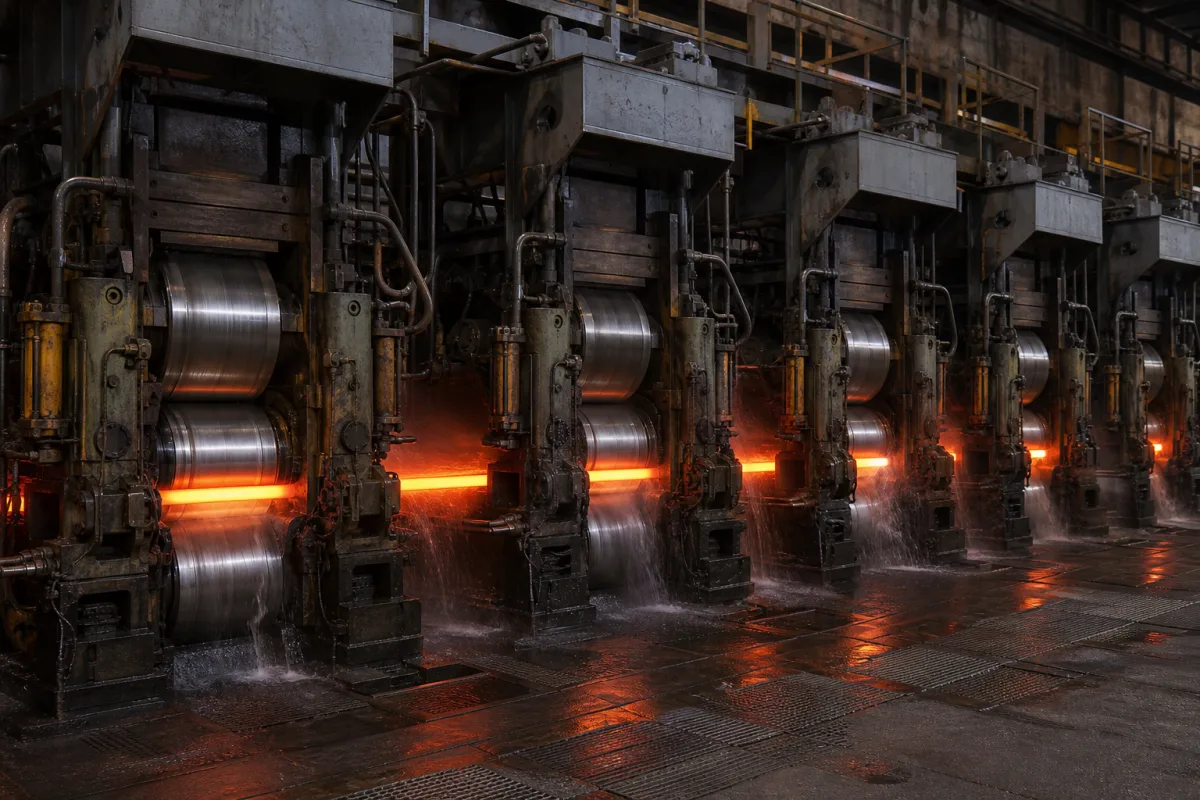
A series of rolling mill stands that reduce the thickness and control the final dimensions and surface quality of hot-rolled steel strip.
Product Specifications

Technical details and manufacturing context for Finishing Mill Train

Definition
The Finishing Mill Train is a critical component within the Integrated Hot Strip Rolling and Finishing System, responsible for the final reduction and shaping of steel slabs into thin, wide strips with precise thickness, width, and surface finish specifications. It typically consists of multiple rolling stands arranged in tandem.
Working Principle
Hot steel from the roughing mill enters the finishing mill train at high temperatures. It passes sequentially through a series of powered rolling stands, where each set of work rolls applies controlled pressure to progressively reduce the strip's thickness while maintaining or adjusting its width and flatness through mechanisms like roll bending and cooling.
Common Materials
Alloy Steel, Tungsten Carbide
Technical Parameters
  • Final strip thickness range (e.g., 1.2mm to 25mm) (mm) Standard Spec
Components / BOM
  • Work Rolls
    Directly contact and deform the hot steel strip to reduce its thickness.
    Material: Forged Alloy Steel or Tungsten Carbide
  • Backup Rolls
    Support the work rolls to prevent deflection under high rolling loads, ensuring strip flatness.
    Material: Forged Alloy Steel
  • Rolling Mill Stand Housing
    A rigid frame that houses and supports the roll assembly, bearings, and adjustment mechanisms.
    Material: Cast Steel
  • Screwdown Mechanism
    Precisely adjusts the gap between the work rolls to control the final strip thickness.
    Material: Alloy Steel
Engineering Reasoning
0.8-2.5 mm thickness reduction per stand, 600-1200°C strip temperature, 5-25 m/s rolling speed
Roll deflection exceeding 0.1 mm/m at 2000 kN roll separating force, strip temperature dropping below 550°C during rolling
Design Rationale: Hertzian contact stress exceeding 1500 MPa causing roll spalling, thermal gradient exceeding 200°C/mm inducing roll surface checking
Risk Mitigation (FMEA)
Trigger Roll eccentricity exceeding 50 μm due to bearing wear
Mode: Periodic thickness variation of ±0.05 mm at roll rotation frequency
Strategy: Hydrodynamic bearing replacement at 0.8 μm/kN stiffness degradation, roll grinding at 0.02 mm crown deviation
Trigger Work roll thermal camber exceeding 0.15 mm due to cooling imbalance
Mode: Strip edge wave formation with 10 mm amplitude, center buckle defect
Strategy: Segmented roll cooling with 0.5°C zone control, work roll bending force adjustment at 500 kN/m stiffness

Industry Taxonomies & Aliases

Commonly used trade names and technical identifiers for Finishing Mill Train.

Industrial Ecosystem & Supply Chain DNA

Complementary Systems
Downstream Applications
Specialized Tooling

Application Fit & Sizing Matrix

Operational Limits
pressure: Up to 3000 kN per stand (typical rolling force)
other spec: Strip thickness reduction: 15-50% per stand, maximum strip width: 2000 mm, maximum entry thickness: 50 mm, minimum exit thickness: 1.2 mm
temperature: 600-1200°C (hot rolling temperature range)
Media Compatibility
✓ Low-carbon steel strip ✓ High-strength low-alloy (HSLA) steel ✓ Stainless steel grades (austenitic/ferritic)
Unsuitable: Highly abrasive materials (e.g., tungsten carbide composites) due to excessive roll wear
Sizing Data Required
  • Required annual production capacity (tons/year)
  • Final strip thickness and width specifications
  • Incoming hot band thickness and material grade

Reliability & Engineering Risk Analysis

Failure Mode & Root Cause
Roll bearing fatigue failure
Cause: Cyclic loading from high-torque operations, inadequate lubrication leading to metal-to-metal contact, and contamination ingress from mill scale or coolant
Gear tooth pitting and spalling
Cause: Surface fatigue from repeated Hertzian contact stresses, misalignment of drive train components, and insufficient gear oil film thickness due to improper viscosity or degraded lubricant
Maintenance Indicators
  • High-frequency metallic screeching or grinding noises from gear housings during operation
  • Visible oil leaks around bearing seals or gearbox joints with metallic particles in leaked fluid
Engineering Tips
  • Implement condition-based lubrication using oil analysis to monitor wear metals, viscosity, and contamination levels, adjusting intervals based on actual operating conditions rather than fixed schedules
  • Install laser alignment systems for periodic verification of motor-to-gearbox and gearbox-to-roll couplings, maintaining angular and parallel alignment within 0.05mm tolerance to reduce abnormal loading

Compliance & Manufacturing Standards

Reference Standards
ISO 9001:2015 - Quality management systems ASTM A6/A6M - Standard Specification for General Requirements for Rolled Structural Steel Bars, Plates, Shapes, and Sheet Piling CE Marking - Machinery Directive 2006/42/EC
Manufacturing Precision
  • Roll alignment: +/-0.01mm
  • Surface finish: Ra 0.8μm maximum
Quality Inspection
  • Ultrasonic Testing (UT) for internal defects
  • Hardness Testing (Rockwell C scale)

Factories Producing Finishing Mill Train

Verified manufacturers with capability to produce this product in China

✓ 94% Supplier Capability Match Found

P Procurement Specialist from United Arab Emirates Jan 11, 2026
★★★★★
"Great transparency on the Finishing Mill Train components. Essential for our Basic Metal Manufacturing supply chain."
Technical Specifications Verified
T Technical Director from Australia Jan 08, 2026
★★★★★
"The Finishing Mill Train we sourced perfectly fits our Basic Metal Manufacturing production line requirements."
Technical Specifications Verified
P Project Engineer from Singapore Jan 05, 2026
★★★★★
"Found 39+ suppliers for Finishing Mill Train on CNFX, but this spec remains the most cost-effective."
Technical Specifications Verified
Verification Protocol

“Feedback is collected from verified sourcing managers during RFQ (Request for Quote) and factory evaluation processes on CNFX. These reports represent historical performance data and technical audit summaries from our B2B manufacturing network.”

15 sourcing managers are analyzing this specification now. Last inquiry for Finishing Mill Train from Thailand (1h ago).

Supply Chain Compatible Machinery & Devices

Electromagnetic Induction Heater

Industrial heating device using electromagnetic induction for metal processing

Explore Specs →
Vacuum Induction Melting Furnace

Industrial furnace for melting metals under vacuum using electromagnetic induction

Explore Specs →
Electroslag Remelting Furnace

Secondary refining furnace for high-quality metal ingots

Explore Specs →
Molten Metal Flow Control Valve

Precision valve for regulating molten metal flow in casting and pouring operations.

Explore Specs →

Frequently Asked Questions

What is the primary function of a finishing mill train in basic metal manufacturing?

A finishing mill train reduces the thickness of hot-rolled steel strip to precise final dimensions while controlling surface quality through a series of rolling mill stands.

Why are materials like alloy steel and tungsten carbide used in finishing mill trains?

Alloy steel provides structural strength for components like housing and backup rolls, while tungsten carbide offers exceptional wear resistance for work rolls that directly contact the steel strip.

How does the screwdown mechanism contribute to the finishing process?

The screwdown mechanism precisely adjusts the gap between work rolls, enabling accurate control over the final thickness and dimensional consistency of the steel strip.

Can I contact factories directly on CNFX?

CNFX is an open directory, not a transaction platform. Each factory profile provides direct contact information and production details to help you initiate direct inquiries with Chinese suppliers.

Get Quote for Finishing Mill Train

Request technical pricing, lead times, or customized specifications for Finishing Mill Train directly from verified manufacturing units.

Your business information is encrypted and only shared with verified Finishing Mill Train suppliers.

Thank you! Your message has been sent. We'll respond within 1–3 business days.

Need to Manufacture Finishing Mill Train?

Connect with verified factories specializing in this product category

Add Your Factory Contact Us
Previous Product
Extrusion Press
Next Product
Flow Control Device