Industry-Verified Manufacturing Data (2026)

Gas Inlet Bustle

Based on aggregated insights from multiple verified factory profiles within the CNFX directory, the standard Gas Inlet Bustle used in the Basic Metal Manufacturing sector typically supports operational capacities ranging from standard industrial configurations to heavy-duty production requirements.

Technical Definition & Core Assembly

A canonical Gas Inlet Bustle is characterized by the integration of Main Bustle Pipe and Branch Connections. In industrial production environments, manufacturers listed on CNFX commonly emphasize Heat-resistant alloy steel construction to support stable, high-cycle operation across diverse manufacturing scenarios.

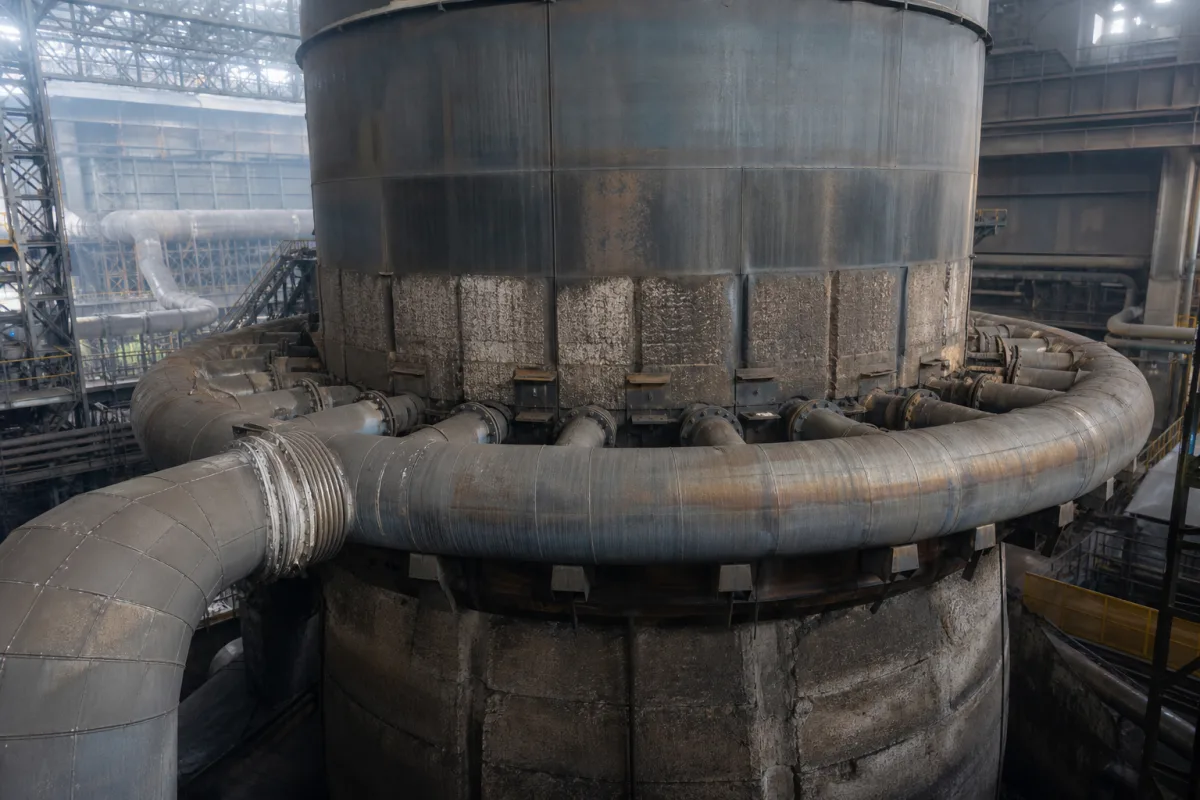
A critical distribution component in a Direct Reduction Shaft Furnace that receives and evenly distributes reducing gases to multiple injection points around the furnace circumference.
Product Specifications

Technical details and manufacturing context for Gas Inlet Bustle

Definition
The Gas Inlet Bustle is a specialized piping assembly that serves as the primary gas distribution manifold in a Direct Reduction Shaft Furnace. It receives hot reducing gases (typically a mixture of hydrogen, carbon monoxide, and natural gas) from the main gas supply system and distributes them uniformly to multiple tuyeres or injection nozzles positioned around the furnace's circumference. This ensures consistent gas flow and pressure to all injection points, which is essential for maintaining uniform reduction conditions throughout the furnace burden. The bustle is typically constructed as a large-diameter circular or semi-circular pipe that encircles the furnace shaft, with multiple branch connections leading to individual injection points.
Working Principle
The Gas Inlet Bustle operates on fluid distribution principles. Hot reducing gases enter the bustle through one or more main inlet connections. The bustle's large cross-sectional area and circular design help maintain consistent pressure throughout the system. The gases then flow through multiple branch pipes or tuyeres that connect to injection nozzles positioned at regular intervals around the furnace. This design ensures that each injection point receives approximately equal gas flow, which is critical for achieving uniform reduction reactions across the entire furnace cross-section. Pressure regulators and flow control valves are typically integrated into the bustle system to manage gas distribution.
Common Materials
Heat-resistant alloy steel, Refractory lining materials, High-temperature gaskets and seals
Technical Parameters
  • Diameter of the bustle main pipe, typically ranging from 800mm to 2000mm depending on furnace capacity (mm) Standard Spec
Components / BOM
  • Main Bustle Pipe
    Primary gas distribution conduit that encircles the furnace
    Material: Heat-resistant alloy steel
  • Branch Connections
    Connect main bustle to individual injection nozzles or tuyeres
    Material: Alloy steel with expansion joints
  • Refractory Lining
    Insulates bustle pipe from high-temperature gases
    Material: High-alumina refractory
  • Support Structure
    Supports bustle weight and accommodates thermal expansion
    Material: Structural steel
Engineering Reasoning
0.8-1.2 MPa (8-12 bar) at 850-950°C
Material yield strength threshold: 220 MPa at 950°C for 310S stainless steel, or thermal stress exceeding 180 MPa from 200°C thermal gradient across 50 mm wall thickness
Design Rationale: Creep rupture from sustained high-temperature operation exceeding 0.4×melting temperature (310S: ~1400°C) combined with thermal fatigue from cyclic heating/cooling during furnace shutdowns
Risk Mitigation (FMEA)
Trigger Carbon deposition from Boudouard reaction (2CO → C + CO₂) at 400-700°C in stagnant gas zones
Mode: Flow restriction increasing pressure drop from 0.2 MPa to >0.5 MPa, causing uneven gas distribution with >15% variation between injection points
Strategy: Maintain gas velocity >5 m/s through bustle cross-section and implement periodic nitrogen purges at 800°C to remove deposited carbon
Trigger Differential thermal expansion between 310S stainless steel bustle (CTE: 18.5 μm/m·°C) and ceramic-lined furnace shell (CTE: 5.3 μm/m·°C)
Mode: Weld fracture at bustle-to-furnace interface after 1000 thermal cycles, causing gas leakage exceeding 2% of total flow
Strategy: Install bellows expansion joints with 50 mm axial movement capacity and 15° angular deflection capability at all connection points

Industry Taxonomies & Aliases

Commonly used trade names and technical identifiers for Gas Inlet Bustle.

Applied To / Applications

This component is essential for the following industrial systems and equipment:

Industrial Ecosystem & Supply Chain DNA

Complementary Systems
Downstream Applications
Specialized Tooling

Application Fit & Sizing Matrix

Operational Limits
pressure: Up to 5 bar (gauge) maximum design pressure
flow rate: 50,000-200,000 Nm³/h (depends on furnace capacity)
temperature: 200-450°C (typical operating range for reducing gases like H2/CO mixtures)
slurry concentration: Not applicable (gas-only component)
Media Compatibility
✓ Hydrogen-rich reducing gases (H2/CO mixtures) ✓ Natural gas reformed gases ✓ Syngas from coal gasification
Unsuitable: Oxygen-containing environments (risk of oxidation/combustion)
Sizing Data Required
  • Total reducing gas flow rate (Nm³/h)
  • Number of injection points around furnace circumference
  • Furnace internal diameter and bustle positioning requirements

Reliability & Engineering Risk Analysis

Failure Mode & Root Cause
Thermal fatigue cracking
Cause: Cyclic thermal stresses from rapid temperature fluctuations during gas flow variations, leading to crack initiation and propagation in the bustle material, often exacerbated by inadequate thermal expansion accommodation.
Corrosion-induced thinning
Cause: Chemical attack from corrosive contaminants (e.g., H2S, CO2, chlorides) in the gas stream, combined with moisture condensation, resulting in material degradation and localized thinning, particularly at welds and stress concentration points.
Maintenance Indicators
  • Audible gas leakage or hissing sounds from the bustle joints or body, indicating seal failure or crack development.
  • Visible external discoloration, bulging, or localized hot spots on the bustle surface, suggesting internal corrosion, material thinning, or insulation breakdown.
Engineering Tips
  • Implement regular non-destructive testing (NDT) such as ultrasonic thickness gauging and thermal imaging to monitor wall thickness and detect early-stage corrosion or thermal anomalies before failure occurs.
  • Optimize gas stream conditioning by installing upstream moisture separators and corrosion inhibitors to reduce corrosive contaminants, and ensure proper thermal insulation to minimize thermal cycling stresses on the bustle structure.

Compliance & Manufacturing Standards

Reference Standards
ISO 10497:2010 (Fire testing of valves) ANSI/ASME B16.5 (Pipe flanges and flanged fittings) DIN EN 1092-1 (Flanges and their joints)
Manufacturing Precision
  • Bore diameter: +/-0.05mm
  • Flange flatness: 0.1mm per 100mm diameter
Quality Inspection
  • Hydrostatic pressure test
  • Dimensional verification with CMM

Factories Producing Gas Inlet Bustle

Verified manufacturers with capability to produce this product in China

✓ 98% Supplier Capability Match Found

T Technical Director from Singapore Feb 07, 2026
★★★★★
"Great transparency on the Gas Inlet Bustle components. Essential for our Basic Metal Manufacturing supply chain."
Technical Specifications Verified
P Project Engineer from Germany Feb 04, 2026
★★★★☆
"The Gas Inlet Bustle we sourced perfectly fits our Basic Metal Manufacturing production line requirements. (Delivery took slightly longer than expected, but technical support was excellent.)"
Technical Specifications Verified
S Sourcing Manager from Brazil Feb 01, 2026
★★★★★
"Found 32+ suppliers for Gas Inlet Bustle on CNFX, but this spec remains the most cost-effective."
Technical Specifications Verified
Verification Protocol

“Feedback is collected from verified sourcing managers during RFQ (Request for Quote) and factory evaluation processes on CNFX. These reports represent historical performance data and technical audit summaries from our B2B manufacturing network.”

15 sourcing managers are analyzing this specification now. Last inquiry for Gas Inlet Bustle from Germany (1h ago).

Supply Chain Compatible Machinery & Devices

Electromagnetic Induction Heater

Industrial heating device using electromagnetic induction for metal processing

Explore Specs →
Vacuum Induction Melting Furnace

Industrial furnace for melting metals under vacuum using electromagnetic induction

Explore Specs →
Electroslag Remelting Furnace

Secondary refining furnace for high-quality metal ingots

Explore Specs →
Molten Metal Flow Control Valve

Precision valve for regulating molten metal flow in casting and pouring operations.

Explore Specs →

Frequently Asked Questions

What is the primary function of a Gas Inlet Bustle in a Direct Reduction Shaft Furnace?

The Gas Inlet Bustle receives reducing gases and evenly distributes them to multiple injection points around the furnace circumference, ensuring uniform gas flow for efficient direct reduction processes in basic metal manufacturing.

What materials are used in manufacturing high-quality Gas Inlet Bustles?

Premium Gas Inlet Bustles are constructed from heat-resistant alloy steel for structural integrity, lined with refractory materials to withstand extreme temperatures, and sealed with high-temperature gaskets to prevent gas leakage in demanding furnace environments.

How does the refractory lining in a Gas Inlet Bustle extend component lifespan?

The refractory lining protects the alloy steel structure from direct exposure to high-temperature reducing gases (typically 800-1000°C), preventing thermal degradation, reducing maintenance frequency, and ensuring consistent gas distribution performance throughout extended operational cycles.

Can I contact factories directly on CNFX?

CNFX is an open directory, not a transaction platform. Each factory profile provides direct contact information and production details to help you initiate direct inquiries with Chinese suppliers.

Get Quote for Gas Inlet Bustle

Request technical pricing, lead times, or customized specifications for Gas Inlet Bustle directly from verified manufacturing units.

Your business information is encrypted and only shared with verified Gas Inlet Bustle suppliers.

Thank you! Your message has been sent. We'll respond within 1–3 business days.

Need to Manufacture Gas Inlet Bustle?

Connect with verified factories specializing in this product category

Add Your Factory Contact Us
Previous Product
Gas Control System
Next Product
Gas Reforming Unit