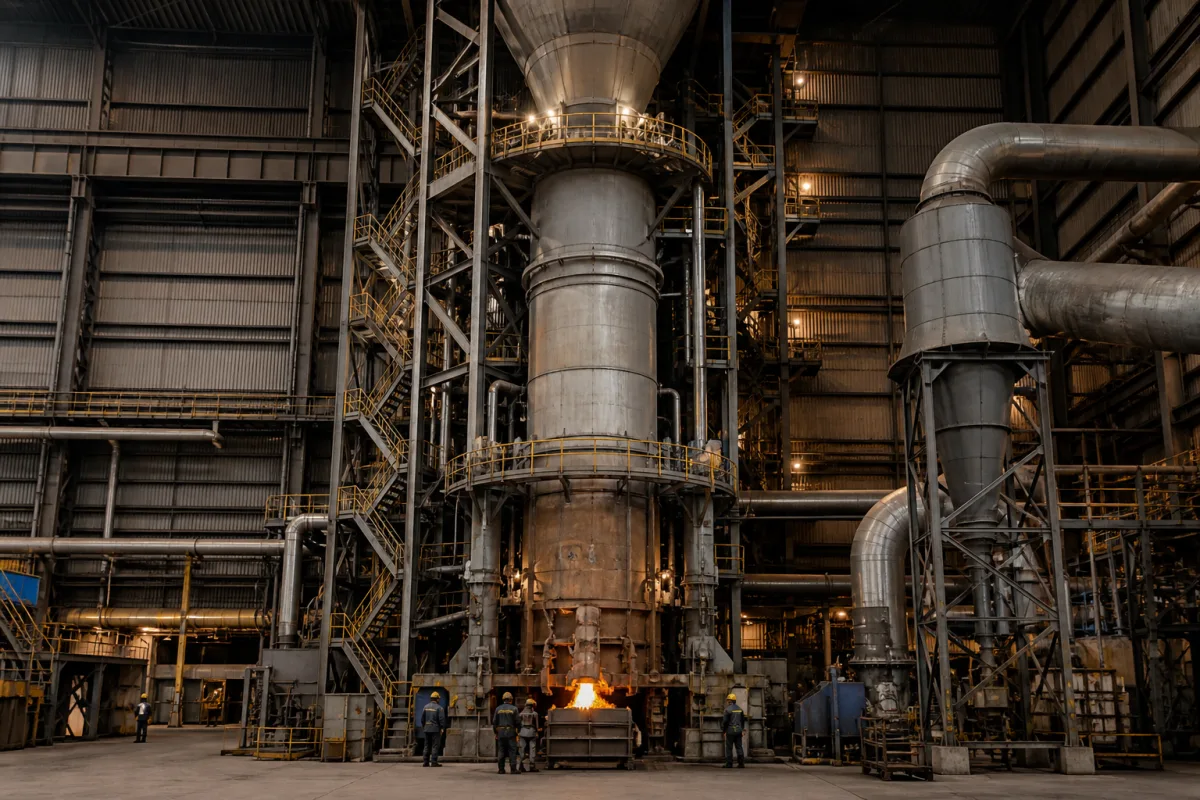
Direct reduction shaft furnaces · Vertical shafts in which iron ore pellets or lump descend against hot hydrogen–carbon monoxide reducing gas to make direct reduced iron (DRI) as cold DRI, hot DRI or hot briquetted iron, with gas reforming, top-gas recycle, module capacity and product carbon
A direct reduction shaft furnace removes oxygen from iron ore in the solid state: pellets or lump ore move down a vertical shaft while hot reducing gas flows up, producing direct reduced iron (DRI) for electric arc furnace steelmaking. Ask three things first: what ore and reducing gas are available, what product form (cold DRI, hot DRI or briquetted iron) and capacity the melt shop needs, and what metallization and carbon the steelmaking requires.
Gas-based direct reduction shaft furnace plants and their reducing gas generation, gas recycle, discharge and briquetting for DRI and HBI. Blast furnaces, rotary-kiln coal-based DRI, electric arc furnaces and pelletizing plants are outside this page.
CNFX editorial research · Sources checked October 11, 2026 · 4 sources
Midrex describes its gas-based process as converting iron ore into DRI through an integrated system of reducing gas generation, a shaft furnace and heat recovery. Iron oxide pellets or lump ore are fed to a vertical shaft furnace and descend by gravity while hot reducing gas flows upward in countercurrent, removing oxygen while the burden keeps its structure; the result is DRI with predictable metallization and carbon. [1]
Midrex says the reducing gas is generated by reforming natural gas or other suitable feedstocks, with shaft furnace top gas recycled within the process to save energy and keep reducing conditions, and that the gas composition can vary, including operation with hydrogen. [1]
Energiron describes its direct reduction process as accepting hydrogen-containing reducing gases (natural gas, syngas, coke oven gas, hydrogen) and various ore qualities, operating at higher pressure for stable DRI quality, producing DRI at high metallization, and letting DRI carbon be set as required to add chemical energy for steelmaking, for cold DRI, hot DRI or HBI. [3]
Give the supplier the ore type (pellets, lump), chemistry and size, available reducing gas or feedstock (natural gas, hydrogen, syngas, coke oven gas) and its composition, target capacity in t/y, product form (CDRI, HDRI, HBI), target metallization and carbon, hot transport or charging to the EAF, utilities, site conditions and emission or carbon capture targets.
02
Size the module capacity and product form
Midrex's process can produce cold DRI (CDRI), hot DRI (HDRI) for hot charging and hot briquetted iron (HBI), and can be designed to switch between these without disruption to suit the melt shop and logistics. [1]
A Midrex case study reports that Hadeed's Module E at Al Jubail, commissioned in late 2007 as a 1.76 million tonne per year HDRI and CDRI plant, became the first single direct reduction module to produce more than 2 million tonnes of DRI in a calendar year. It contrasts this with the earliest plants, designed for nominally 400,000–600,000 t/y, and states that, on nominal values, 1.5 million tonnes of EAF steel needs about 1.75 million tonnes of DRI if no scrap or pig iron is used. [2]
Editorial calculation: 1.76 Mt/y is about 4,820 t/d and 2.0 Mt/y about 5,480 t/d; 1.75 Mt DRI for 1.5 Mt steel is about 1.17 t DRI per tonne of steel. [2]
03
Plan gas volume and blow temperature for hydrogen-rich operation
Nippon Steel's US patent application 2023/0167517 A1 sets out the heat problem of running a shaft furnace on hydrogen. In conventional operation the reducing gas is heated to a blow temperature of about 900–1,000 °C and the burden is close to 100% reduced when it reaches the tuyere level; with an H2/CO ratio of 80/20 to 66/33 and a 900 °C blow, the reducing gas intensity is about 1,200–1,400 Nm³ per tonne of Fe. Because hydrogen reduction absorbs heat, a gas of 90 vol% or more hydrogen needs a blow temperature at least 100 °C higher to run at the same gas intensity, which raises the risk of burden sticking. [4]
The application's remedy adds nitrogen to the hydrogen as a heat carrier: with 330 Nm³/t-Fe of nitrogen, 100 vol% hydrogen can be blown at 900 °C at about 1,500–1,700 Nm³/t-Fe, and nitrogen addition lets the blow temperature drop from 1,000 °C to 900 °C at the same hydrogen intensity. In its simulation, 1,620 Nm³/t-Fe of hydrogen gives 100% reduction; blowing about 450–550 Nm³/t-Fe of that hydrogen cold into the cooling zone keeps reduction at 95% or more and discharges the iron near ambient temperature, so about 500 Nm³/t-Fe, roughly 30% of the total, need not be heated. [4]
Editorial calculation: 500 ÷ 1,620 ≈ 31% of the hydrogen bypasses the gas heater; at the upper conventional figure of 1,400 Nm³/t-Fe, the 1,620 Nm³/t-Fe hydrogen case needs about 16% more reducing gas per tonne of Fe. [4]
Editorial note: for a hydrogen-ready plant, ask the licensor for the gas intensity, blow temperature, heater duty and any inert-gas addition at each hydrogen share you may run.
Ask any technology supplier for the process licence and references, guaranteed capacity, metallization and carbon, gas and energy consumption, product forms and switching, furnace dimensions and operating pressure, reformer or gas heater design, hydrogen capability, emissions and CO2 capture options, and project scope.
Capacity, gas temperature and gas volume can be taken from the Midrex and Nippon Steel figures above; furnace dimensions, lining and design pressure are left for the licensor.
Explore company information and manufacturing capabilities, then discuss the scope of your project with a relevant supplier.
Share this page
Compiled and source-reviewed by the CNFX editorial team.
Each manufacturer above links to the page on that company's own website where the product is listed, with the date we checked it. How we source and review
· Page last updated 13 October 2026
Buyer questions
How does a DRI shaft furnace work?
Midrex: ore descends by gravity while hot H2/CO reducing gas rises in countercurrent, removing oxygen. [1]
Can DRI shaft furnaces run on hydrogen?
Midrex says gas composition can include hydrogen; Energiron lists hydrogen among accepted reducing gases. [1][3]
How large are single DRI modules?
A Midrex case study reports a 1.76 Mt/y module that produced over 2 Mt in one year. [2]
How much hydrogen does a shaft furnace need per tonne of iron?
Nippon Steel's US patent application 2023/0167517 A1 simulates 1,620 Nm³ of hydrogen per tonne of Fe at a 900 °C blow for 100% reduction, against about 1,200–1,400 Nm³/t-Fe of reducing gas for conventional H2/CO operation at 900 °C. [4]