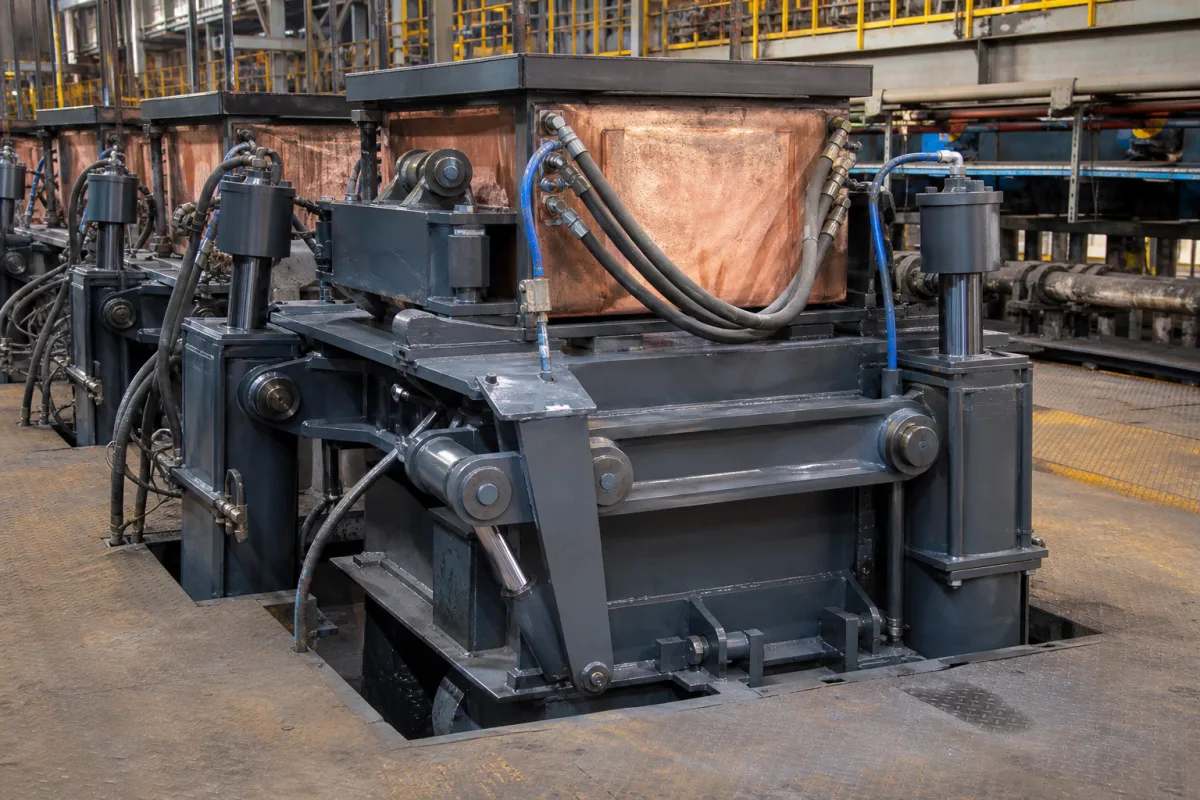
Continuous casting mould oscillators · Hydraulic-cylinder oscillation tables that move the copper mould up and down to stop the shell sticking: stroke, frequency, sinusoidal or non-sinusoidal waveform, negative strip time, cylinder synchronisation and oscillation measurement
A mould oscillator moves the water-cooled copper mould of a continuous caster up and down while the strand is withdrawn, so the solidifying shell does not stick to the mould wall and mould powder can lubricate it. Ask three things first: which caster and mould mass it must carry, what stroke, frequency and waveform range the steel grades need, and how the drive, control and measurement will be arranged.
Mould oscillation tables and drives for slab, bloom and billet continuous casters, with their hydraulic cylinders, guiding, control software and oscillation measurement. Moulds and mould tubes, mould flux (see continuous casting mold flux), the complete caster (see continuous casting machine) and strand guides are outside this page.
CNFX editorial research · Sources checked October 11, 2026 · 4 sources
A 2025 paper in the Journal of the Southern African Institute of Mining and Metallurgy states that the main purpose of mould oscillation is to prevent the billet sticking to the mould wall. It defines negative strip time as the period in each cycle when the mould moves downward relative to the billet. Sinusoidal oscillation depends only on stroke and frequency; non-sinusoidal oscillation adds a modification ratio that shortens negative strip time and oscillation mark depth, lengthens positive strip time to increase powder consumption and lubrication, and reduces friction. [1]
For its proposed waveform at an 8 mm stroke and 120 cycles per minute, the paper reports a 15.9% shorter negative strip time than sinusoidal motion. It finds negative strip time falls as modification ratio, frequency and casting speed rise and grows as stroke rises; in plant use its model reduced mean oscillation mark depth by 10.1 µm and raised flux consumption from 0.37 to 0.45 kg/t. [1]
Primetals states that as casting speed increases, oscillator stroke increases and frequency decreases, and that its OsciCon keeps negative strip time low and stable while increasing positive strip time, applying different oscillation curves to specific steel grades from Level 2 process data. [2]
Editorial calculation: 120 cycles per minute is 2 Hz; a rise in flux consumption from 0.37 to 0.45 kg/t is about 22%. [1]
Give the supplier the caster type (slab, bloom, billet; straight or curved mould), mould and water jacket mass, casting speed range, steel grades, required stroke and frequency range, waveform types (sinusoidal, non-sinusoidal, inverse), hydraulic supply, Level 1 and Level 2 interfaces, measurement and maintenance requirements, and the space in the caster.
02
Specify the drive, control and measurement
Primetals' OsciCon is control software that adjusts stroke, frequency and oscillation pattern online for flat and long product casting, including non-sinusoidal and inverse oscillation. Its feed-forward position control reduces phase shift between cylinders in double-cylinder configurations and avoids non-sinusoidal jerking, and an iterative learning algorithm compensates for wear in hydraulic valves and cylinders across all strokes and frequencies. It can be added to existing oscillators by a control cabinet upgrade. [2]
Primetals says irregular oscillator movement can cause surface defects. Its OsciChecker uses up to four capacitive acceleration sensors to measure mould movement in three directions, reporting stroke, frequency, non-sinusoidal values, negative strip time and percentage, and total harmonic distortion, for straight and curved moulds, with a portable and a wireless version. [3]
03
Coordinate stroke, frequency and casting rate within a window
US patent 4,602,671 A, assigned to Fried Krupp AG (priority 1983), covers sinusoidal oscillation of a rigid horizontal continuous casting mould for steel billets and blooms, for which it cites casting rates of about 1.5 to 4 m/min. It requires a frequency f of at least about 100 cycles/min, an average value of 2fH/V0 (stroke H, casting rate V0) of at least 0.64 so the mould leads the casting, and a negative strip, the distance the mould travels ahead of the casting in each forward movement, of no more than 1 mm and preferably 0.1–0.5 mm. Stroke is limited to 6 mm, preferably 5 mm, and set to 2–4 mm at the 120 cycles/min minimum it prefers. A process computer derives the three values from the casting rate. [4]
Its worked examples show how the window narrows with speed: at 1.5 m/min, 5 mm and 100 cycles/min meet both limits, but 150 cycles/min would push the negative strip above 1 mm; at 2.0 m/min the permitted frequency range moves upward and widens as the stroke shortens. [4]
Editorial calculation: at 1.5 m/min (1,500 mm/min), 5 mm stroke and 100 cycles/min, 2fH/V0 = 2 × 100 × 5 ÷ 1,500 ≈ 0.67, just above the 0.64 minimum. The patent's horizontal-caster limits are not transferable to vertical or curved slab casters, but the method of fixing a stroke–frequency window per casting speed applies to any oscillator specification. [4]
Casting rate (m/min)
Stroke (mm)
Frequency window meeting lead and negative-strip limits (cycles/min)
Moving mass, stroke and frequency range, waveforms and checks to ask any oscillator supplier for
Ask any supplier for rated moving mass, stroke and frequency ranges, waveform capability, cylinder and servo valve type, hydraulic pressure and flow, guiding design and stiffness, position accuracy, control interfaces, measurement tools, spare parts and maintenance intervals, dimensions and weight.
05
Oscillation table, hydraulic cylinders, control software, position control and measurement sensors
On a double-cylinder drive the position control keeps both cylinders in phase; Primetals' OsciCon uses feed-forward position control to cut that phase shift and compensates for wear. [2]
Stroke, frequency, waveform, moving mass and hydraulic supply for an oscillator quotation
Nine of the twelve rows have no published value, and the stroke and frequency figures are one study's 8 mm at 120 cycles per minute, so state your own ranges from your casting speeds. [1]
Explore company information and manufacturing capabilities, then discuss the scope of your project with a relevant supplier.
Share this page
Compiled and source-reviewed by the CNFX editorial team.
Each manufacturer above links to the page on that company's own website where the product is listed, with the date we checked it. How we source and review
· Page last updated 13 October 2026
Buyer questions
Why does a continuous casting mould oscillate?
A 2025 SAIMM paper states the main purpose is to prevent the billet sticking to the mould wall. [1]
What does non-sinusoidal oscillation improve?
It shortens negative strip time and mark depth and lengthens positive strip time for better powder lubrication. [1]
How is mould oscillation checked?
Primetals' OsciChecker measures stroke, frequency and negative strip in three axes with acceleration sensors. [3]
How are stroke and frequency chosen for a given casting speed?
Fried Krupp's US patent 4,602,671 A sets a window per casting rate: for its horizontal caster at 2.0 m/min, a 5 mm stroke needs 130–200 cycles/min and a 2 mm stroke above 320 cycles/min to keep negative strip at or under 1 mm. [4]
Sources and what still needs a direct check
Sources checked 2026-10-11. Primetals Technologies supplies oscillation control and measurement; the SAIMM journal published a study of non-sinusoidal oscillation; Fried Krupp's US patent 4,602,671 A sets stroke–frequency windows for a horizontal caster.