Industry-Verified Manufacturing Data (2026)

Heavy-Duty Rolling Mill Stand

Based on aggregated insights from multiple verified factory profiles within the CNFX directory, the standard Heavy-Duty Rolling Mill Stand used in the Basic Metal Manufacturing sector typically supports operational capacities ranging from standard industrial configurations to heavy-duty production requirements.

Technical Definition & Core Assembly

A canonical Heavy-Duty Rolling Mill Stand is characterized by the integration of Mill Housing and Work Rolls. In industrial production environments, manufacturers listed on CNFX commonly emphasize cast steel housing construction to support stable, high-cycle operation across diverse manufacturing scenarios.

Industrial machine for shaping steel through compression between rotating rolls

Product Specifications

Technical details and manufacturing context for Heavy-Duty Rolling Mill Stand

Definition
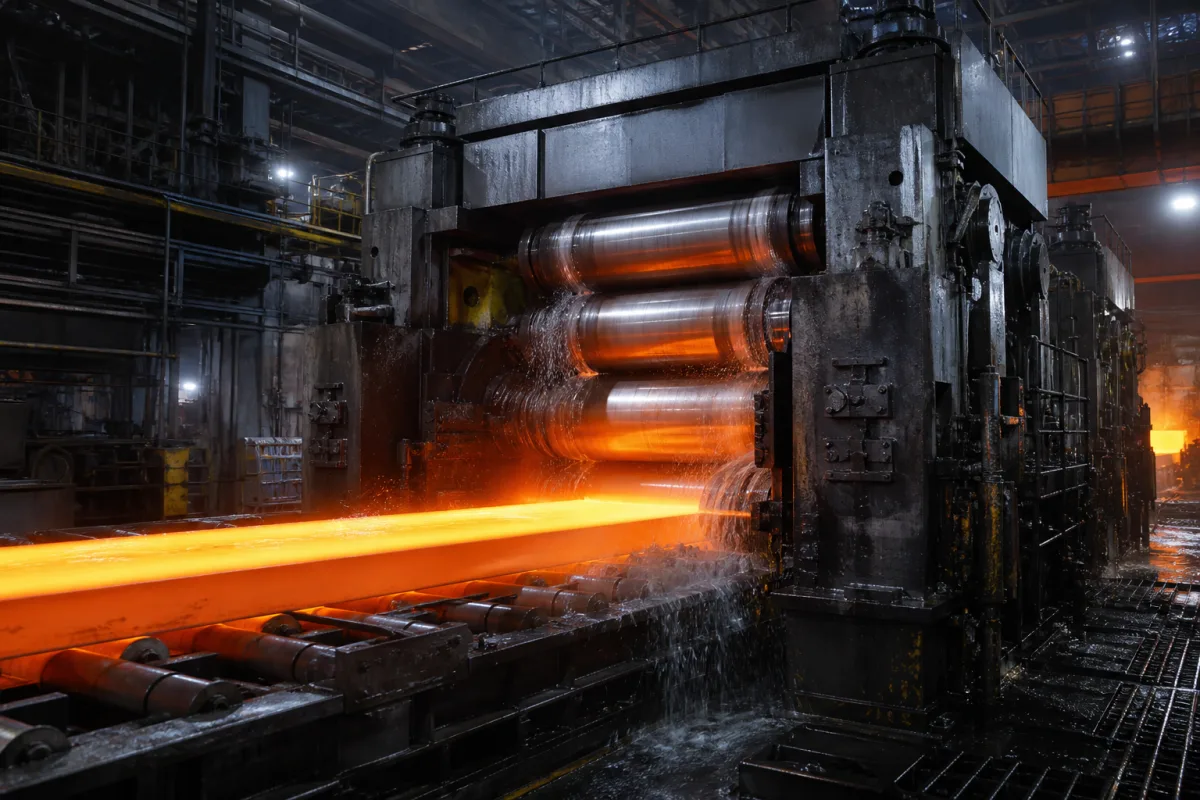
A heavy-duty rolling mill stand is a core industrial machine used in steel production facilities to reduce and shape steel slabs, blooms, or billets into desired cross-sectional profiles. It consists of a rigid frame housing two or more work rolls that apply compressive force to hot or cold steel as it passes through. This machine is essential for producing flat products (plates, sheets) or long products (bars, beams, rails) with precise dimensional tolerances. It operates as a standalone unit that can be integrated into rolling mill lines but is purchased and maintained as individual equipment.
Working Principle
Steel stock is fed between counter-rotating work rolls under high pressure, causing plastic deformation and reduction in thickness or change in cross-section through compressive force.
Common Materials
cast steel housing, forged alloy steel rolls, high-strength bolts, bronze bearings, hardened gear components
Technical Parameters
  • Maximum rolling force capacity (MN) Customizable
  • Main drive motor rating (kW) Customizable
  • Work roll diameter (mm) Customizable
Components / BOM
  • Mill Housing
    Structural frame supporting all components
    Material: Cast Steel
  • Work Rolls
    Direct contact with steel for deformation
    Material: Forged Alloy Steel
  • Roll Bearings
    Support rolls and reduce friction
    Material: Bronze/Composite
  • Screwdown Mechanism
    Precise adjustment of roll gap
    Material: Alloy Steel
  • Roll Chocks
    Housing for roll bearings
    Material: Cast Steel
Engineering Reasoning
Rolling force: 10-40 MN, Rolling speed: 0.5-6.0 m/s, Roll gap: 0.5-50 mm, Temperature: 800-1250°C
Roll neck bearing fatigue at 10^7 cycles under 25 MN load, Roll deflection exceeding 0.15 mm/m at 35 MN, Spindle torque exceeding 2.5 MN·m
Design Rationale: Hertzian contact stress exceeding 1500 MPa in roll neck bearings causes subsurface fatigue cracking, Thermal gradient of 300°C across roll face induces compressive yielding at 450 MPa
Risk Mitigation (FMEA)
Trigger Roll eccentricity exceeding 0.05 mm due to uneven thermal expansion
Mode: Periodic thickness variation of 0.3 mm in strip product
Strategy: Install hydraulic gap control with 0.01 mm resolution and adaptive roll bending compensation
Trigger Lubricant film breakdown at Sommerfeld number < 0.001
Mode: Roll neck bearing seizure at 120°C operating temperature
Strategy: Implement forced oil circulation with 40 L/min flow rate and 40 μm filtration

Industry Taxonomies & Aliases

Commonly used trade names and technical identifiers for Heavy-Duty Rolling Mill Stand.

Industrial Ecosystem & Supply Chain DNA

Complementary Systems
Downstream Applications
Specialized Tooling

Application Fit & Sizing Matrix

Operational Limits
pressure: Up to 5000 kN roll separating force
other spec: Roll speed: 0.1-10 m/s, Material thickness reduction: 20-80% per pass, Maximum strip width: 2000 mm
temperature: Ambient to 1200°C (for hot rolling applications)
Media Compatibility
✓ Carbon steel billets ✓ Stainless steel slabs ✓ Aluminum alloys
Unsuitable: Highly abrasive materials like tungsten carbide or ceramics without specialized roll coatings
Sizing Data Required
  • Required maximum rolling force (kN)
  • Material yield strength and thickness reduction percentage
  • Production throughput (tons/hour) and strip width

Reliability & Engineering Risk Analysis

Failure Mode & Root Cause
Roll bearing fatigue spalling
Cause: Cyclic loading exceeding bearing fatigue limits due to improper preload, contamination ingress, or lubrication breakdown under high radial/axial forces during rolling operations.
Hydraulic cylinder seal extrusion/failure
Cause: Excessive system pressure spikes, misalignment-induced side loading, or incompatible fluid temperatures causing seal hardening/degradation in roll gap adjustment systems.
Maintenance Indicators
  • High-frequency metallic screeching during roll engagement indicating severe bearing distress or lubrication failure
  • Visible hydraulic fluid weeping/streaming from cylinder housings accompanied by erratic roll positioning
Engineering Tips
  • Implement automated oil particle counting with trend analysis to detect bearing wear initiation 200+ hours before catastrophic failure
  • Install pressure transient dampeners on hydraulic systems and conduct quarterly laser alignment checks on all load-bearing components

Compliance & Manufacturing Standards

Reference Standards
ISO 9001:2015 - Quality Management Systems CE Marking - Machinery Directive 2006/42/EC ASTM A36/A36M - Standard Specification for Carbon Structural Steel
Manufacturing Precision
  • Bearing Bore Diameter: +/-0.015mm
  • Roller Parallelism: 0.05mm per meter
Quality Inspection
  • Ultrasonic Testing for Internal Defects
  • Hardness Testing (Rockwell C Scale)

Factories Producing Heavy-Duty Rolling Mill Stand

Verified manufacturers with capability to produce this product in China

✓ 92% Supplier Capability Match Found

P Project Engineer from United States Jan 10, 2026
★★★★★
"Reliable performance in harsh Basic Metal Manufacturing environments. No issues with the Heavy-Duty Rolling Mill Stand so far."
Technical Specifications Verified
S Sourcing Manager from United Arab Emirates Jan 07, 2026
★★★★★
"Testing the Heavy-Duty Rolling Mill Stand now; the Maximum Rolling Force (MN) results are within 1% of the laboratory datasheet."
Technical Specifications Verified
P Procurement Specialist from Australia Jan 04, 2026
★★★★★
"Impressive build quality. Especially the Maximum Rolling Force (MN) is very stable during long-term operation."
Technical Specifications Verified
Verification Protocol

“Feedback is collected from verified sourcing managers during RFQ (Request for Quote) and factory evaluation processes on CNFX. These reports represent historical performance data and technical audit summaries from our B2B manufacturing network.”

15 sourcing managers are analyzing this specification now. Last inquiry for Heavy-Duty Rolling Mill Stand from Germany (55m ago).

Supply Chain Commonly Integrated Components

Infrared Pyrometer

A non-contact temperature measurement device that detects infrared radiation emitted by objects to determine their surface temperature.

Explore Specs →
Signal Processor

Electronic device that conditions, amplifies, filters, and converts raw sensor signals into standardized outputs for temperature measurement systems

Explore Specs →
Purge Air System

A system that provides controlled airflow to clear optical paths and protect sensors in molten metal temperature measurement applications.

Explore Specs →
Degassing Chamber

A specialized vessel within a molten metal degassing system where dissolved gases are removed from molten metal through controlled processes.

Explore Specs →

Frequently Asked Questions

What is the maximum rolling force this heavy-duty rolling mill stand can handle?

This heavy-duty rolling mill stand is designed to handle a maximum rolling force measured in meganewtons (MN), suitable for industrial steel shaping applications in basic iron and steel production.

What materials are used in the construction of this rolling mill stand?

The rolling mill stand features a durable cast steel housing, forged alloy steel rolls for strength, high-strength bolts, bronze bearings for smooth operation, and hardened gear components for longevity.

How is the roll gap adjusted on this industrial rolling mill stand?

The roll gap is precisely adjusted using a screwdown mechanism, allowing for fine control over the compression between rotating rolls to shape steel according to specific production requirements.

Can I contact factories directly on CNFX?

CNFX is an open directory, not a transaction platform. Each factory profile provides direct contact information and production details to help you initiate direct inquiries with Chinese suppliers.

Get Quote for Heavy-Duty Rolling Mill Stand

Request technical pricing, lead times, or customized specifications for Heavy-Duty Rolling Mill Stand directly from verified manufacturing units.

Your business information is encrypted and only shared with verified Heavy-Duty Rolling Mill Stand suppliers.

Thank you! Your message has been sent. We'll respond within 1–3 business days.

Need to Manufacture Heavy-Duty Rolling Mill Stand?

Connect with verified factories specializing in this product category

Add Your Factory Contact Us
Previous Product
Heavy-Duty Rolling Mill Hydraulic Screwdown System
Next Product
Heavy-Duty Rolling Mill Work Roll