Industry-Verified Manufacturing Data (2026)

Rolling Mill Stand Housing

Based on aggregated insights from multiple verified factory profiles within the CNFX directory, the standard Rolling Mill Stand Housing used in the Basic Metal Manufacturing sector typically supports operational capacities ranging from standard industrial configurations to heavy-duty production requirements.

Technical Definition & Core Assembly

A canonical Rolling Mill Stand Housing is characterized by the integration of Column and Window Liner. In industrial production environments, manufacturers listed on CNFX commonly emphasize Cast Steel construction to support stable, high-cycle operation across diverse manufacturing scenarios.

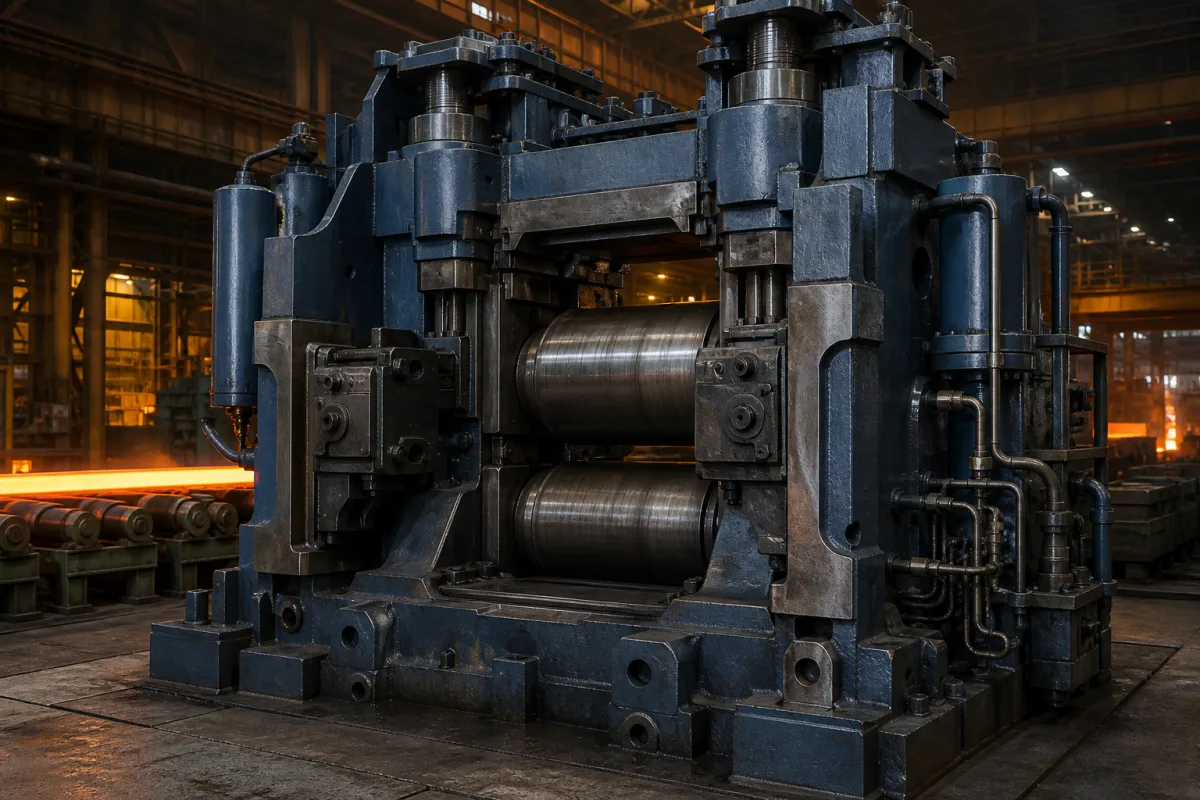
The structural frame that supports and contains the rolls, bearings, and adjustment mechanisms of a rolling mill stand.
Product Specifications

Technical details and manufacturing context for Rolling Mill Stand Housing

Definition
In a Finishing Mill Train, the Rolling Mill Stand Housing is the robust, stationary structural component that forms the main body of each rolling stand. It provides the rigid foundation necessary to withstand the immense forces generated during metal rolling operations, ensuring precise alignment and stability of the work rolls, backup rolls, and associated equipment. The housing maintains dimensional accuracy and prevents deflection under load, which is critical for producing metal products with consistent thickness and surface quality.
Working Principle
The housing functions as a load-bearing structure. It transfers the rolling forces from the rolls through its columns and windows to the mill foundation. It is designed with high stiffness to minimize elastic deformation under the separating forces generated when metal is compressed between the rolls. The housing typically incorporates windows or openings that allow for the installation, removal, and adjustment of the roll assemblies and their chocks.
Common Materials
Cast Steel, Forged Steel
Technical Parameters
  • Window dimensions (width and height) to accommodate roll chocks and allow for roll changes. (mm) Per Request
Components / BOM
  • Column
    The vertical structural members that bear the primary rolling load and connect the top and bottom crossheads.
    Material: Cast Steel
  • Window Liner
    Wear plates installed on the inner surfaces of the housing window to protect against abrasion from the roll chocks.
    Material: Hardened Steel
  • Screwdown Mechanism Mounting Pad
    The machined surface on the top crosshead for attaching the mechanism that adjusts the vertical position of the top roll.
    Material: Forged Steel
Engineering Reasoning
0-500 MPa compressive stress, -20°C to 200°C temperature
Yield strength exceedance at 550 MPa (ASTM A36 steel), crack propagation beyond 2 mm depth (Paris' Law threshold)
Design Rationale: High-cycle fatigue from cyclic rolling loads exceeding 10^7 cycles at 300 kN roll force, stress concentration at housing window corners (Kt=3.2)
Risk Mitigation (FMEA)
Trigger Roll eccentricity exceeding 0.1 mm TIR
Mode: Resonant vibration at 85-120 Hz causing housing bolt loosening
Strategy: Dynamic balancing of rolls to 0.05 mm TIR, housing natural frequency tuning to 150 Hz via rib stiffening
Trigger Thermal gradient of 150°C across housing cross-section
Mode: Differential thermal expansion causing 0.5 mm housing distortion
Strategy: Integrated cooling channels maintaining ΔT<50°C, Inconel 718 thermal barrier coating

Industry Taxonomies & Aliases

Commonly used trade names and technical identifiers for Rolling Mill Stand Housing.

Applied To / Applications

This component is essential for the following industrial systems and equipment:

Industrial Ecosystem & Supply Chain DNA

Complementary Systems
Downstream Applications
Specialized Tooling

Application Fit & Sizing Matrix

Operational Limits
pressure: Up to 50 MPa (static load), up to 100 MPa (dynamic shock load)
other spec: Roll separating force: 10-50 MN typical, roll bending moment: 1-10 MN·m, vibration tolerance: <0.5 mm displacement at 10-100 Hz
temperature: Ambient to 150°C (operational), up to 300°C (peak during hot rolling)
Media Compatibility
✓ Hot steel billets/slabs (900-1250°C) ✓ Cold steel strip/sheet (ambient to 200°C) ✓ Non-ferrous metals (aluminum, copper alloys)
Unsuitable: Highly corrosive chemical environments (e.g., acid pickling lines, chlorine exposure)
Sizing Data Required
  • Maximum roll separating force (MN)
  • Roll barrel length and diameter (mm)
  • Required mill stiffness (MN/mm) for product tolerance

Reliability & Engineering Risk Analysis

Failure Mode & Root Cause
Fatigue cracking
Cause: Cyclic loading from rolling forces and thermal stresses, exacerbated by stress concentrations at geometric transitions or weld seams.
Bearing seat wear/loosening
Cause: Inadequate lubrication, contamination ingress, or improper bearing fit leading to fretting, abrasion, and loss of interference fit.
Maintenance Indicators
  • Visible cracks or spalling on housing surfaces, especially near load-bearing areas or weld joints.
  • Abnormal vibration or audible knocking during operation, indicating bearing instability or structural looseness.
Engineering Tips
  • Implement regular non-destructive testing (e.g., ultrasonic or magnetic particle inspection) to detect early-stage cracks before propagation.
  • Maintain strict contamination control in lubrication systems and ensure proper bearing installation with verified interference fits and alignment.

Compliance & Manufacturing Standards

Reference Standards
ISO 9001:2015 Quality Management Systems ASTM A36/A36M Standard Specification for Carbon Structural Steel CE Marking for Machinery Directive 2006/42/EC
Manufacturing Precision
  • Bore Diameter: +/-0.05mm
  • Surface Flatness: 0.08mm per meter
Quality Inspection
  • Ultrasonic Testing for Internal Defects
  • Dimensional Verification with CMM

Factories Producing Rolling Mill Stand Housing

Verified manufacturers with capability to produce this product in China

✓ 95% Supplier Capability Match Found

P Project Engineer from Brazil Feb 06, 2026
★★★★★
"Found 23+ suppliers for Rolling Mill Stand Housing on CNFX, but this spec remains the most cost-effective."
Technical Specifications Verified
S Sourcing Manager from Canada Feb 03, 2026
★★★★★
"The technical documentation for this Rolling Mill Stand Housing is very thorough, especially regarding technical reliability."
Technical Specifications Verified
P Procurement Specialist from United States Jan 31, 2026
★★★★★
"Reliable performance in harsh Basic Metal Manufacturing environments. No issues with the Rolling Mill Stand Housing so far."
Technical Specifications Verified
Verification Protocol

“Feedback is collected from verified sourcing managers during RFQ (Request for Quote) and factory evaluation processes on CNFX. These reports represent historical performance data and technical audit summaries from our B2B manufacturing network.”

16 sourcing managers are analyzing this specification now. Last inquiry for Rolling Mill Stand Housing from UAE (50m ago).

Supply Chain Compatible Machinery & Devices

Vacuum Induction Melting Furnace

Industrial furnace for melting metals under vacuum using electromagnetic induction

Explore Specs →
Electroslag Remelting Furnace

Secondary refining furnace for high-quality metal ingots

Explore Specs →
Molten Metal Flow Control Valve

Precision valve for regulating molten metal flow in casting and pouring operations.

Explore Specs →
Molten Metal Temperature Measurement System

Automated system for continuous temperature monitoring of molten metals during processing.

Explore Specs →

Frequently Asked Questions

What is the primary function of a rolling mill stand housing?

The rolling mill stand housing serves as the structural frame that supports and contains all critical components including rolls, bearings, and adjustment mechanisms, ensuring stability and precision during metal forming operations.

What materials are typically used for rolling mill stand housings?

Rolling mill stand housings are commonly manufactured from cast steel or forged steel, chosen for their exceptional strength, durability, and ability to withstand the extreme forces and stresses of metal rolling processes.

What are the key components (BOM) of a rolling mill stand housing?

Key components include the Column (main vertical support), Window Liner (internal wear surface), and Screwdown Mechanism Mounting Pad (attachment point for roll gap adjustment systems), forming a complete structural assembly.

Can I contact factories directly on CNFX?

CNFX is an open directory, not a transaction platform. Each factory profile provides direct contact information and production details to help you initiate direct inquiries with Chinese suppliers.

Get Quote for Rolling Mill Stand Housing

Request technical pricing, lead times, or customized specifications for Rolling Mill Stand Housing directly from verified manufacturing units.

Your business information is encrypted and only shared with verified Rolling Mill Stand Housing suppliers.

Thank you! Your message has been sent. We'll respond within 1–3 business days.

Need to Manufacture Rolling Mill Stand Housing?

Connect with verified factories specializing in this product category

Add Your Factory Contact Us
Previous Product
Roll Gap Adjustment System
Next Product
Rolling Stand