Industry-Verified Manufacturing Data (2026)

Rolls (Work Rolls)

Based on aggregated insights from multiple verified factory profiles within the CNFX directory, the standard Rolls (Work Rolls) used in the Basic Metal Manufacturing sector typically supports operational capacities ranging from standard industrial configurations to heavy-duty production requirements.

Technical Definition & Core Assembly

A canonical Rolls (Work Rolls) is characterized by the integration of Barrel and Neck (Journal). In industrial production environments, manufacturers listed on CNFX commonly emphasize Forged alloy steel construction to support stable, high-cycle operation across diverse manufacturing scenarios.

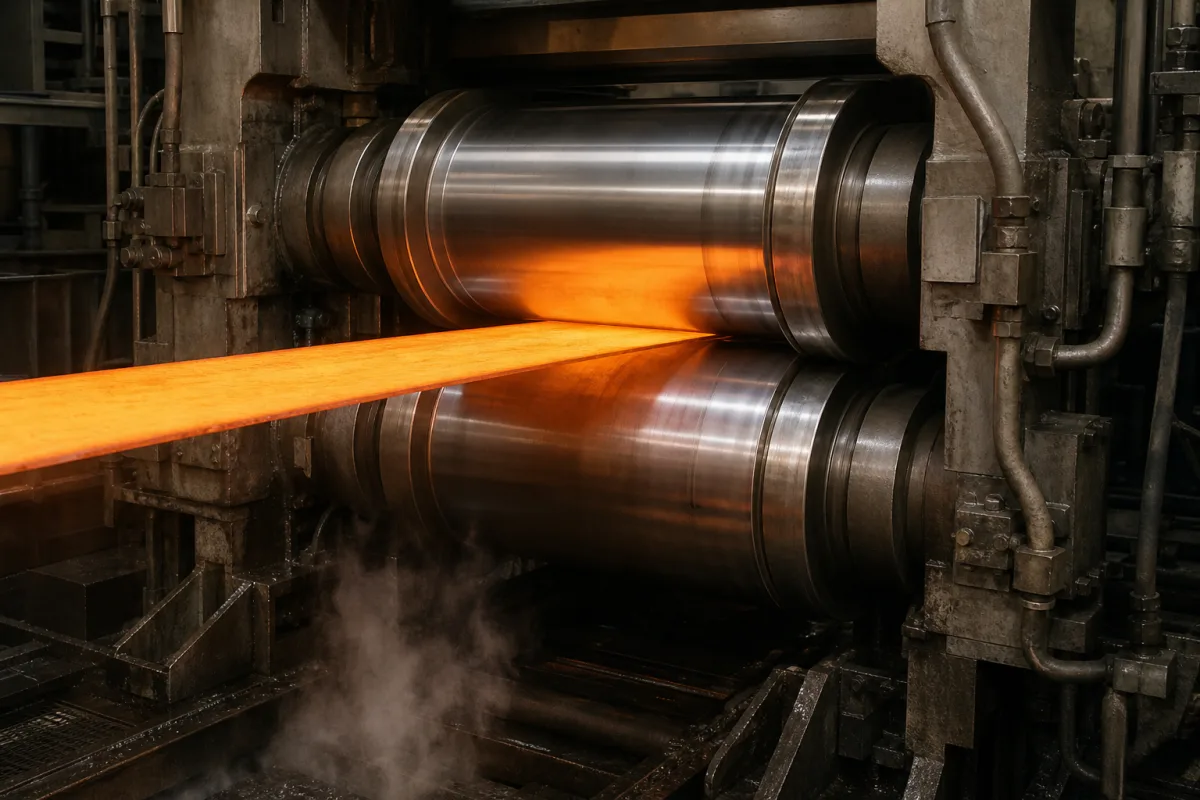
The primary rotating cylinders in a rolling mill that directly contact and deform the metal workpiece.
Product Specifications

Technical details and manufacturing context for Rolls (Work Rolls)

Definition
Work rolls are the central components in a multi-stand rolling mill responsible for applying compressive force to reduce the thickness, shape, or improve the surface finish of metal strips, plates, or bars as they pass through successive stands. They are mounted in pairs within each stand and are driven to rotate, pulling the material through the mill.
Working Principle
Work rolls are powered to rotate in opposite directions. The metal workpiece is fed into the gap (the roll bite) between them. The compressive force generated by the rolls, combined with friction, reduces the workpiece's cross-sectional area and elongates it. In a multi-stand mill, the workpiece undergoes incremental deformation through a series of these roll pairs, with each stand set to a progressively smaller gap.
Common Materials
Forged alloy steel, Indefinite chill double-pour (ICDP) iron, High-speed steel (HSS), Tungsten carbide
Technical Parameters
  • Barrel length and diameter, which define the maximum width and reduction capability of the material being rolled. (mm) Customizable
Components / BOM
  • Barrel
    The central cylindrical body that directly contacts and deforms the metal workpiece.
    Material: Alloy steel / Cast iron / HSS
  • Neck (Journal)
    The reduced-diameter ends that rotate within the mill housing bearings, supporting the roll and transmitting torque.
    Material: Alloy steel
  • Wobbler End
    A specially shaped end (e.g., with a tongue or fork) that connects to the spindle or coupling to receive driving torque from the mill drive.
    Material: Alloy steel
Engineering Reasoning
Contact pressure: 800-1200 MPa, Surface temperature: 150-300°C, Rotational speed: 100-600 rpm
Hertzian contact stress exceeding 1400 MPa, Surface temperature exceeding 350°C, Surface roughness exceeding Ra 0.8 μm
Design Rationale: Thermal fatigue from cyclic heating/cooling during rolling contact, Spalling due to subsurface shear stress exceeding material yield strength (typically 1000-1200 MPa for forged steel rolls), Surface oxidation at temperatures above 300°C accelerating wear
Risk Mitigation (FMEA)
Trigger Insufficient cooling water flow rate below 50 L/min per meter of roll face width
Mode: Thermal crown development exceeding 0.15 mm/meter of roll length
Strategy: Closed-loop cooling system with flow sensors and automatic pressure compensation to maintain 70-100 L/min flow
Trigger Workpiece entry temperature exceeding 1250°C for carbon steel rolling
Mode: Surface heat checking with crack depth propagation beyond 2 mm
Strategy: Infrared pyrometer feedback to mill control system with automatic roll gap adjustment when temperature exceeds 1200°C

Industry Taxonomies & Aliases

Commonly used trade names and technical identifiers for Rolls (Work Rolls).

Applied To / Applications

This component is essential for the following industrial systems and equipment:

Industrial Ecosystem & Supply Chain DNA

Complementary Systems
Downstream Applications
Specialized Tooling

Application Fit & Sizing Matrix

Operational Limits
pressure: Up to 3000 MPa (contact pressure during metal deformation)
other spec: Surface hardness: 60-85 HRC, Diameter tolerance: ±0.1 mm, Surface finish: Ra 0.2-0.8 μm
temperature: 20°C to 300°C (operating range, depends on cooling system and rolling process)
Media Compatibility
✓ Hot steel rolling (carbon/alloy steels) ✓ Cold rolling of aluminum alloys ✓ Copper/brass strip rolling
Unsuitable: Highly abrasive materials without proper lubrication (e.g., tungsten alloys with inadequate coolant)
Sizing Data Required
  • Roll diameter and barrel length (based on mill type and product width)
  • Required surface hardness and material grade (e.g., forged steel, high-chrome iron)
  • Maximum rolling force and torque capacity

Reliability & Engineering Risk Analysis

Failure Mode & Root Cause
Surface spalling and fatigue cracking
Cause: Cyclic thermal and mechanical stresses from repeated contact with hot metal during rolling operations, leading to subsurface crack initiation and propagation
Roll neck bearing failure
Cause: Inadequate lubrication, contamination ingress, or improper bearing installation causing excessive friction, overheating, and premature wear
Maintenance Indicators
  • Audible grinding or knocking noises from roll assembly during operation
  • Visible surface irregularities or scoring on roll body indicating material degradation
Engineering Tips
  • Implement precision grinding and surface finishing protocols to maintain optimal roll profile and minimize stress concentrations
  • Establish rigorous lubrication management program with scheduled oil analysis and contamination control measures

Compliance & Manufacturing Standards

Reference Standards
ISO 9001:2015 - Quality management systems ASTM A681 - Standard Specification for Tool Steels Alloy DIN 1543 - Steel for forgings; technical delivery conditions
Manufacturing Precision
  • Bore diameter: +/-0.02mm
  • Surface runout: 0.05mm per meter length
Quality Inspection
  • Ultrasonic Testing for internal defects
  • Hardness testing (Rockwell C scale) for material consistency

Factories Producing Rolls (Work Rolls)

Verified manufacturers with capability to produce this product in China

✓ 96% Supplier Capability Match Found

P Procurement Specialist from Australia Jan 27, 2026
★★★★★
"As a professional in the Basic Metal Manufacturing sector, I confirm this Rolls (Work Rolls) meets all ISO standards."
Technical Specifications Verified
T Technical Director from Singapore Jan 24, 2026
★★★★★
"Standard OEM quality for Basic Metal Manufacturing applications. The Rolls (Work Rolls) arrived with full certification."
Technical Specifications Verified
P Project Engineer from Germany Jan 21, 2026
★★★★★
"Great transparency on the Rolls (Work Rolls) components. Essential for our Basic Metal Manufacturing supply chain."
Technical Specifications Verified
Verification Protocol

“Feedback is collected from verified sourcing managers during RFQ (Request for Quote) and factory evaluation processes on CNFX. These reports represent historical performance data and technical audit summaries from our B2B manufacturing network.”

11 sourcing managers are analyzing this specification now. Last inquiry for Rolls (Work Rolls) from UAE (17m ago).

Supply Chain Compatible Machinery & Devices

Continuous Casting Machine

Industrial machine for solidifying molten metal into continuous billets/blooms/slabs.

Explore Specs →
Electromagnetic Induction Heater

Industrial heating device using electromagnetic induction for metal processing

Explore Specs →
Vacuum Induction Melting Furnace

Industrial furnace for melting metals under vacuum using electromagnetic induction

Explore Specs →
Electroslag Remelting Furnace

Secondary refining furnace for high-quality metal ingots

Explore Specs →

Frequently Asked Questions

What are the main components of a work roll in a rolling mill?

Work rolls consist of three primary components: the barrel (which contacts and deforms the metal), the neck or journal (which supports the roll in bearings), and the wobbler end (which transmits torque from the drive system).

When should I choose tungsten carbide work rolls over forged steel rolls?

Tungsten carbide work rolls offer exceptional wear resistance and are ideal for high-speed rolling of hard metals or when extended service life is critical. Forged steel rolls provide better toughness for heavy reduction applications.

How does ICDP iron compare to high-speed steel for work roll materials?

ICDP (Indefinite Chill Double-Pour) iron provides excellent thermal fatigue resistance and is cost-effective for hot rolling applications. High-speed steel (HSS) offers superior hardness and wear resistance, making it suitable for both hot and cold rolling of demanding materials.

Can I contact factories directly on CNFX?

CNFX is an open directory, not a transaction platform. Each factory profile provides direct contact information and production details to help you initiate direct inquiries with Chinese suppliers.

Get Quote for Rolls (Work Rolls)

Request technical pricing, lead times, or customized specifications for Rolls (Work Rolls) directly from verified manufacturing units.

Your business information is encrypted and only shared with verified Rolls (Work Rolls) suppliers.

Thank you! Your message has been sent. We'll respond within 1–3 business days.

Need to Manufacture Rolls (Work Rolls)?

Connect with verified factories specializing in this product category

Add Your Factory Contact Us
Previous Product
Rolling Stand
Next Product
Roof