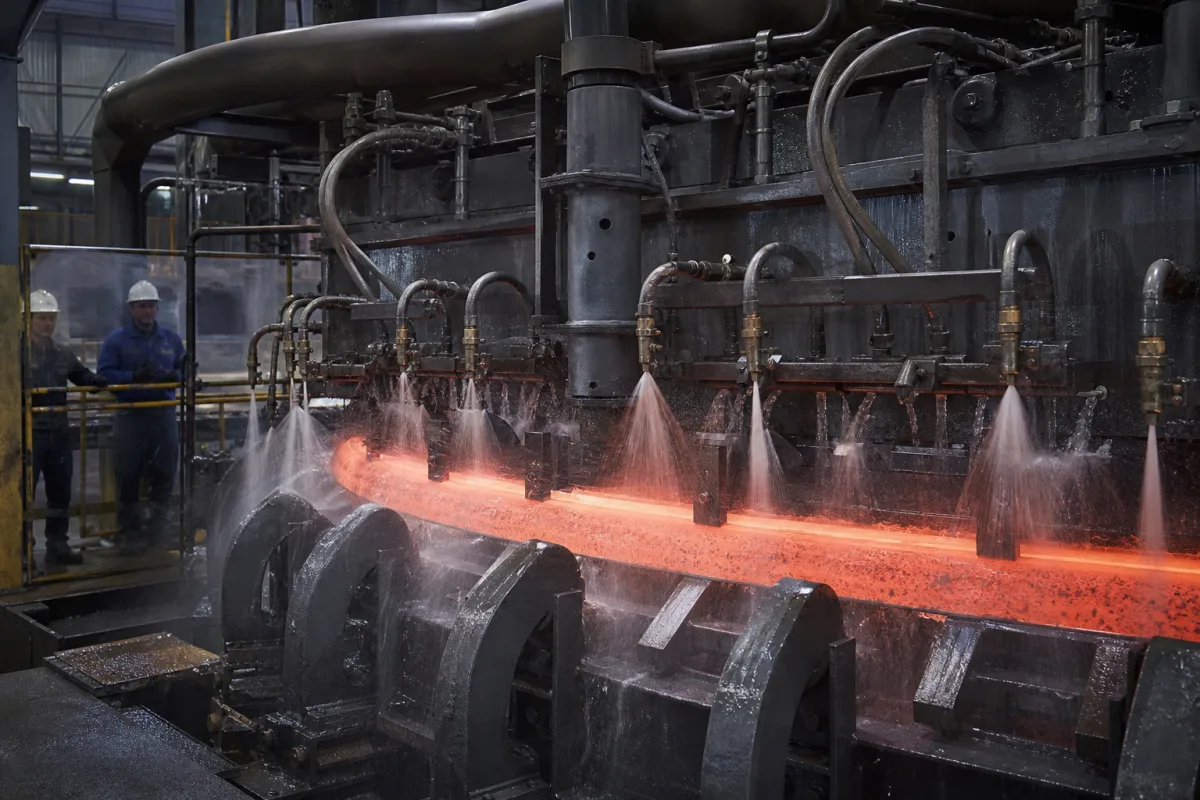
Secondary cooling (spray) zone of a continuous caster
Continuous caster spray cooling · air-mist and water-only nozzles, spray headers, turndown, heat transfer and compressed air
The secondary cooling zone is the part of a continuous caster below the mould where rows of spray nozzles on headers between the support rolls cool the strand surface with water or an air-water mist until the shell is thick enough. Ask three things first: whether the zone uses water-only or air-mist nozzles, what water turndown each control loop needs from the slowest to the fastest casting speed, and how much compressed air and water the zone will draw.
Secondary cooling (spray cooling) zones of billet, bloom and slab continuous casters: spray nozzles, spray headers, cooling loops and their water and air supply. Complete casting machines, including caster sizing by section, speed and strand count, are covered on the Billet continuous caster page. Mould cooling and the plant water treatment system are outside this page.
CNFX editorial research · Sources checked October 12, 2026 · 4 sources
Lechler states that it offers nozzles for water-only cooling and air-mist systems across billet, bloom, beam blank and slab casters, as single-fluid nozzles with flat or full cone sprays and twin-fluid nozzles, together with spray headers for secondary cooling zones. [2] Spraying Systems likewise offers air-mist nozzles and hydraulic full cone, rectangular, oval and flat spray nozzles for billets, blooms and slabs. [4]
Spraying Systems' technical brief TB200 explains why pattern stability matters for hydraulic nozzles: a traditional round full cone gives less coverage at 20 psi than at 60 and 100 psi, and a square-pattern full cone rotates as pressure rises and turns star-shaped by 400 psi, which can leave hot spots. It reports that in independent tests its HHX full cone nozzle reached a maximum heat transfer coefficient 34% higher than traditional and competitor full cone nozzles, measured on a heated sample at surface temperatures from 650 to 850 °C. [3]
Editorial note: compare nozzles on measured liquid distribution and heat transfer coefficient at your operating pressures, not on catalogue spray angle alone, and ask how the nozzles are protected from mould flux and debris; TB200 describes a low-profile socket design to keep debris off the nozzle. [3]
Give the supplier the caster type and section, casting speed range, steel grades, number of cooling loops, segment and roll layout, nozzle spacing and spray height, water and air pressures available, water quality, and the cooling curves or specific water ratios you run.
02
Check water turndown and air use across the speed range
Lechler and Montanuniversität Leoben tested air-mist nozzles for slab casting on the university's nozzle measuring stand, with a 950 °C start temperature, 2 m/min sample speed and 130 mm spray height, at five water–air pressure pairs from 0.5/1 bar to 10/3 bar. Against the earlier design, the new nozzle reduced air consumption by 30–40% at water flows of 1–10 l/min (size 3) and by 20–25% at 2–15 l/min (size 5) for equivalent cooling performance. [1]
The authors also note that there is no standard for water turndown ratio and that it does not by itself describe water distribution or cooling efficiency. Their example assumes a two-strand slab caster with 16,000 m³/h maximum compressed air capacity, running on average at 50% of that for 20 hours a day on 300 days a year. [1] Editorial calculation: 16,000 × 0.5 × 20 × 300 = 48,000,000 m³ of air a year; a 30% saving is 14,400,000 m³ a year.
Editorial note: ask the supplier for pressure–flow curves of each nozzle size at your air pressure, and for the lowest water flow at which the spray pattern and distribution stay within tolerance, and compare it with the water flow your slowest casting speed needs.
03
Lay out headers, loops and supply
Lechler supplies spray headers made for secondary cooling zones, and both Lechler and Spraying Systems describe nozzle selection as tied to the cooling strategy, steel grade and caster type. [2][4]
Spraying Systems states that the arrangement and control of spray nozzles determine cooling intensity and distribution, and that different grades and formats need different cooling profiles to limit thermal stress. [4] TB200 notes that HHX nozzle capacities can be changed without major changes to the manifold or segment, and lists 1/4, 3/8 and 1/2 inch sizes. [3]
04
Nozzles, headers, separately controlled loops and test data to ask a spray-zone supplier for
Ask each supplier which nozzles, headers and control valves are included, which loops are controlled separately, and what test data supports the cooling performance quoted.
05
Nozzles, headers, cooling loops, atomizing air, filtered water and spray chamber
Water flow per loop, water and air pressure, zone length and cooling curve for a caster spray zone
The pressures in this table come from the Leoben nozzle-stand tests (0.5–10 bar water, 1–3 bar air); cooling capacity and cooling rate depend on your grade and casting speed and need the supplier's HTC data. [1]
Field
What it means and published values
Ask the supplier for
Cooling Capacity (kW)
Heat removed from the strand; set by water, pattern and HTC. [3]
HTC data at your conditions.
Cooling Water Flow Rate (m³/h)
Per loop and total; tests used 1–15 l/min per nozzle. [1]
Paste it into your enquiry below or into an email to a maker, then replace every bracket.
Caster: [type; section; strands; speed range]
Grades: [steel grades; cooling curves]
Nozzles: [water-only or air-mist; size; spray height]
Loops: [number; water flow range per loop]
Supply: [water pressure and quality; air pressure and capacity]
Headers: [layout; spacing; material]
Documents: [pressure–flow curves; distribution and HTC test data]
1 company lists this product among what they make. Company figures are quoted from each
company's own website; every card states where the relationship came from.
Tai'an Hualu Equipment Technology Group Co.,Ltd.
Manufacturing site to be confirmed for the order
Lists secondary cooling zone equipment for continuous casting among its metallurgical equipment.
Explore company information and manufacturing capabilities, then discuss the scope of your project with a relevant supplier.
Share this page
Compiled and source-reviewed by the CNFX editorial team.
Each manufacturer above links to the page on that company's own website where the product is listed, with the date we checked it. How we source and review
· Page last updated 13 October 2026
Buyer questions
How much air can new air-mist nozzles save?
Lechler and Montanuniversität Leoben measured 30–40% lower air use at 1–10 l/min water, and 20–25% at 2–15 l/min for a larger size, at equivalent cooling performance. [1]
Why does nozzle pattern stability matter?
Spraying Systems shows full cone coverage changing between 20 and 100 psi and square patterns rotating and turning star-shaped by 400 psi, which can leave hot spots. [3]
Is there a standard water turndown ratio?
Lechler's paper states there is no standardization for water turndown ratio and no direct correlation to distribution or cooling efficiency. [1]
Sources and what still needs a direct check
Sources checked 2026-10-12. Lechler and Spraying Systems are spray nozzle makers; the Lechler paper reports tests at Montanuniversität Leoben's nozzle measuring stand presented at AISTech 2018. Figures are for the nozzles and conditions named.