Industry-Verified Manufacturing Data (2026)

Separation Chamber / Launder

Based on aggregated insights from multiple verified factory profiles within the CNFX directory, the standard Separation Chamber / Launder used in the Basic Metal Manufacturing sector typically supports operational capacities ranging from standard industrial configurations to heavy-duty production requirements.

Technical Definition & Core Assembly

A canonical Separation Chamber / Launder is characterized by the integration of Refractory Lining and Flow Control Weir. In industrial production environments, manufacturers listed on CNFX commonly emphasize Refractory Lined Steel construction to support stable, high-cycle operation across diverse manufacturing scenarios.

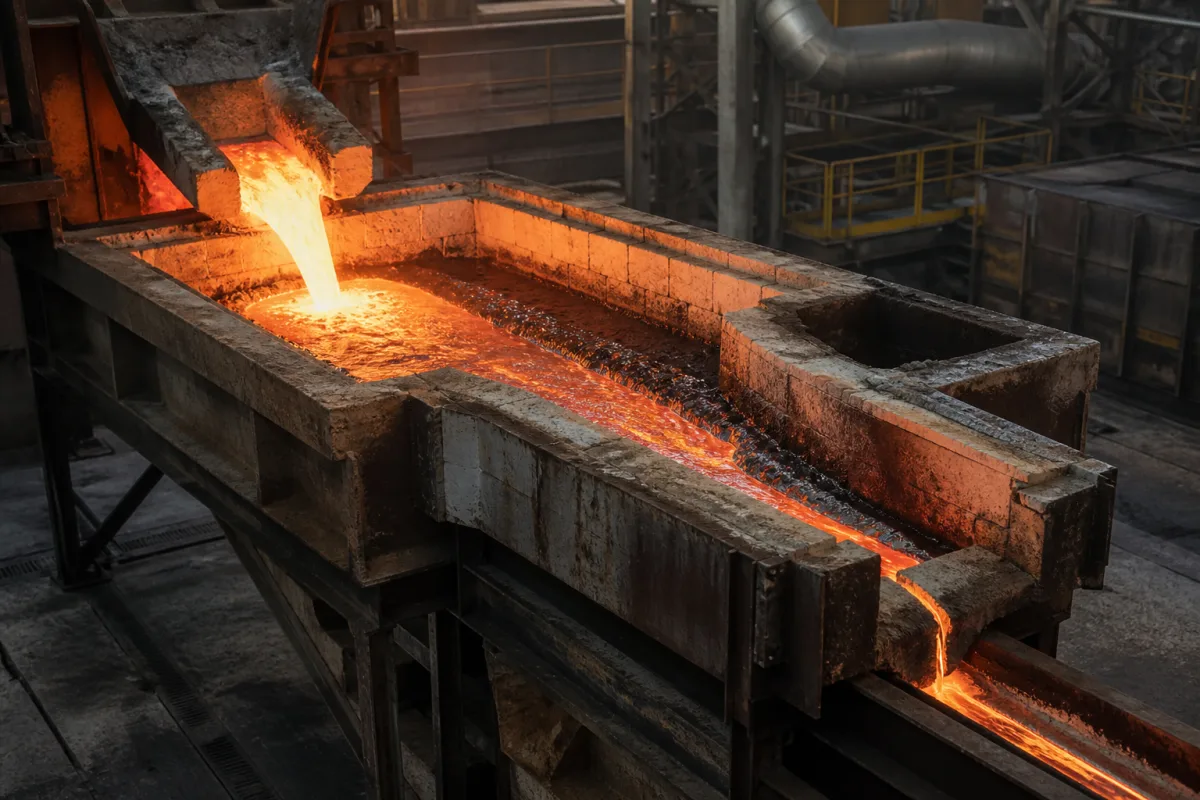
A component within a Slag Separation Unit designed to facilitate the separation of molten slag from metal through controlled flow and settling.
Product Specifications

Technical details and manufacturing context for Separation Chamber / Launder

Definition
The Separation Chamber/Launder is a critical part of the Slag Separation Unit in metallurgical processes. It serves as a channel or chamber where molten materials (typically slag and metal) are directed after initial processing. The design allows for controlled flow velocity and residence time, enabling the separation of lighter slag from denser metal through gravity settling. The chamber/launder may include features like weirs, baffles, or temperature control elements to optimize separation efficiency.
Working Principle
Molten material flows through the chamber/launder at a controlled rate. Due to differences in density between slag (lighter) and metal (denser), gravity causes the metal to settle toward the bottom while slag floats to the top. The geometry and flow control features of the chamber/launder enhance this natural separation, allowing for efficient collection of separated materials at different outlets.
Common Materials
Refractory Lined Steel
Technical Parameters
  • Internal dimensions (length, width, depth) critical for flow control and residence time. (mm) Per Request
Components / BOM
  • Refractory Lining
    Provides thermal insulation and protects the steel structure from high-temperature molten materials
    Material: Refractory Ceramic
  • Flow Control Weir
    Regulates the depth and velocity of molten material flow within the chamber
    Material: Refractory or High-Temperature Alloy
  • Slag Outlet
    Channel for removing separated slag from the top of the chamber
    Material: Refractory Lined Steel
  • Metal Outlet
    Channel for removing separated metal from the bottom of the chamber
    Material: Refractory Lined Steel
Engineering Reasoning
0.1-0.5 m/s flow velocity, 1200-1500°C temperature, 0.5-2.0 m³/min throughput
Flow velocity exceeding 0.8 m/s causes turbulent mixing preventing separation, temperature below 1150°C causes slag solidification, temperature above 1550°C causes refractory erosion >5 mm/hour
Design Rationale: Stokes' law settling failure at Reynolds number >2000, refractory spalling due to thermal expansion coefficient mismatch (α_refractory=6.5×10⁻⁶/K vs α_shell=12×10⁻⁶/K), slag viscosity reduction below 0.5 Pa·s causing boundary layer disruption
Risk Mitigation (FMEA)
Trigger Thermal cycling exceeding 300°C/hour gradient
Mode: Refractory lining crack propagation >10 mm depth
Strategy: Multilayer refractory design with graded expansion coefficients (inner: 4.5×10⁻⁶/K, middle: 7.2×10⁻⁶/K, outer: 10.8×10⁻⁶/K)
Trigger Slag basicity (CaO/SiO₂ ratio) deviation beyond 1.2-1.8 range
Mode: Viscosity change causing interface instability and metal entrainment >3%
Strategy: Real-time XRF composition monitoring with automated flux addition system (CaO/SiO₂ control within ±0.1)

Industry Taxonomies & Aliases

Commonly used trade names and technical identifiers for Separation Chamber / Launder.

Applied To / Applications

This component is essential for the following industrial systems and equipment:

Industrial Ecosystem & Supply Chain DNA

Complementary Systems
Downstream Applications
Specialized Tooling

Application Fit & Sizing Matrix

Operational Limits
pressure: Atmospheric to 0.5 bar gauge (low pressure, gravity-driven flow)
flow rate: 5-50 m³/h (depends on chamber dimensions and slag properties)
temperature: 800-1600°C (typical molten slag/metal processing range)
slurry concentration: Up to 60% solids by weight (slag particles in molten metal)
Media Compatibility
✓ Molten ferrous slag (steelmaking) ✓ Molten non-ferrous slag (copper, aluminum) ✓ High-temperature ceramic-lined systems
Unsuitable: Chloride-containing environments (risk of corrosive attack on refractory linings)
Sizing Data Required
  • Required slag throughput (tons/hour)
  • Metal-slag density difference (kg/m³)
  • Required residence time for separation (seconds)

Reliability & Engineering Risk Analysis

Failure Mode & Root Cause
Abrasive erosion
Cause: High-velocity slurry flow containing hard particles wearing away chamber walls, particularly at bends and discharge points, due to improper slurry density control or inadequate wear liner maintenance.
Corrosion-induced structural failure
Cause: Chemical attack from aggressive process fluids (e.g., acidic or alkaline solutions) combined with galvanic corrosion at weld joints or dissimilar metal interfaces, exacerbated by poor material selection or coating degradation.
Maintenance Indicators
  • Visible thinning or localized wear spots on chamber walls, especially near slurry entry/exit points
  • Unusual vibration or audible knocking sounds during operation indicating internal component detachment or severe erosion
Engineering Tips
  • Implement routine ultrasonic thickness testing at critical wear zones to monitor erosion rates and schedule proactive liner replacements before failure occurs
  • Upgrade to corrosion-resistant alloy liners (e.g., polyurethane, ceramic, or high-chrome steel) at high-wear areas and ensure cathodic protection systems are functional for submerged components

Compliance & Manufacturing Standards

Reference Standards
ISO 9001:2015 - Quality Management Systems ASTM A240/A240M - Standard Specification for Chromium and Chromium-Nickel Stainless Steel Plate, Sheet, and Strip for Pressure Vessels and for General Applications CE Marking - Pressure Equipment Directive 2014/68/EU
Manufacturing Precision
  • Flatness: +/- 0.5mm per meter
  • Wall Thickness: +/- 10% of nominal thickness
Quality Inspection
  • Liquid Penetrant Testing (PT) for surface defects
  • Dimensional Verification using Coordinate Measuring Machine (CMM)

Factories Producing Separation Chamber / Launder

Verified manufacturers with capability to produce this product in China

✓ 98% Supplier Capability Match Found

S Sourcing Manager from Singapore Jan 28, 2026
★★★★★
"Standard OEM quality for Basic Metal Manufacturing applications. The Separation Chamber / Launder arrived with full certification."
Technical Specifications Verified
P Procurement Specialist from Germany Jan 25, 2026
★★★★☆
"Great transparency on the Separation Chamber / Launder components. Essential for our Basic Metal Manufacturing supply chain. (Delivery took slightly longer than expected, but technical support was excellent.)"
Technical Specifications Verified
T Technical Director from Brazil Jan 22, 2026
★★★★★
"The Separation Chamber / Launder we sourced perfectly fits our Basic Metal Manufacturing production line requirements."
Technical Specifications Verified
Verification Protocol

“Feedback is collected from verified sourcing managers during RFQ (Request for Quote) and factory evaluation processes on CNFX. These reports represent historical performance data and technical audit summaries from our B2B manufacturing network.”

13 sourcing managers are analyzing this specification now. Last inquiry for Separation Chamber / Launder from Germany (1h ago).

Supply Chain Compatible Machinery & Devices

Vacuum Induction Melting Furnace

Industrial furnace for melting metals under vacuum using electromagnetic induction

Explore Specs →
Electroslag Remelting Furnace

Secondary refining furnace for high-quality metal ingots

Explore Specs →
Molten Metal Flow Control Valve

Precision valve for regulating molten metal flow in casting and pouring operations.

Explore Specs →
Molten Metal Temperature Measurement System

Automated system for continuous temperature monitoring of molten metals during processing.

Explore Specs →

Frequently Asked Questions

What is the primary function of a separation chamber in basic metal manufacturing?

A separation chamber, also called a launder, facilitates the separation of molten slag from metal through controlled flow and settling processes within a slag separation unit, improving material purity and recovery efficiency.

Why is refractory lining important for slag separation chambers?

Refractory lining protects the steel structure from extreme temperatures (often exceeding 1500°C) and corrosive properties of molten slag and metal, ensuring durability and preventing contamination of processed materials.

How does the flow control weir optimize slag-metal separation?

The flow control weir regulates the velocity and depth of molten material flow, allowing sufficient residence time for slag and metal to separate by density differential, resulting in cleaner metal recovery and efficient slag removal.

Can I contact factories directly on CNFX?

CNFX is an open directory, not a transaction platform. Each factory profile provides direct contact information and production details to help you initiate direct inquiries with Chinese suppliers.

Get Quote for Separation Chamber / Launder

Request technical pricing, lead times, or customized specifications for Separation Chamber / Launder directly from verified manufacturing units.

Your business information is encrypted and only shared with verified Separation Chamber / Launder suppliers.

Thank you! Your message has been sent. We'll respond within 1–3 business days.

Need to Manufacture Separation Chamber / Launder?

Connect with verified factories specializing in this product category

Add Your Factory Contact Us
Previous Product
Secondary Cooling Zone
Next Product
Servo Control Valve