Editorial Technical Reference

Slag Skimming Mechanism

This page explains how Slag Skimming Mechanism is classified within Basic Metal Manufacturing. Technical values and manufacturer relationships are research references; confirm the current specification and supplier evidence for each order.

Technical Definition & Core Assembly

A mechanical device within a Slag Separation Unit designed to remove slag (impurities) from the surface of molten metal.
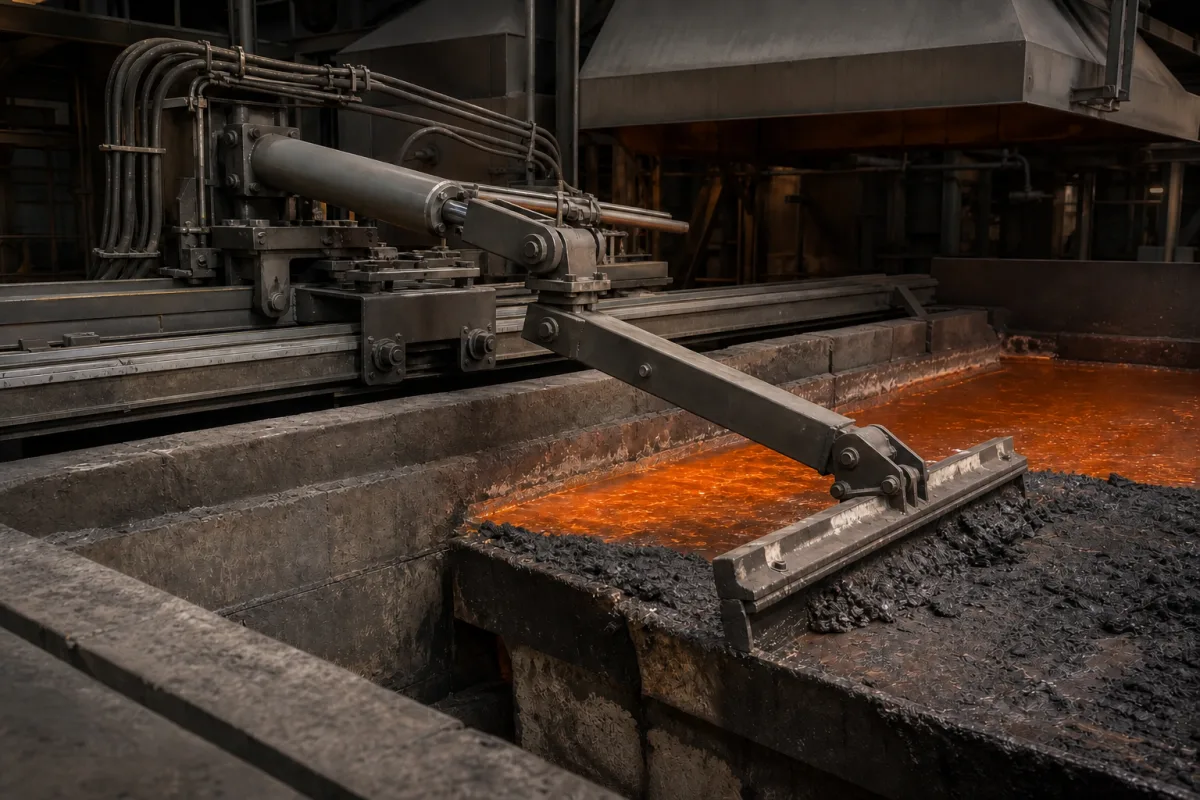
Representative product image. Confirm appearance and specifications with the manufacturer.

Product Specifications

Technical details and manufacturing context for Slag Skimming Mechanism

Definition
The Slag Skimming Mechanism is a critical component of the Slag Separation Unit in metal processing operations. It functions to continuously or intermittently remove the layer of slag that forms on the surface of molten metal during smelting, refining, or casting processes. This ensures the purity of the final metal product by separating non-metallic impurities. The mechanism typically employs a raking, scraping, or tilting action. A refractory-lined or water-cooled arm or blade is moved across the surface of the molten metal bath, physically pushing the lighter slag layer towards an overflow weir or into a separate collection chamber. The operation can be manual, semi-automatic, or fully automated, often synchronized with the furnace or ladle tilting cycle. Typical construction materials include refractory material, high-temperature steel, and water-cooled copper. The mechanism is available with a range of parameters that must be confirmed for the specific application: operating pressure 1.0–1.6 MPa, operating temperature -40 to 85 °C, skimming speed 0.5–2.0 m/s, stroke length 500–2000 mm, positioning accuracy ±0.05 mm, motor power 1.5–7.5 kW (IEC 60034), supply voltage 380–480 V AC (IEC 60038), ingress protection IP54–IP65 (IEC 60529), material grade 304–316L (ASTM A240), weight 150–800 kg, and footprint 1.5–4.0 m². These values are reference ranges; the actual model must be verified with the manufacturer. When selecting a Slag Skimming Mechanism, consider the slag viscosity, tank size, and required skimming speed. The mechanism interfaces with the furnace or ladle control system for synchronization. Verification questions include: What is the exact operating pressure and temperature range for the chosen model? What material grades are used for wetted parts? What is the actual stroke length and positioning accuracy? What are the electrical requirements and ingress protection rating? Maintenance signals include reduced skimming efficiency, unusual noise, or visible wear on the blade or arm. Failure boundaries include operating outside the specified pressure or temperature range, which may cause seal failure.
Working Principle
The mechanism uses a raking, scraping, or tilting action. A refractory-lined or water-cooled arm or blade moves across the molten metal surface, pushing the lighter slag layer towards an overflow weir or collection chamber. The motion can be manual, semi-automatic, or fully automated, often synchronized with the furnace or ladle tilting cycle. The arm or blade is typically made of high-temperature steel, refractory material, or water-cooled copper to withstand the harsh environment.
Common Materials
Refractory Material, High-Temperature Steel, Water-Cooled Copper
Technical Parameters
ParameterTypical rangeNotes & selection driver
Operating Pressure1.0–1.6 MPa
Operating Temperature-40–85 °COutside this range seals may fail
Skimming Speed0.5–2.0 m/sHigher speeds may cause splashing
Stroke Length500–2000 mmCustomizable per tank size
Positioning Accuracy±0.05 mmEnsures consistent slag removal
Motor Power1.5–7.5 kWDepends on slag viscosityIEC 60034
Supply Voltage380–480 V ACThree-phase, 50/60 HzIEC 60038
Ingress ProtectionIP54–IP65IP65 for dusty environmentsIEC 60529
Material Grade304–316L316L for corrosive slagASTM A240
Weight150–800 kgIncludes drive and frame
Footprint1.5–4.0 Compact design for retrofit

Ranges are indicative industry figures for RFQ preparation, not a supplier commitment. Confirm every value and standard with the legal manufacturer before ordering.

Components / BOM
  • Skimming Arm/Blade
    The primary component that contacts and moves the slag layer.
    Material: Refractory-lined steel or water-cooled copper
  • Drive Mechanism
    Provides the motive force (hydraulic, pneumatic, or electric) to move the skimming arm.
    Material: Steel
  • Support Frame Part
    Provides structural support and mounting for the skimming assembly over the furnace or ladle.
    Material: Structural Steel
  • Water Cooling System Optional
    Circulates water through the arm so a copper blade can sit in the slag without melting.

Applied To / Applications

This component is essential for the following industrial systems and equipment:

Industrial Ecosystem & Supply Chain Structure

Complementary Systems
Downstream Applications
Specialized Tooling

Application Fit & Sizing Matrix

Operational Limits
pressure: Atmospheric to 1.5 bar (non-pressurized vessel operation)
flow rate: 0.1-5.0 m³/min (slag removal capacity)
temperature: Up to 1600°C (typical for molten steel applications)
slurry concentration: Up to 40% solids by volume
Media Compatibility
✓ Molten steel slag systems ✓ Copper smelting operations ✓ Aluminum dross removal
Unsuitable: Hydrochloric acid pickling lines (corrosive to mechanism components)
Sizing Data Required
  • Vessel diameter (m)
  • Slag generation rate (kg/hr)
  • Required skimming cycle time (minutes)

Reliability & Engineering Risk Analysis

Failure Mode & Root Cause
Thermal fatigue cracking
Cause: Repeated exposure to extreme temperature cycles from molten slag contact and cooling cycles, leading to material stress and crack propagation in skimmer arms or blades.
Mechanical binding or jamming
Cause: Accumulation of solidified slag deposits or foreign debris in moving components (e.g., pivot points, guide rails), often due to inadequate cleaning or misalignment.
Maintenance Indicators
  • Unusual grinding or scraping noises during operation, indicating mechanical interference or wear
  • Visible slag buildup on non-contact surfaces or misalignment of skimmer components during visual inspection
Engineering Tips
  • Implement regular thermal imaging inspections to detect early-stage heat-related stress points and schedule preventive maintenance before cracks develop
  • Establish a strict post-operation cleaning protocol using appropriate tools to remove slag residues from all mechanical components, combined with alignment checks during routine shutdowns

Indicative industry ranges for design and RFQ preparation. Confirm the exact figures and applicable standard with the manufacturer before specifying.

Compliance & Manufacturing Standards

Applicable Standards
ASTM A36/A36M Standard Specification for Carbon Structural Steel CE Machinery Directive 2006/42/EC

Quoted from the published standard.

Manufacturing Precision
  • Shaft Alignment: +/-0.05mm
  • Surface Finish: Ra 3.2 μm
Quality Inspection
  • Non-Destructive Testing (NDT) - Ultrasonic Testing
  • Hardness Test - Rockwell C Scale

Manufacturers of Slag Skimming Mechanism

Manufacturer profiles associated with Slag Skimming Mechanism.

Sourcing Slag Skimming Mechanism from China?
Tell us your specification and target quantity — we will match it against manufacturer records and come back with the factories that fit.
Request manufacturers We manufacture this

Manufacturer listings support early research and capability understanding. They are not certification, ranking, or transaction guarantees.

Technical documentation
Request current drawings, revision history, and a signed specification sheet.
Manufacturing capability
Verify equipment lists, process limits, capacity, and representative production evidence.
Inspection readiness
Confirm test methods, calibrated equipment, sampling plans, and traceable reports.
Supplier transparency
Check the legal entity, factory address, ownership, certifications, and direct contacts.

CNFX does not score or rank suppliers. Buyers must verify all claims and documents with the legal manufacturer before ordering.

Supply Chain Compatible Machinery & Devices

Continuous Casting Machine

Industrial machine for solidifying molten metal into continuous billets/blooms/slabs.

Explore Specs →
Vacuum Induction Melting Furnace

Industrial furnace for melting metals under vacuum using electromagnetic induction

Explore Specs →
Electroslag Remelting Furnace

An industrial furnace used in basic metal manufacturing for secondary refining of alloys through the electroslag remelting (ESR) process.

Explore Specs →
Molten Metal Temperature Measurement System

Automated system for continuous temperature monitoring of molten metals during processing.

Explore Specs →

Frequently Asked Questions

What is the typical operating pressure range for a Slag Skimming Mechanism?

The reference range is 1.0–1.6 MPa. Confirm the exact value for your model with the manufacturer.

What materials are commonly used in the construction of the mechanism?

Common materials include refractory material, high-temperature steel, and water-cooled copper. The material grade may be 304–316L stainless steel (ASTM A240) depending on the application.

How is the skimming speed specified?

The reference skimming speed is 0.5–2.0 m/s. Higher speeds may cause splashing. The optimal speed depends on slag viscosity and tank configuration.

What are the electrical requirements?

The supply voltage is typically 380–480 V AC, three-phase, 50/60 Hz (IEC 60038). Motor power ranges from 1.5 to 7.5 kW (IEC 60034). Ingress protection is IP54–IP65 (IEC 60529). Verify with the manufacturer.

Data Basis

Editorial classification, named public sources where available, and source-reviewed manufacturer records.

Preliminary Technical Classification
This page supports structured research, RFQ preparation, and supplier evaluation. It does not replace buyer-led supplier qualification, standards review, or technical approval.
Buyer enquiry

Request manufacturing insight for Slag Skimming Mechanism

Ask for use case, specification boundaries, supplier type, and RFQ preparation information for this product.

Where it goes
Straight to the CNFX editorial desk, and to the manufacturer if this product is linked to a claimed profile. Nothing is broadcast to a supplier list.
Your details stay here
We do not sell or rent enquiry data, and we do not add you to a mailing list. Used only to answer this request.
No commission, no middleman
CNFX is a directory. We take no cut of any order and never negotiate on a supplier's behalf.
What we don't claim
A listing is not an endorsement. Qualify every supplier and verify every figure yourself before ordering.

Your business information is used only to process this request.

Thank you! Your message has been sent. We'll respond within 1–3 business days.
Sorry, we couldn't send your message. Please try again, or email us at contact@cnfx.com.

Need to Manufacture Slag Skimming Mechanism?

Compare manufacturer profiles with relevant product and process capability.

Previous Product
Work Rolls
Last Product
Get QuotesChat