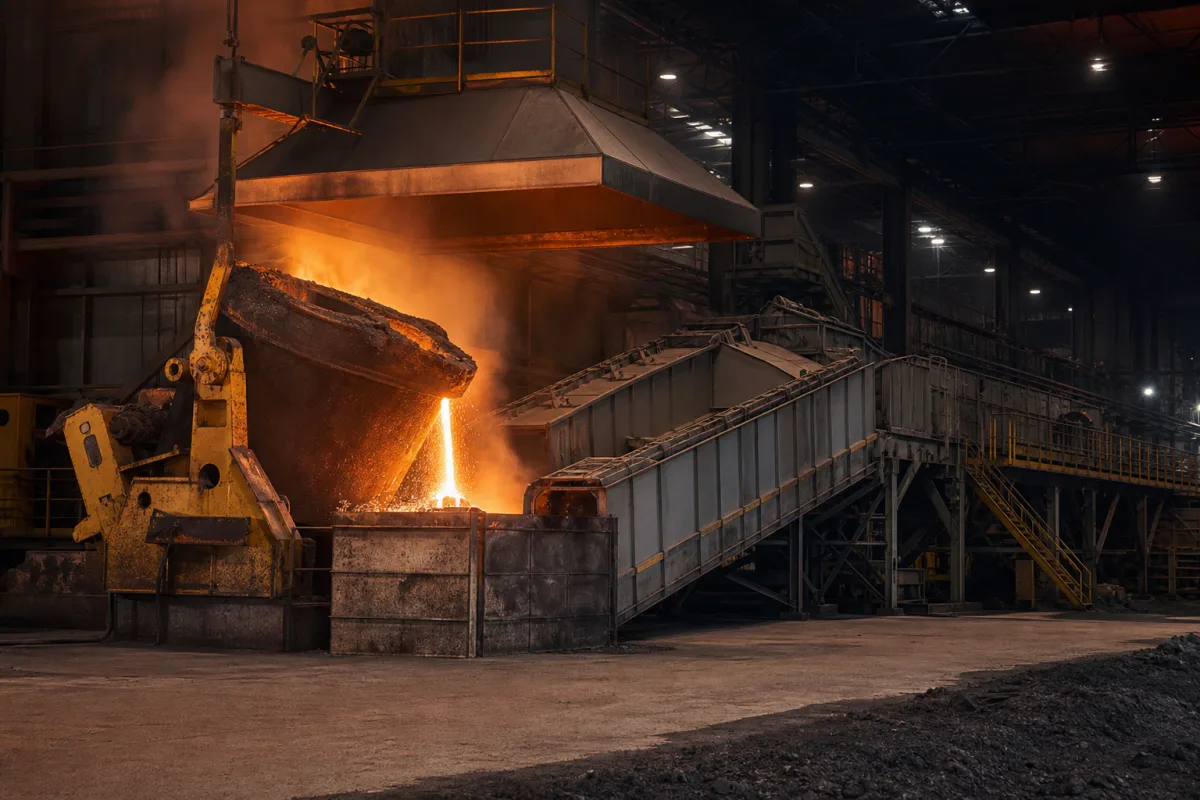
Steel slag handling and processing system: from the BOF or EAF slag pot to recovered iron and aged aggregate
Steelmaking slag handling · pot carriers from 35 to 250 tons, pit cooling, magnetic metal recovery, crushing and months of outdoor ageing before BOF or EAF slag can be sold
Steel furnace slag leaves the converter or arc furnace as a liquid in a slag pot, and everything after that — hauling and tipping the pot, cooling the slag in a pit, picking out the steel it still carries, crushing what remains and letting it weather before sale — is the slag system. USGS estimates that steel furnace slag amounts to 10–15% of raw steel output, so the system has to keep pace with the melt shop every heat. What a buyer has to settle is how big a pot the carrier must lift, how the plant separates slag types, how metal is recovered, and where and how long the aggregate is aged.
Post-furnace handling and processing of basic oxygen furnace (BOF) and electric arc furnace (EAF) steel slag: slag pot carriers and dumping, pit cooling, separation of furnace slag from ladle, raker and pit slag, magnetic recovery of entrained steel, crushing and screening, and stockpile ageing of steel slag aggregate. Blast furnaces, including their casthouse slag runners and slag granulation, are covered on the Blast furnace page; the apron conveyor that carries hot slag is on the Slag conveyor (steel plate and apron conveyor for hot slag) page; removing slag from the melt surface is on the Slag skimming machine page; ladle transport is on the Molten metal (ladle) transfer car page.
CNFX editorial research · Sources checked October 12, 2026 · 4 sources
Slag pot carriers: 35 to 250 tons, and why EAF shops pick reach-back models
Kress Corporation, which describes itself as the leading builder of slag pot carriers, custom-designs each carrier around one specific slag pot and the site's haul roads and clearances; its range lifts pots up to 1,589 cu ft (45 m³) and up to 250 tons (227 tonnes), and the pot is tipped under positive hydraulic control to pour molten slag into pits for cooling and processing. [3] Kress says the configuration is set by slag weight, operating procedures and haul conditions, with the vehicle dimensions governed by the size and shape of the pot. [4]
Skulls — slag frozen to the pot wall — are part of the duty cycle. Kress's pot-knock system has the operator retract the pot a few inches from a skulling block and let the dump cylinders free-fall so the pot strikes the block, removing the remaining slag without an overhead crane. [4] The carrier's articulated steering turns 90° each way, and the cab has passed ISO 11201:1995 and EN 12053:2001 sound tests. [4]
Editorial calculation: USGS puts steel furnace slag at 10–15% of raw steel output, [2] so a melt shop producing 1 million t of steel a year generates roughly 100,000–150,000 t of slag, or about 270–410 t a day over 365 days. That daily tonnage, divided by the slag weight per pot, sets how many pot trips the carriers must make.
Kress series
Published capacity
What it is built for
P
35–170 tons (32–154 t)
Narrow or low designs for confined access; industrial rear tires; hydraulic lift cylinder at each rear axle [4]
PES
90–210 tons (81.6–190 t)
Single large earthmover rear tires for long hauls or poor roads; can pick pots up from uneven ground [4]
PRES
35–180 tons (32–163 t)
EAF shops where slag spillage and foamy slag are a concern; places pots on and off transfer cars [4]
PELS
35–250 tons (32–227 t)
Linkage dumping for a greater dump angle and higher dump and pull-back forces; the largest series [4]
PR
Up to 140 tons (127 t)
Picks pots from rail or transfer cars; short hauls in the reach-back position without outriggers [4]
PRL
Up to 165 tons (150 t)
Picks pots from transfer cars or platforms; carrier width “often no wider than” the pot [4]
Give the carrier supplier the pot drawing (volume, empty and full weight, trunnion or lift-point geometry), whether pots are picked from the ground, a transfer car or a platform, haul distance and road condition, tipping-point layout, and any clearance or width limits in the melt shop.
02
Metallic iron at 0.5–10% of steel slag: magnetic recovery and return to the furnace
FHWA's slag guideline gives this composition range for basic oxygen furnace slag; the metallic iron line is what the recovery circuit is there to capture. [1]
FHWA describes the recovery step as a magnetic separator on a conveyor and/or a crane electromagnet, with the recovered metal reused in the plant as blast furnace feed; slag processors also handle ladle slag, pit slag and used refractory to recover steel metallics. [1] USGS adds that entrained metal, particularly in steel slag, is “routinely recovered” during slag processing for return to the furnaces and is an important revenue source for slag processors, although no data on metal returns are published, and that its slag sales figures exclude entrained metal. [2]
Editorial calculation: at FHWA's 0.5–10% metallic iron, every 1,000 t of steel slag carries 5–100 t of metal for the magnets to find — a twenty-fold spread, which is why the separator and crusher sizing should be based on a sample of the plant's own slag rather than a generic figure.
Ask for the metallic iron content of a representative slag sample, the magnet type and position (overbelt, drum or crane magnet), the target cleanliness of the recovered scrap, and the residual metal allowed in the aggregate.
03
Keeping furnace slag apart from ladle, raker and pit slag
FHWA identifies four steel slag streams: furnace or tap slag, raker slag, synthetic or ladle slag, and pit or clean-out slag. Furnace slag is the main source of steel slag aggregate; ladle-refining slags carry comparatively high flux additions, differ in properties, and FHWA calls them “generally unsuitable for processing as steel slag aggregates”, so they must be segregated from furnace slag. [1]
FHWA writes that “most of the furnace slag is recycled for use as an aggregate” while excess raker, ladle, clean-out and pit slag “is usually sent to landfills for disposal”, and the processor needs source separation and well-defined handling to avoid contaminating the aggregate. [1] The non-metallic fraction left after metal recovery can be crushed and screened as aggregate or sintered and returned to the furnaces as flux. [1]
Editorial note: separate pots, separate tipping bays or separate pit cells per slag stream are layout decisions; agree with the processor which streams the system must keep apart before the pit and conveyor layout is fixed.
04
Ageing steel slag aggregate up to 18 months against expansion of up to 10%
Free lime and magnesium oxide left unreacted in steel slag hydrate in humid conditions and can expand the material by up to 10% or more by volume, which FHWA gives as one reason steel slag aggregate is not suitable for Portland cement concrete or as compacted fill beneath slabs. [1]
FHWA advises stockpiling steel slag destined for aggregate outdoors “for several months”, wetted by rain or water spray, so that the expansion happens before use; the time varies a great deal and up to 18 months may be needed. [1] Before use the slag must be crushed and screened to the gradation the application specifies, and a processor may also have to meet moisture limits for hot mix asphalt plants. [1]
FHWA lists typical physical properties of the resulting aggregate: specific gravity above 3.2–3.6, unit weight 1,600–1,920 kg/m³ (100–120 lb/ft³) and absorption up to 3%. [1] Editorial calculation: at 100,000–150,000 t of slag a year from the 1 Mt melt shop above and 18 months of ageing, up to 150,000–225,000 t could be in the ageing yard at once, about 78,000–141,000 m³ at FHWA's 1,600–1,920 kg/m³ (low tonnage at the high density, high tonnage at the low density).
Size the ageing yard and water-spray system from your slag tonnage and the ageing time your aggregate customers require, and ask how expansion will be tested before release.
05
Where processed steel slag goes: road base, asphalt and fill at about $38 a ton
USGS estimates U.S. slag sales in 2024 at 16 million tons worth about $600 million, with an average unit value of $38 per ton free on board the plant across all slag types; steel slag from BOFs and EAFs makes up the tonnage beyond the less than 3% that is granulated blast furnace slag. [2]
USGS counts 25 companies processing slag at about 120 plants in 33 states and notes that prices for some steel slags fall to a few cents a ton at a few locations; because of low unit values “most slag types can be shipped only short distances by truck”, while rail and water transport reach further. [2] End uses it lists for steel furnace slag are asphaltic concrete, fill and road base. [2] FHWA's older estimate was 7.0–7.5 million t of steel slag used each year in the United States, with granular base and construction aggregate named as the primary applications. [1]
Editorial calculation: 16 million t spread over about 120 plants averages roughly 133,000 t per plant per year; this mixes blast furnace and steel slag plants and is an order-of-magnitude figure only.
06
What to send for a steel slag handling and processing system
Paste it into your enquiry below or into an email to a maker, then replace every bracket.
Furnace: [BOF or EAF; heats per day; raw steel tonnage per year]
Slag: [tonnage per heat; streams to keep separate — furnace, ladle, raker, pit]
Pots: [volume; full weight; pick-up from ground, transfer car or platform]
Haul: [distance; road condition; width and height limits]
Cooling: [pit layout; water spray]
Recovery: [metallic Fe in a sample; magnet type; scrap destination]
Product: [aggregate gradation; moisture limits; ageing time and expansion test]
Explore company information and manufacturing capabilities, then discuss the scope of your project with a relevant supplier.
Share this page
Compiled and source-reviewed by the CNFX editorial team.
Each manufacturer above links to the page on that company's own website where the product is listed, with the date we checked it. How we source and review
· Page last updated 13 October 2026
Buyer questions
How big are slag pot carriers?
Kress lists series from 35 tons (32 t) up to 250 tons (227 t), handling pots up to 45 m³, each designed around a specific pot and site. [3][4]
How much metal is left in steel slag?
FHWA gives 0.5–10% metallic iron for BOF steel slag; it is recovered with conveyor magnets or crane electromagnets and returned to the plant. [1]
Why is steel slag aged before use?
Free lime and magnesia can hydrate and expand it by up to 10% or more; FHWA advises outdoor stockpiling “for several months”, up to 18 months. [1]
How much slag does a steel plant make?
USGS estimates steel furnace slag at 10–15% of raw steel production. [2]
Sources and what still needs a direct check
Sources checked 2026-10-12. Carrier capacities and the pot-knock method come from Kress Corporation's own slag pot carrier page and brochure; slag streams, composition, metal recovery and ageing from the US Federal Highway Administration's steel slag guideline; slag-to-steel ratio, sales, prices and processor counts from the US Geological Survey's 2025 Mineral Commodity Summary.