Industry-Verified Manufacturing Data (2026)

Temperature Maintenance System

Based on aggregated insights from multiple verified factory profiles within the CNFX directory, the standard Temperature Maintenance System used in the Basic Metal Manufacturing sector typically supports operational capacities ranging from standard industrial configurations to heavy-duty production requirements.

Technical Definition & Core Assembly

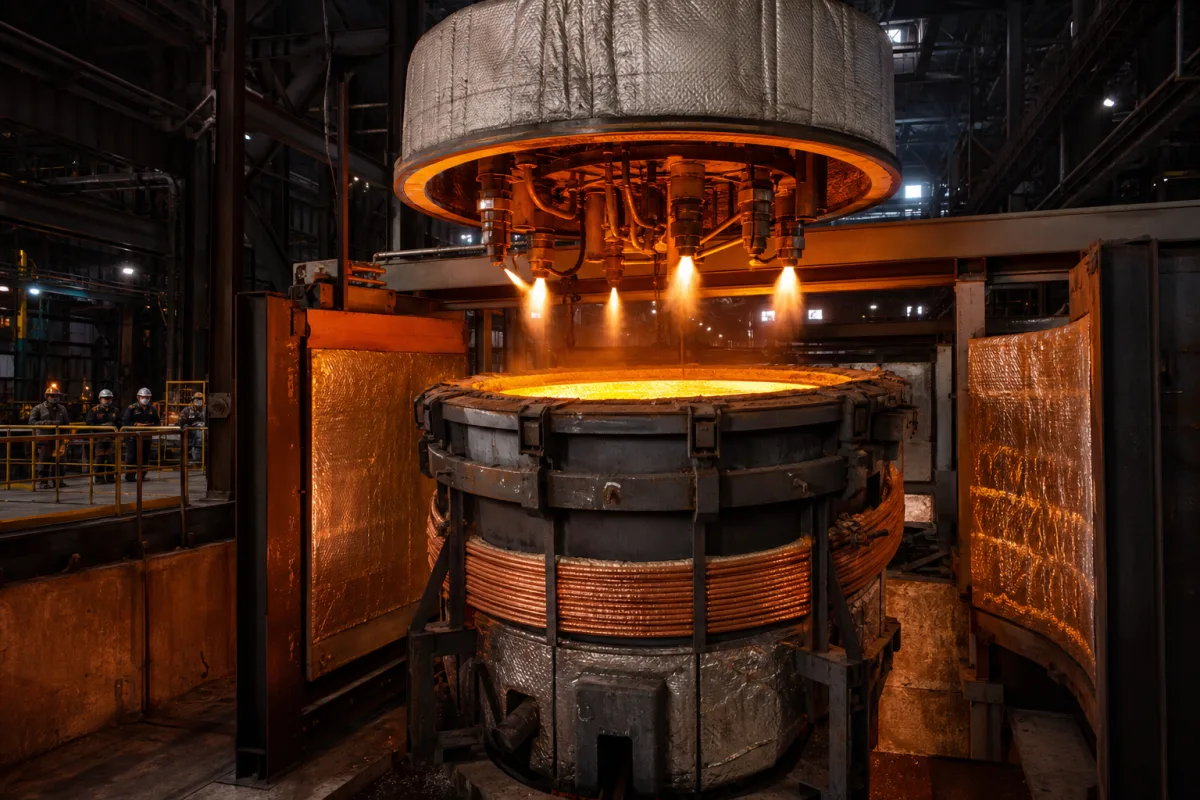
A canonical Temperature Maintenance System is characterized by the integration of Heating Elements and Temperature Sensors. In industrial production environments, manufacturers listed on CNFX commonly emphasize Refractory ceramics construction to support stable, high-cycle operation across diverse manufacturing scenarios.

A subsystem within non-ferrous metal continuous casting and rolling systems that precisely controls and maintains the temperature of molten metal throughout the casting and initial rolling stages.
Product Specifications

Technical details and manufacturing context for Temperature Maintenance System

Definition
The Temperature Maintenance System is a critical component of Non-Ferrous Metal Continuous Casting and Rolling Systems, responsible for ensuring the molten metal maintains optimal temperature parameters from the tundish through the mold and into the initial rolling stands. It prevents premature solidification, controls cooling rates, and ensures uniform temperature distribution to achieve proper metallurgical properties, surface quality, and dimensional accuracy in the final rolled product.
Working Principle
The system typically employs a combination of induction heating elements, resistance heaters, or gas burners strategically positioned along the casting line and initial rolling section. Temperature sensors (thermocouples, infrared pyrometers) continuously monitor the metal temperature at multiple points. A control unit processes this data and adjusts the heating output in real-time to maintain the metal within a narrow target temperature range, compensating for heat loss to the environment and the casting/rolling process itself.
Common Materials
Refractory ceramics, High-temperature alloy steel, Insulation materials, Copper (for induction coils)
Technical Parameters
  • Temperature control range and precision (°C) Customizable
Components / BOM
  • Heating Elements
    Generate heat to maintain metal temperature, typically induction coils, resistance heaters, or gas burners
    Material: High-temperature alloy, refractory ceramics
  • Temperature Sensors
    Continuously measure metal temperature at strategic points along the line
    Material: Thermocouple alloys (Type K, N), ceramic sheaths
  • Control Unit
    Processes sensor data and regulates heating element output to maintain setpoint temperature
    Material: Electronic components, steel enclosure
  • Insulation Housing
    Minimizes heat loss to the environment and protects system components
    Material: Ceramic fiber, refractory bricks, insulation blankets
Engineering Reasoning
680-720°C for aluminum alloys, 900-950°C for copper alloys
Temperature deviation beyond ±5°C from setpoint for >30 seconds
Design Rationale: Thermal stress-induced microcrack propagation in refractory lining when temperature gradients exceed 15°C/cm
Risk Mitigation (FMEA)
Trigger Induction coil insulation breakdown at 1500V/mm dielectric strength threshold
Mode: Localized overheating creating 50-100°C hot spots
Strategy: Multi-layer mica-based insulation with 2500V/mm rating and embedded thermocouple grid
Trigger Cooling water flow reduction below 2.5 m/s causing boundary layer separation
Mode: Scale formation exceeding 0.5mm thickness reducing heat transfer coefficient by 40%
Strategy: Dual redundant pumps with flow sensors triggering at 2.7 m/s threshold

Industry Taxonomies & Aliases

Commonly used trade names and technical identifiers for Temperature Maintenance System.

Industrial Ecosystem & Supply Chain DNA

Complementary Systems
Downstream Applications
Specialized Tooling

Application Fit & Sizing Matrix

Operational Limits
pressure: 0.1-2.0 bar (atmospheric to low positive pressure)
flow rate: 5-200 m³/h (depending on casting line capacity)
temperature: 800-1300°C (typical non-ferrous metals: aluminum 660-750°C, copper 1085°C, zinc 420°C)
slurry concentration: Not applicable (handles pure molten metal, not slurries)
Media Compatibility
✓ Molten aluminum alloys ✓ Molten copper alloys ✓ Molten zinc alloys
Unsuitable: Oxidizing atmospheres without inert gas protection (causes excessive dross formation)
Sizing Data Required
  • Maximum casting throughput (tons/hour)
  • Required temperature uniformity (±°C)
  • Available installation footprint (length × width)

Reliability & Engineering Risk Analysis

Failure Mode & Root Cause
Thermal stress cracking
Cause: Rapid temperature cycling or thermal shock exceeding material design limits, often due to improper startup/shutdown procedures or sudden load changes.
Corrosion and scaling
Cause: Chemical attack from coolant/fluid impurities, improper pH levels, or galvanic corrosion between dissimilar metals in the system components.
Maintenance Indicators
  • Audible: Unusual pump cavitation noises or vibration indicating flow restriction or impeller damage
  • Visual: Temperature gauge fluctuations beyond normal operating range or visible coolant leaks at connections/joints
Engineering Tips
  • Implement predictive maintenance using infrared thermography to detect early thermal anomalies before failure occurs
  • Establish strict water treatment protocols and regular fluid analysis to maintain proper chemical balance and prevent corrosion/scaling

Compliance & Manufacturing Standards

Reference Standards
ISO 9001:2015 Quality Management Systems ANSI/ASHRAE 15 Safety Standard for Refrigeration Systems DIN EN 378 Refrigerating systems and heat pumps - Safety and environmental requirements
Manufacturing Precision
  • Temperature control accuracy: +/-0.5°C
  • Pressure vessel weld seam alignment: +/-1.5mm
Quality Inspection
  • Hydrostatic pressure test at 1.5x operating pressure
  • Thermal cycling endurance test with 1000 cycles

Factories Producing Temperature Maintenance System

Verified manufacturers with capability to produce this product in China

✓ 94% Supplier Capability Match Found

P Procurement Specialist from United Arab Emirates Feb 20, 2026
★★★★★
"As a professional in the Basic Metal Manufacturing sector, I confirm this Temperature Maintenance System meets all ISO standards."
Technical Specifications Verified
T Technical Director from Australia Feb 17, 2026
★★★★★
"Standard OEM quality for Basic Metal Manufacturing applications. The Temperature Maintenance System arrived with full certification."
Technical Specifications Verified
P Project Engineer from Singapore Feb 14, 2026
★★★★★
"Great transparency on the Temperature Maintenance System components. Essential for our Basic Metal Manufacturing supply chain."
Technical Specifications Verified
Verification Protocol

“Feedback is collected from verified sourcing managers during RFQ (Request for Quote) and factory evaluation processes on CNFX. These reports represent historical performance data and technical audit summaries from our B2B manufacturing network.”

18 sourcing managers are analyzing this specification now. Last inquiry for Temperature Maintenance System from Thailand (19m ago).

Supply Chain Compatible Machinery & Devices

Continuous Casting Machine

Industrial machine for solidifying molten metal into continuous billets/blooms/slabs.

Explore Specs →
Electromagnetic Induction Heater

Industrial heating device using electromagnetic induction for metal processing

Explore Specs →
Vacuum Induction Melting Furnace

Industrial furnace for melting metals under vacuum using electromagnetic induction

Explore Specs →
Electroslag Remelting Furnace

Secondary refining furnace for high-quality metal ingots

Explore Specs →

Frequently Asked Questions

How does this system maintain precise temperature during continuous casting?

The system uses induction heating with copper coils and high-temperature alloy steel elements, controlled by precision sensors and a dedicated control unit to maintain ±5°C accuracy throughout casting and initial rolling stages.

What materials make this system suitable for high-temperature metal processing?

Constructed with refractory ceramics for thermal resistance, high-temperature alloy steel for structural integrity, copper induction coils for efficient heating, and advanced insulation materials to minimize heat loss.

Can this system be integrated with existing continuous casting lines?

Yes, the modular design with standard BOM components (control unit, heating elements, insulation housing, sensors) allows seamless integration with most non-ferrous metal continuous casting and rolling systems.

Can I contact factories directly on CNFX?

CNFX is an open directory, not a transaction platform. Each factory profile provides direct contact information and production details to help you initiate direct inquiries with Chinese suppliers.

Get Quote for Temperature Maintenance System

Request technical pricing, lead times, or customized specifications for Temperature Maintenance System directly from verified manufacturing units.

Your business information is encrypted and only shared with verified Temperature Maintenance System suppliers.

Thank you! Your message has been sent. We'll respond within 1–3 business days.

Need to Manufacture Temperature Maintenance System?

Connect with verified factories specializing in this product category

Add Your Factory Contact Us
Previous Product
Temperature Control System
Next Product
Thermal Insulation Jacket