Industry-Verified Manufacturing Data (2026)

Top Charging System

Based on aggregated insights from multiple verified factory profiles within the CNFX directory, the standard Top Charging System used in the Basic Metal Manufacturing sector typically supports operational capacities ranging from standard industrial configurations to heavy-duty production requirements.

Technical Definition & Core Assembly

A canonical Top Charging System is characterized by the integration of Rotating Distribution Chute and Material Hoppers / Lock Hoppers. In industrial production environments, manufacturers listed on CNFX commonly emphasize High-strength alloy steel construction to support stable, high-cycle operation across diverse manufacturing scenarios.

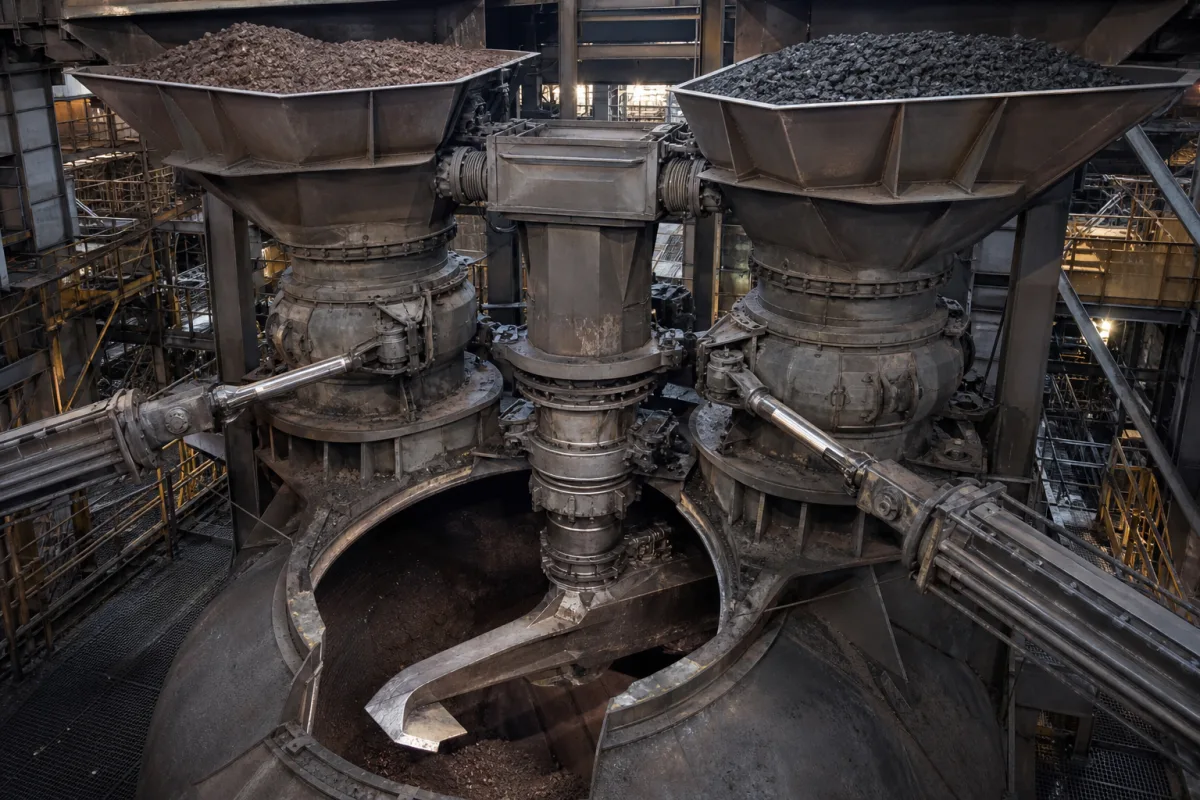
A system located at the top of a blast furnace that controls the charging of raw materials (iron ore, coke, limestone) into the furnace.
Product Specifications

Technical details and manufacturing context for Top Charging System

Definition
The Top Charging System is a critical component of the blast furnace structure responsible for the precise and controlled introduction of raw materials (iron ore, coke, and fluxes like limestone) into the furnace shaft. It ensures a proper layered burden distribution, seals the furnace top to prevent gas escape, and manages the pressure conditions within the furnace. It is integral to the furnace's charging cycle and overall operational efficiency.
Working Principle
The system operates by receiving raw materials from stockhouse conveyors. It typically uses a rotating chute or a bell-less top mechanism to distribute the materials evenly in layers (coke, ore, flux) into the furnace. It maintains a gas-tight seal using pressure locks or valves to contain the high-pressure furnace gases while allowing materials to enter. The charging sequence and distribution pattern are controlled to optimize the chemical reduction process inside the furnace.
Common Materials
High-strength alloy steel, Refractory linings, Abrasion-resistant castings
Technical Parameters
  • Diameter of the charging throat or main chute, critical for determining maximum charge size and distribution pattern. (mm) Standard Spec
Components / BOM
Engineering Reasoning
0.2-0.5 bar differential pressure across charging bell
Bell seal failure at 0.8 bar differential pressure causing gas blow-by
Design Rationale: Bell-seat misalignment due to thermal expansion differential (α_steel=12×10⁻⁶/°C vs α_refractory=5×10⁻⁶/°C) creating 2-3mm radial gap at 300°C ΔT
Risk Mitigation (FMEA)
Trigger Hydraulic cylinder seal degradation from 200°C thermal cycling
Mode: Bell descent velocity drops below 0.3 m/s minimum
Strategy: Double-acting hydraulic cylinders with ceramic-coated piston rods and 250°C rated fluorocarbon seals
Trigger Hopper material bridging from 6% moisture content in iron ore fines
Mode: Charge mass flow deviation exceeds ±5% of 150 kg/s setpoint
Strategy: Vibratory dischargers with 50 Hz excitation frequency and 2 mm amplitude

Industry Taxonomies & Aliases

Commonly used trade names and technical identifiers for Top Charging System.

Applied To / Applications

This component is essential for the following industrial systems and equipment:

Industrial Ecosystem & Supply Chain DNA

Complementary Systems
Downstream Applications
Specialized Tooling

Application Fit & Sizing Matrix

Operational Limits
pressure: Atmospheric to 0.5 bar gauge (typical), up to 2 bar gauge (max surge)
other spec: Flow Rate: 50-500 tons/hour (batch charging), Slurry Concentration: N/A (dry granular materials), Particle Size: 10-150 mm
temperature: Ambient to 250°C (operating), up to 400°C (peak during gas breakthrough)
Media Compatibility
✓ Iron ore pellets/lumps ✓ Coke (metallurgical grade) ✓ Limestone/dolomite flux
Unsuitable: Molten materials or high-moisture slurries (>5% moisture)
Sizing Data Required
  • Blast furnace inner volume and throat diameter
  • Required charging rate (tons/hour) and batch frequency
  • Material bulk density and angle of repose

Reliability & Engineering Risk Analysis

Failure Mode & Root Cause
Insulation Degradation
Cause: Thermal cycling and overheating from excessive current draw or poor ventilation, leading to breakdown of dielectric materials and potential short circuits.
Connector/Contact Wear
Cause: Mechanical fatigue from repeated plug/unplug cycles, oxidation from environmental exposure, or arcing due to loose connections causing increased resistance and heat generation.
Maintenance Indicators
  • Audible buzzing or humming from the charging unit, indicating loose components, transformer issues, or impending electrical failure.
  • Visible discoloration, melting, or burning smells around connectors or housing, signaling overheating and immediate fire/electrical hazard risks.
Engineering Tips
  • Implement regular infrared thermography inspections to detect abnormal heat patterns in connectors and internal components before catastrophic failure occurs.
  • Establish a preventive maintenance schedule for torque checks on electrical connections and cleaning of contacts to prevent oxidation and ensure optimal conductivity.

Compliance & Manufacturing Standards

Reference Standards
ISO 9001:2015 Quality Management Systems IEC 62133-2:2017 Safety of Secondary Cells and Batteries UL 2594 Standard for Electric Vehicle Supply Equipment
Manufacturing Precision
  • Connector Alignment: +/-0.5mm
  • Voltage Regulation: +/-2% of nominal output
Quality Inspection
  • Insulation Resistance Test
  • Thermal Cycling Endurance Test

Factories Producing Top Charging System

Verified manufacturers with capability to produce this product in China

✓ 93% Supplier Capability Match Found

P Procurement Specialist from Germany Feb 04, 2026
★★★★★
"Impressive build quality. Especially the technical reliability is very stable during long-term operation."
Technical Specifications Verified
T Technical Director from Brazil Feb 01, 2026
★★★★★
"As a professional in the Basic Metal Manufacturing sector, I confirm this Top Charging System meets all ISO standards."
Technical Specifications Verified
P Project Engineer from Canada Jan 29, 2026
★★★★★
"Standard OEM quality for Basic Metal Manufacturing applications. The Top Charging System arrived with full certification."
Technical Specifications Verified
Verification Protocol

“Feedback is collected from verified sourcing managers during RFQ (Request for Quote) and factory evaluation processes on CNFX. These reports represent historical performance data and technical audit summaries from our B2B manufacturing network.”

18 sourcing managers are analyzing this specification now. Last inquiry for Top Charging System from Brazil (1h ago).

Supply Chain Compatible Machinery & Devices

Electromagnetic Induction Heater

Industrial heating device using electromagnetic induction for metal processing

Explore Specs →
Vacuum Induction Melting Furnace

Industrial furnace for melting metals under vacuum using electromagnetic induction

Explore Specs →
Electroslag Remelting Furnace

Secondary refining furnace for high-quality metal ingots

Explore Specs →
Molten Metal Flow Control Valve

Precision valve for regulating molten metal flow in casting and pouring operations.

Explore Specs →

Frequently Asked Questions

What materials are used in Top Charging System construction?

Constructed with high-strength alloy steel for structural integrity, refractory linings for heat resistance, and abrasion-resistant castings to withstand constant material flow.

How does the Top Charging System improve blast furnace efficiency?

The system ensures precise, controlled charging of raw materials (iron ore, coke, limestone) into the blast furnace, optimizing material distribution and reducing heat loss through effective sealing mechanisms.

What are the main components of a Top Charging System?

Key components include material hoppers/lock hoppers for storage, rotating distribution chute for even material distribution, and sealing valves (upper & lower) to maintain furnace pressure and prevent gas escape.

Can I contact factories directly on CNFX?

CNFX is an open directory, not a transaction platform. Each factory profile provides direct contact information and production details to help you initiate direct inquiries with Chinese suppliers.

Get Quote for Top Charging System

Request technical pricing, lead times, or customized specifications for Top Charging System directly from verified manufacturing units.

Your business information is encrypted and only shared with verified Top Charging System suppliers.

Thank you! Your message has been sent. We'll respond within 1–3 business days.

Need to Manufacture Top Charging System?

Connect with verified factories specializing in this product category

Add Your Factory Contact Us
Previous Product
Tilting Mechanism
Next Product
Torch or Shear Cutting