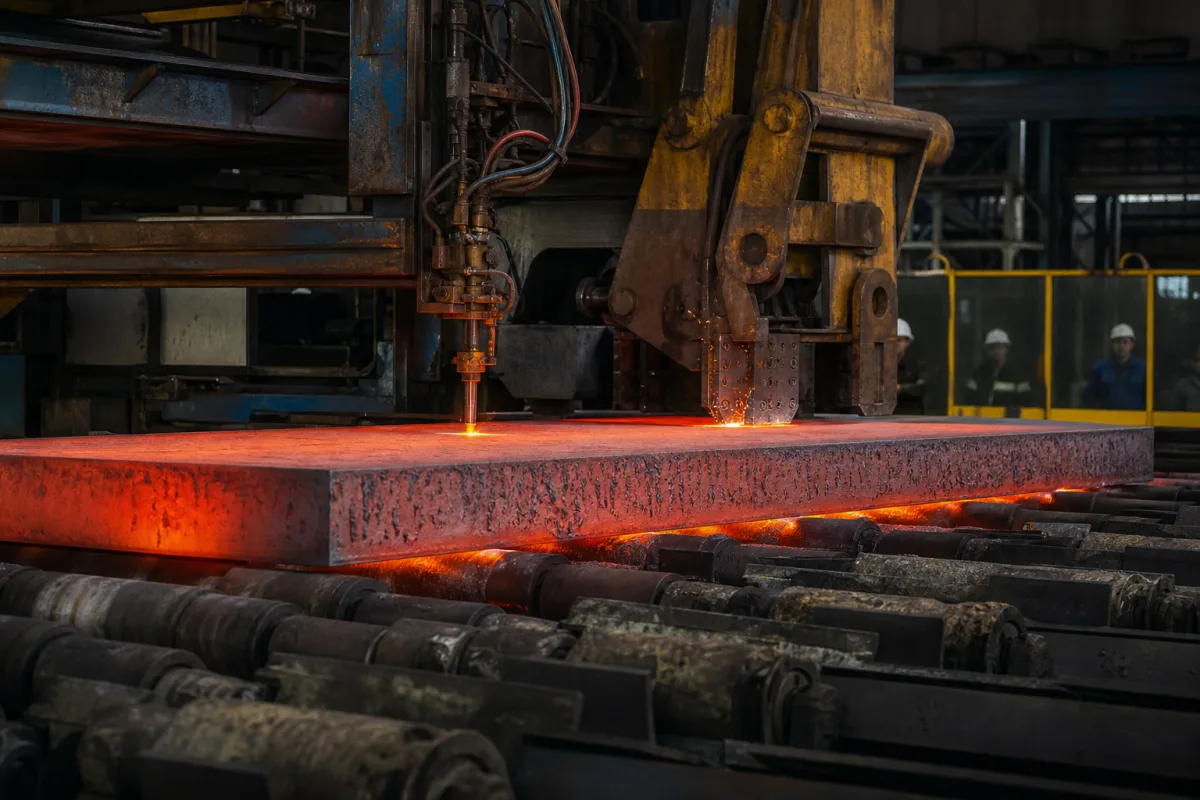
Torch or shear cutting for continuous-cast strands (cut-off machines for slabs and billets)
Strand cut-off equipment · oxy-fuel torch cutting machines and hydraulic hot shears that cut a continuously cast strand into slabs, blooms or billets
Torch or shear cutting is the cut-off station after the withdrawal straightener of a continuous caster: either an oxy-fuel torch cutting machine whose carriage clamps to and travels with the hot strand while the torch crosses it, or a hydraulic shear that travels with the strand and cuts it in one stroke. Ask three things first: whether the cut finishes within the travel the machine has at your casting speed and section, what oxygen pressure, nozzle and kerf the torch uses and how the slag bead is removed, and whether the section and steel temperature suit a shear instead.
Cut-off equipment that divides a continuously cast steel strand into slabs, blooms or billets: travelling oxy-fuel torch cutting machines with their torches, nozzles and slag (deburring) devices, and travelling hydraulic hot shears. Complete billet and bloom casting machines, from tundish to discharge, are covered on the Billet continuous caster page. Plate-shop CNC flame or plasma cutting tables, cold saws and scrap shears are outside this page.
CNFX editorial research · Sources checked October 12, 2026 · 4 sources
Check the cut time against how far the strand travels
Messer Griesheim's patent on oxygen cutting states that the speed of flame cutting continuously cast slabs is lower than the withdrawal speed: with 200 mm thick slabs the cutting speed is at most about 0.5 m/min, while the withdrawal speed is 1.5–2.0 m/min. The patent names discharge of slag from the cutting gap as the limiting factor on cutting speed. [1]
Because the cut is slower than the strand, the torch carriage clamps to the strand and travels with it during the cut. Messer Griesheim's billet patent describes a torch carriage clamped directly to the billet so that the cutting jet crosses the billet while the strand keeps moving out of the casting machine, cutting perpendicular to the strand axis. [3]
Editorial calculation: crossing an assumed 1,500 mm wide, 200 mm thick slab at about 0.5 m/min takes about 3 minutes; at 1.5–2.0 m/min withdrawal the strand moves 4.5–6.0 m in that time, so the carriage travel and return must cover at least that distance plus preheat time. Slab width is an assumed example; use your widest section and highest casting speed. [1]
Primetals' patent on linking billet casting lines to a rolling mill states that shearing time can be less than one second, whereas it says torch cutting needs 15–60 seconds, depending mainly on billet cross-section and torch output power; the patent places the shear just after the strand's maximum solidification length. [4]
Give the supplier the section sizes (thickness × width or square size), steel grades, maximum and minimum casting speed, number of strands and strand spacing, cut lengths and tolerance, strand surface temperature at the cut-off point, and the oxygen and fuel gas pressures available at the works.
02
Set oxygen pressure, nozzle and kerf from data
GEGA's patent on high-pressure oxygen cutting for continuous casting plants states that about 15 bar nozzle supply pressure is used today, and that works oxygen supply systems run at 10 bar (Japan) up to a maximum of 25 bar (Europe and others). Its system holds a working pressure of about 20 to 36 bar within ±0.1 bar using a pressure regulating valve and a mass flow control valve. [2]
Source of all table values: GEGA patent US 5,902,544, Table 1. [2] The patent states that a separation nozzle designed for its working pressure needs 90 to 120 Nm³ of oxygen per hour at 100% operation. [2]
Editorial calculation: on an assumed 250 mm × 2,000 mm slab at 750 °C, a cut at 380 mm/min takes about 5.3 minutes and at 580 mm/min about 3.4 minutes. Each cut removes kerf volume of 6.2–6.9 mm × 250 mm × 2,000 mm, about 3,100–3,450 cm³, or about 24–27 kg of steel at an assumed density of 7.85 g/cm³. Section size and density are assumptions. [2]
GEGA Table 1 item
Conventional nozzle (EP 0097883)
High-pressure nozzle
Cutting oxygen working pressure
approx. 14 bar
26.3 ± 0.1 bar
Oxygen throughput
45 Nm³/h
90 Nm³/h
Narrowest diameter DE / outlet DA
3.6 / 4.3 mm
2.6 / 4.9 mm
Average kerf width
6.2 mm
6.9 mm
Cutting speed, low-carbon steel, 250 mm thick, at 20 °C
250 mm/min
360 mm/min
Same, at 750 °C
380 mm/min
580 mm/min
03
Plan how the slag bead is removed
Messer Griesheim's billet-cutting patent explains that as the oxy-fuel jet cuts, molten steel and iron oxide flow down the kerf; part of it adheres as a slag bead along the lower edges, and if not removed at once it hardens and has to be taken off in a secondary operation such as scarfing, or it can cause defects in later forming. [3]
The patent notes that slow cutting reduces slag but conflicts with faster casting. Its solution is a fixed nozzle beside the billet, which can be mounted on a billet clamping arm, that directs a thin, flat oxygen jet along the lower edge of the kerf while the torch cuts; the divergent surfaces of the nozzle opening form an angle of about 8°. [3]
04
Compare torch cutting machines and hot shears
The two cut-off principles differ in cycle time, kerf and what they leave on the cut face.
Point
Oxy-fuel torch cutting machine
Hydraulic hot shear
Cut time
15–60 s per billet cut (Primetals patent); about 0.5 m/min maximum on 200 mm slabs (Messer Griesheim patent). [4][1]
Explore company information and manufacturing capabilities, then discuss the scope of your project with a relevant supplier.
Share this page
Compiled and source-reviewed by the CNFX editorial team.
Each manufacturer above links to the page on that company's own website where the product is listed, with the date we checked it. How we source and review
· Page last updated 13 October 2026
Buyer questions
Why does a torch cutting machine travel with the strand?
Messer Griesheim's patent gives a maximum cutting speed of about 0.5 m/min on 200 mm slabs against 1.5–2.0 m/min withdrawal, so the cut takes longer than the strand stays in one place. [1]
What oxygen pressure do caster torches use?
GEGA's patent says about 15 bar is used today and describes a high-pressure system at about 20–36 bar; in its test a 26.3 bar nozzle cut 250 mm steel at 580 mm/min at 750 °C. [2]
Is a shear faster than a torch?
Primetals' patent states shearing can take less than one second, against 15–60 seconds for torch cutting depending on billet section and torch power. [4]
Sources and what still needs a direct check
Sources checked 2026-10-12. All four sources are patents: one from a caster cutting-equipment maker (GEGA), two from an industrial gas and cutting company (Messer Griesheim) and one from a plant builder (Primetals). Patent figures describe the inventors' tests and examples, not guaranteed performance.