Industry-Verified Manufacturing Data (2026)

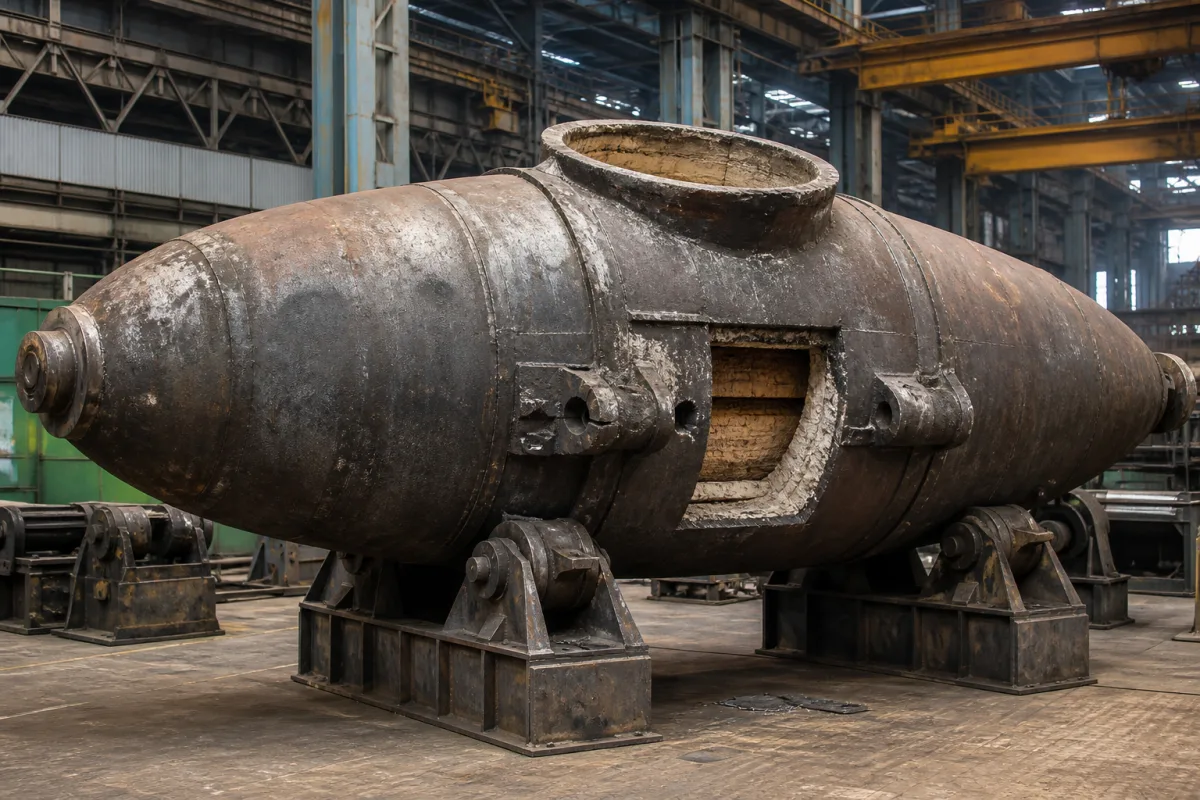
Torpedo-shaped vessel

Based on aggregated insights from multiple verified factory profiles within the CNFX directory, the standard Torpedo-shaped vessel used in the Basic Metal Manufacturing sector typically supports operational capacities ranging from standard industrial configurations to heavy-duty production requirements.

Technical Definition & Core Assembly

A canonical Torpedo-shaped vessel is characterized by the integration of Refractory Lining and Pouring Spout. In industrial production environments, manufacturers listed on CNFX commonly emphasize Refractory lining (e.g., alumina, magnesia, carbon) construction to support stable, high-cycle operation across diverse manufacturing scenarios.

A specialized, torpedo-shaped container designed for transporting and temporarily storing molten metal in a Hot Metal Torpedo Car.
Product Specifications

Technical details and manufacturing context for Torpedo-shaped vessel

Definition
The torpedo-shaped vessel is the core component of a Hot Metal Torpedo Car, a specialized rail vehicle used in steelmaking. It is a large, refractory-lined, cylindrical container with tapered ends, designed to efficiently transport high-temperature molten metal (typically iron or steel) from the blast furnace to various processing stations like the basic oxygen furnace or steelmaking shop. Its shape minimizes heat loss and slag carryover during transit.
Working Principle
The vessel is loaded with molten metal via a tilting mechanism at the blast furnace tap hole. Its refractory lining insulates the molten metal to maintain temperature during rail transport. The aerodynamic, torpedo shape reduces radiative heat loss from the surface area and promotes stability during movement. It is emptied by tilting the entire car to pour the metal out through its spout.
Common Materials
Refractory lining (e.g., alumina, magnesia, carbon), Steel shell
Technical Parameters
  • Capacity (e.g., 100-400 tonnes of molten metal) (tonnes) Per Request
Components / BOM
  • Refractory Lining
    Insulates the vessel to retain molten metal heat and protect the steel shell from thermal and chemical damage.
    Material: Refractory bricks/monolithics (alumina, magnesia, carbon)
  • Pouring Spout
    Tapered opening through which molten metal is poured out of the vessel.
    Material: Refractory material, steel reinforcement
  • Trunnion Rings
    Heavy-duty rings mounted on the vessel shell that interface with the car's tilting mechanism for loading and pouring.
    Material: Forged steel
Engineering Reasoning
0.1-0.3 MPa internal pressure, 1450-1650°C molten metal temperature, 50-100 metric tons capacity
0.35 MPa internal pressure causing permanent deformation, 1700°C causing refractory lining failure, 110 metric tons exceeding structural yield strength
Design Rationale: Thermal stress exceeding refractory material's 2.5 MPa tensile strength at 1700°C, pressure-induced hoop stress surpassing steel shell's 345 MPa yield strength, creep deformation at sustained 1600°C exceeding 0.2% strain limit
Risk Mitigation (FMEA)
Trigger Thermal cycling between 1450-1650°C causing differential expansion
Mode: Refractory lining spalling and cracking with 5-10 mm material loss
Strategy: Multilayer refractory design with graded thermal expansion coefficients (8.5×10⁻⁶ to 12×10⁻⁶ /°C) and expansion joints
Trigger Molten metal slag accumulation exceeding 150 mm thickness
Mode: Localized overheating to 1750°C and refractory chemical corrosion
Strategy: Automated slag detection system with 5 mm resolution and scheduled refractory maintenance at 100-cycle intervals

Industry Taxonomies & Aliases

Commonly used trade names and technical identifiers for Torpedo-shaped vessel.

Applied To / Applications

This component is essential for the following industrial systems and equipment:

Industrial Ecosystem & Supply Chain DNA

Complementary Systems
Downstream Applications
Specialized Tooling

Application Fit & Sizing Matrix

Operational Limits
pressure: Atmospheric to 1.5 bar (primarily for inert gas purging)
flow rate: Not applicable (batch transport vessel)
temperature: 1300°C to 1650°C (typical molten iron/steel range)
capacity range: 50 to 400 metric tons molten metal
slurry concentration: Not applicable (pure molten metal transport)
Media Compatibility
✓ Molten pig iron ✓ Molten steel ✓ Ferroalloys in molten state
Unsuitable: Aqueous or corrosive chemical environments (causes refractory degradation)
Sizing Data Required
  • Required molten metal capacity (metric tons)
  • Transport distance and cycle time
  • Available refractory lining thickness and composition

Reliability & Engineering Risk Analysis

Failure Mode & Root Cause
Cavitation damage
Cause: Low pressure zones forming on surfaces due to high fluid velocity or improper flow design, leading to bubble implosion and material pitting.
Corrosion fatigue
Cause: Cyclic stresses combined with corrosive fluid environments causing crack initiation and propagation, often at weld joints or structural discontinuities.
Maintenance Indicators
  • Unusual vibration or humming audible during operation, indicating flow turbulence or imbalance
  • Visible surface pitting, discoloration, or material loss on the exterior, especially near the nose or tail sections
Engineering Tips
  • Implement regular non-destructive testing (e.g., ultrasonic thickness gauging) to monitor wall thickness and detect early-stage corrosion or erosion
  • Optimize flow conditions through computational fluid dynamics (CFD) analysis to minimize turbulence and pressure variations that accelerate wear

Compliance & Manufacturing Standards

Reference Standards
ISO 9001:2015 - Quality management systems ASME BPVC Section VIII - Rules for construction of pressure vessels EN 13445 - Unfired pressure vessels
Manufacturing Precision
  • Wall thickness: +/- 0.5 mm
  • Overall length: +/- 2.0 mm
Quality Inspection
  • Hydrostatic pressure test
  • Ultrasonic thickness measurement

Factories Producing Torpedo-shaped vessel

Verified manufacturers with capability to produce this product in China

✓ 94% Supplier Capability Match Found

T Technical Director from United Arab Emirates Feb 03, 2026
★★★★★
"Found 46+ suppliers for Torpedo-shaped vessel on CNFX, but this spec remains the most cost-effective."
Technical Specifications Verified
P Project Engineer from Australia Jan 31, 2026
★★★★☆
"The technical documentation for this Torpedo-shaped vessel is very thorough, especially regarding technical reliability. (Delivery took slightly longer than expected, but technical support was excellent.)"
Technical Specifications Verified
S Sourcing Manager from Singapore Jan 28, 2026
★★★★★
"Reliable performance in harsh Basic Metal Manufacturing environments. No issues with the Torpedo-shaped vessel so far."
Technical Specifications Verified
Verification Protocol

“Feedback is collected from verified sourcing managers during RFQ (Request for Quote) and factory evaluation processes on CNFX. These reports represent historical performance data and technical audit summaries from our B2B manufacturing network.”

19 sourcing managers are analyzing this specification now. Last inquiry for Torpedo-shaped vessel from Vietnam (13m ago).

Supply Chain Compatible Machinery & Devices

Vacuum Induction Melting Furnace

Industrial furnace for melting metals under vacuum using electromagnetic induction

Explore Specs →
Electroslag Remelting Furnace

Secondary refining furnace for high-quality metal ingots

Explore Specs →
Molten Metal Flow Control Valve

Precision valve for regulating molten metal flow in casting and pouring operations.

Explore Specs →
Molten Metal Temperature Measurement System

Automated system for continuous temperature monitoring of molten metals during processing.

Explore Specs →

Frequently Asked Questions

What is the primary function of a torpedo-shaped vessel in basic metal manufacturing?

A torpedo-shaped vessel is designed to transport and temporarily store molten metal, typically in Hot Metal Torpedo Cars, ensuring safe and efficient movement of high-temperature materials between processing stages in metal production facilities.

What materials are used in the construction of these torpedo-shaped vessels?

These vessels feature a durable steel shell with an interior refractory lining made from materials like alumina, magnesia, or carbon to withstand extreme temperatures and prevent contamination of the molten metal during transport and storage.

What are the key components in the Bill of Materials (BOM) for these vessels?

The essential BOM components include the pouring spout for controlled metal discharge, refractory lining for thermal protection, and trunnion rings that provide structural support and enable secure mounting on transport cars.

Can I contact factories directly on CNFX?

CNFX is an open directory, not a transaction platform. Each factory profile provides direct contact information and production details to help you initiate direct inquiries with Chinese suppliers.

Get Quote for Torpedo-shaped vessel

Request technical pricing, lead times, or customized specifications for Torpedo-shaped vessel directly from verified manufacturing units.

Your business information is encrypted and only shared with verified Torpedo-shaped vessel suppliers.

Thank you! Your message has been sent. We'll respond within 1–3 business days.

Need to Manufacture Torpedo-shaped vessel?

Connect with verified factories specializing in this product category

Add Your Factory Contact Us
Previous Product
Torch or Shear Cutting
Next Product
Treatment Ladle