Continuous Casting Machine
View system integration details
This page explains how Tundish is classified within Basic Metal Manufacturing. Technical values and manufacturer relationships are research references; confirm the current specification and supplier evidence for each order.
A refractory-lined vessel used in continuous casting to receive molten metal from a ladle and distribute it evenly to the mold.
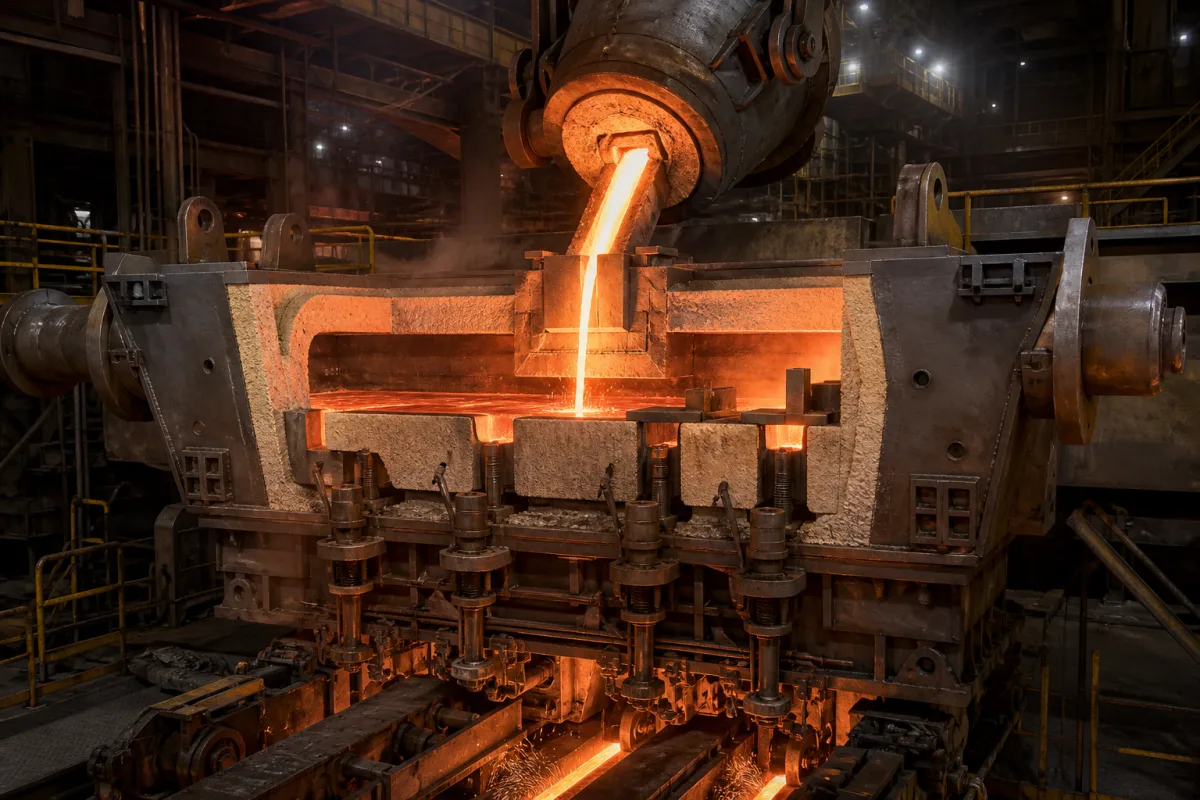
Technical details and manufacturing context for Tundish
| Parameter | Typical range | Notes & selection driver |
|---|---|---|
| Capacity | 15–60 t | 15–60 — Working capacity; 20–35 t typical for a 100–150 t ladle. Working capacity; 20–35 t typical for a 100–150 t ladle. |
| Throughput | 1.0–3.5 t/min | 1.0–3.5 — Steel flow rate; depends on casting speed and strand count. Steel flow rate; depends on casting speed and strand count. |
| Lining material | MgO-C, Al2O3-SiC-C, or ZrO2 | MgO-C, Al2O3-SiC-C, or ZrO2 — Working lining; permanent lining typically high-alumina or MgO-based castable. Working lining; permanent lining typically high-alumina or MgO-based castable. |
| Shell material | ASTM A516 Gr.70 or S355J2 | ASTM A516 Gr.70 or S355J2 — Steel shell; thickness 20–40 mm. Steel shell; thickness 20–40 mm.ASTM A516/A516M, EN 10025 |
| Slide gate size | DN 100–DN 200 mm | DN 100–DN 200 — Nozzle bore; matches ladle shroud and SEN. Nozzle bore; matches ladle shroud and SEN. |
| Slide gate plate material | Al2O3-C or ZrO2-C | Al2O3-C or ZrO2-C — High wear resistance; thermal shock resistance. High wear resistance; thermal shock resistance. |
| Thermal homogeneity | ±5 °C | ±5 — Temperature difference across tundish; ensures consistent casting. Temperature difference across tundish; ensures consistent casting. |
| Lining service life | 10–30 heats | 10–30 — Depends on steel grade and lining material; MgO-C longer life. Depends on steel grade and lining material; MgO-C longer life. |
| Slide gate service life | 3–8 heats | 3–8 — Plate wear; ZrO2-C longer life. Plate wear; ZrO2-C longer life. |
| Tundish preheat gas | Natural gas or LPG | Natural gas or LPG — Flow rate 50–150 Nm3/h depending on size. Flow rate 50–150 Nm3/h depending on size. |
| Tundish cover | Steel reinforced with castable or ceramic fiber | Steel reinforced with castable or ceramic fiber — Reduces heat loss and reoxidation. Reduces heat loss and reoxidation. |
| Tundish capacity accuracy | ±2 % | ±2 — Deviation from nominal capacity; affects steel level control. Deviation from nominal capacity; affects steel level control. |
| Molten steel temperature | 1520–1560 °C | 1520–1560 °C — Outside this window: Below 1520 °C: risk of premature solidification; above 1560 °C: refractory wear accelerates and reoxidation increases. Outside this window: Below 1520 °C: risk of premature solidification; above 1560 °C: refractory wear accelerates and reoxidation increases. |
| Preheat temperature | 1100–1200 °C | 1100–1200 °C — Outside this window: Below 1100 °C: thermal shock cracking of lining; above 1200 °C: sintering and spalling. Before casting to prevent thermal shock and steel skulling. |
| Preheat rate | ≤ 100 °C/h | ≤ 100 °C/h — Outside this window: Faster heating causes thermal shock and cracking. To avoid cracking the refractory lining. |
| Steel flow rate | 1.0–3.5 t/min | 1.0–3.5 t/min — Outside this window: Too low: steel level fluctuations; too high: turbulence and slag entrainment. Outside this window: Too low: steel level fluctuations; too high: turbulence and slag entrainment. |
| Slide gate opening | 20–80% of full opening | 20–80% of full opening — Outside this window: Below 20%: poor flow control and erosion; above 80%: reduced controllability. Outside this window: Below 20%: poor flow control and erosion; above 80%: reduced controllability. |
Ranges are indicative industry figures for RFQ preparation, not a supplier commitment. Confirm every value and standard with the legal manufacturer before ordering.
This component is essential for the following industrial systems and equipment:
Indicative industry ranges for design and RFQ preparation. Confirm the exact figures and applicable standard with the manufacturer before specifying.
Quoted from the published standard.
Manufacturer profiles associated with Tundish.
Manufacturer listings support early research and capability understanding. They are not certification, ranking, or transaction guarantees.
A practical evidence checklist for RFQ preparation and supplier evaluation.
CNFX does not score or rank suppliers. Buyers must verify all claims and documents with the legal manufacturer before ordering.
The working capacity typically ranges from 15 to 60 tonnes, depending on the ladle size and casting requirements. For a 100–150 t ladle, a capacity of 20–35 t is common. Always confirm the exact capacity for your specific model with the manufacturer.
The working lining can be MgO-C, Al2O3-SiC-C, or ZrO2, while the permanent lining is typically high-alumina or MgO-based castable. The steel shell is often ASTM A516 Gr.70 or S355J2, with a thickness of 20–40 mm. Material selection depends on steel grade and service life requirements.
Preheating to 1100–1200 °C prevents thermal shock and steel skulling. The preheat rate should not exceed 100 °C/h to avoid cracking the refractory lining. Proper preheating ensures the tundish is ready for casting and extends lining life.
If the molten steel temperature falls below 1520 °C, there is a risk of premature solidification. Above 1560 °C, refractory wear accelerates and reoxidation increases. Maintaining the 1520–1560 °C window is critical for consistent casting and product quality.
Editorial classification, named public sources where available, and source-reviewed manufacturer records.
Ask for use case, specification boundaries, supplier type, and RFQ preparation information for this product.
Compare manufacturer profiles with relevant product and process capability.