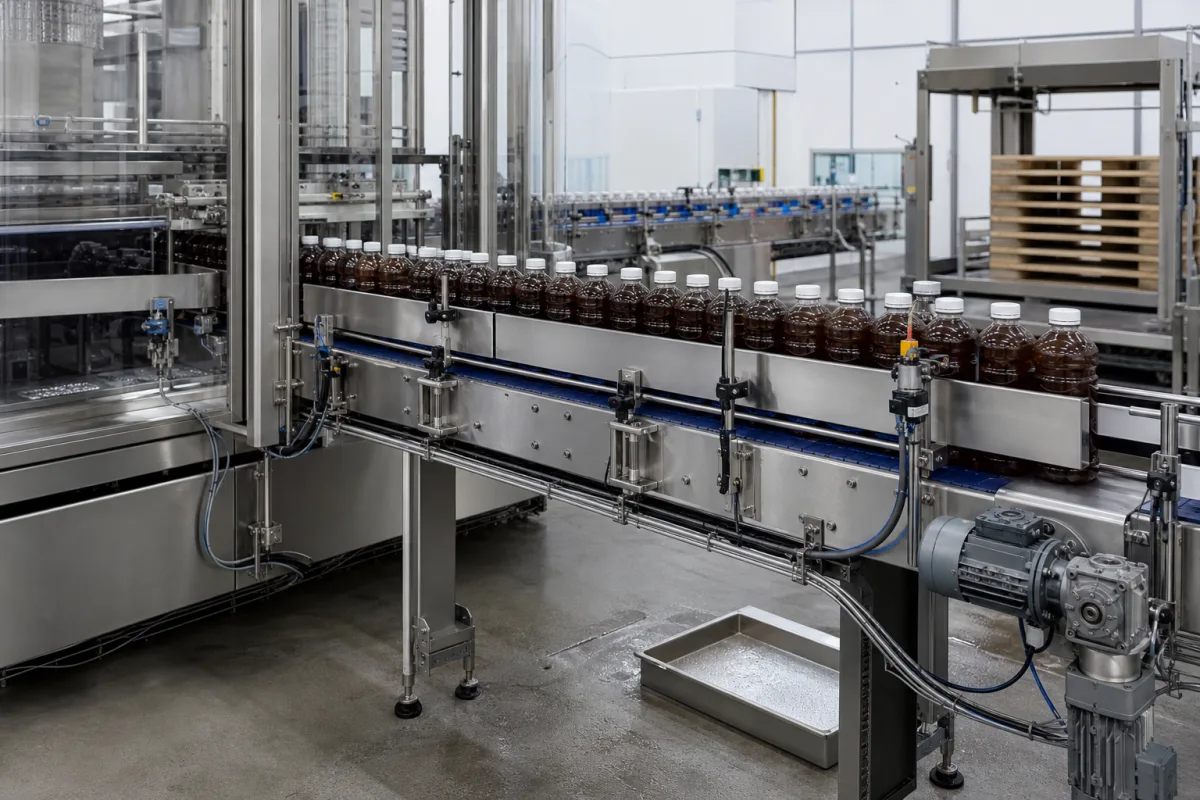
Outfeed conveyor of a beverage filler: the discharge and accumulation run that keeps the filler going when the labeller stops
Filled bottles leaving the filler and capper · how much backlog the outfeed holds, how fast it empties again, and the photo-eyes that set downstream speed
The filler is the machine a beverage line is built around, and the conveyor leaving it decides how often it has to stop. If the labeller or packer downstream halts, the outfeed has to take the bottles the filler is still discharging; when the labeller restarts, the outfeed has to hand that backlog back faster than the filler makes new bottles. That makes the outfeed a buffer measured in minutes and bottles, controlled by photo-eyes along its length.
Discharge and accumulation conveyors carrying filled and capped bottles from a filler or filler-capper monobloc to the labeller or next machine, including accumulation tables and in-line buffers, backlog sensors and the speed control between filler and labeller. Plant-wide conveyor types are covered on the Conveyor systems page; TableTop chain, wear strips and guide rails of single-file runs are covered on the Conveyor module for beverage containers page; infeed and outfeed starwheels of leak testers on the in-line container leak tester infeed/outfeed page; truck loading conveyors on the Loading conveyor for trucks and containers page.
CNFX editorial research · Sources checked October 13, 2026 · 3 sources
In a Garvey Conveyors bottled-water case study, a line analysis found the filler to be the constraint, and an accumulator between filler and labeller was added so that downstream stops would not halt it. For 12 oz plastic bottles, 2.5 in in diameter and 6 in tall, with an infeed rate of 360 bottles per minute and an outfeed rate of 420 bpm, the accumulator holds 1,650 bottles for approximately 4.5 minutes; bottles arrive in single file from the filler and either accumulate on the table or pass through to a two-lane nested outfeed. [1]
Editorial calculation: 1,650 bottles ÷ 360 bpm = about 4.6 minutes of filler output, matching Garvey's approximately 4.5 minutes. Once the downstream machine restarts at 420 bpm while the filler still runs at 360 bpm, the buffer drains at only 60 bpm net, so a full buffer takes about 1,650 ÷ 60 = 27.5 minutes to empty again. A buffer that refills before it has drained gives less than its full minutes on the next stop. [1]
The Illinois Tool Works patent US 9,670,007 describes the same buffering duty for its accumulators between a filler and a capper: when the downstream station slows or stops, the outfeed conveyor slows or stops while the infeed keeps running and a transfer device moves to take more articles in, and the line need not stop as long as the downstream station returns before the accumulator is full. If the upstream station stops instead, the outfeed keeps running at full speed while articles remain. [3]
Give the supplier the filler's rated speed, the downstream machine's speed, the container size and the downtime the outfeed must ride through; ask for buffer capacity in bottles and in minutes, and for the time it takes to empty again.
02
Photo-eyes along the outfeed that hold a set backlog ahead of the labeller
Canadian Stackpole's US patent 4,361,759 (1982) describes a distillery line in which a filler-capper discharges onto an accumulation conveyor feeding a labeller. The labeller runs slower than the capper so bottles build up; when a photoelectric sensor sees a set backlog, the labeller speed is synchronised to the capper speed, holding that backlog whatever the capper does. [2]
The patent contrasts this with earlier on/off control from single sensors upstream and downstream of the labeller, where each sensor change switched the labeller between speeds, and says that holding a set backlog lets the accumulation tables be up to 50% smaller. A time delay on the backlog sensor lets a few extra bottles build up before synchronising, so uneven packing does not switch it on and off. [2]
Editorial calculation: in the patent example, 600 bottles at the 200 bpm capper rate is 3 minutes, and the same 600 bottles at the 150–175 bpm labeller rate last about 3.4 to 4 minutes, consistent with the patent's three to four minutes. [2]
Element
Value in the patent example
Backlog area ahead of the labeller
About 500 bottles at a line speed of 200 bottles a minute [2]
Speed steps where a mass-flow table narrows to single file
On the outfeed side of an accumulation table, bottles carried in mass have to be thinned back to single file. ITW's patent drives a set of nested endless conveyor loops, each loop outward of the innermost one running about 10% faster than the loop inside it; with seven loops, the linear speed roughly doubles. [3]
Editorial calculation: seven 10% steps multiply speed by 1.1⁷ ≈ 1.95, consistent with the patent's description of roughly doubling. [3] Garvey's line also recombines a two-lane nested pattern into single file through a pressure combiner before feeding a labeller at 180 bpm. [1]
The image shows filled, capped amber bottles leaving the filler in single file on a plastic chain conveyor with photo-eyes on posts, a geared motor drive and a drip tray beneath. Ask where the backlog, overflow and low-level sensors sit along the outfeed and what each one does to filler and labeller speed.
04
Line speeds and stoppages the outfeed has to absorb
Paste it into your enquiry below or into an email to a maker, then replace every bracket.
Containers: [type; diameter; height; filled weight; cap]
Filler: [rated speed bpm; monobloc with capper yes/no]
Downstream: [labeller or packer speed; longest stop to ride through]
Buffer: [bottles; minutes; time to empty; single file or mass flow]
Control: [backlog, overflow and low-level sensor positions; speed signals to filler and labeller]
Layout: [length available; transfers; wet-floor drainage]
Explore company information and manufacturing capabilities, then discuss the scope of your project with a relevant supplier.
Share this page
Compiled and source-reviewed by the CNFX editorial team.
Each manufacturer above links to the page on that company's own website where the product is listed, with the date we checked it. How we source and review
· Page last updated 13 October 2026
Buyer questions
How much accumulation does a filler outfeed need?
It is sized in minutes of filler output; in Garvey's case 1,650 bottles gave about 4.5 minutes at 360 bpm. [1]
Why should the downstream machine run faster than the filler?
To empty the buffer after a stop: at 420 bpm against a 360 bpm filler, a full 1,650-bottle buffer takes about 27.5 minutes to drain (editorial calculation from Garvey's figures). [1]
How do sensors hold a backlog ahead of the labeller?
In Stackpole's patent the labeller runs slower than the capper until a photo-eye sees the set backlog, then is synchronised to the capper speed. [2]
How is a mass of bottles turned back into single file?
ITW's patent uses nested loops, each about 10% faster than the one inside it, roughly doubling speed over seven loops. [3]
Sources and what still needs a direct check
Sources checked 2026-10-13. A conveyor maker's case study (Garvey Conveyors) and two patents, one by Canadian Stackpole on speed control between capper and labeller and one by Illinois Tool Works on mass-flow accumulation with single-file output.