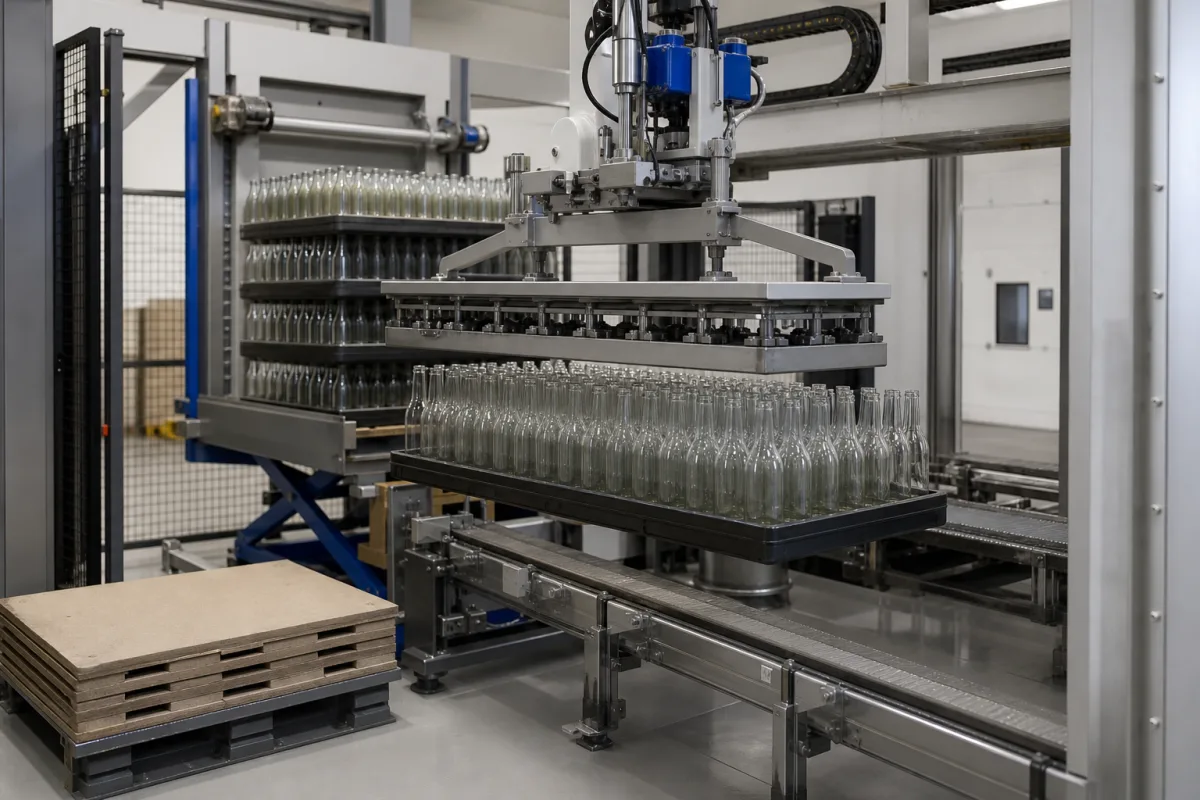
Bulk depalletizers for empty bottles and cans · Layer hoist, sweep-off carriage and discharge table, tier-sheet and pallet removal, layers per hour against containers per hour, pallet and container size limits, discharge height and single-file transfer
An automated beverage container depalletizing machine takes empty bottles or cans delivered in bulk — stacked in layers on a pallet with sheets between them — lifts each layer to a discharge table, sweeps it off, removes the sheets, trays and empty pallet, and feeds the containers to the line, where they are brought into single file for rinsing, filling or decorating. Ask three things first: what containers and pallet pattern arrive, how many layers per hour the line needs, and what must happen to sheets, top frames and pallets.
Bulk depalletizers that unload layers of empty glass, plastic or metal beverage containers from pallets: low-level sweep-off machines and other layer-transfer designs, sheet and pallet handling, and discharge tables. Case and full-product depalletizing, palletizers (see automated beverage container palletizing system), bottle unscramblers for loose PET (see bottle unscrambler) and pallet conveyors are outside this page except where compared.
CNFX editorial research · Sources checked October 12, 2026 · 4 sources
KHS's data sheet for the Innopal AS-1-N describes a two-column, low-level bulk depalletizer for new containers of glass, plastic or metal, with a capacity of up to 240 layers per hour; it accepts pallets 800–1,200 mm in the sweep-off direction and 1,000–1,200 mm across it, a block height including pallet of up to 2,000 mm, and containers at least 40 mm in diameter and 60–400 mm tall; the machine measures 4,500 × 2,400 × 4,765 mm (L × W × H) and weighs 5,900 kg, both without control cabinet and discharge table, uses servomotors and cog belts, and has plastic-covered product-contact surfaces. [1]
A dealer's bulk-depalletizer listings describe an Ocme Dorado 162 LF low-level, single-lane machine rated to 2.5 layers per minute or 150 layers per hour for 40 × 40 in and 40 × 48 in pallets with a 600 kg maximum payload, and an Ouellette BKD-500 rated from 30 to 210 tiers per hour, each with the number of containers depending on materials and application. [3]
Editorial calculation: container output equals layers per hour × containers per layer. As an illustration, a 1,200 × 1,000 mm layer of 60 mm-diameter bottles in a square pattern holds at most 20 × 16 = 320 bottles (ignoring edge clearance), so 240 layers/h would be a ceiling of about 76,800 bottles/h; real patterns and pallet changes reduce this, so ask for the rate with your pallet pattern. [1]
Give the supplier the container drawings (material, diameter, height, mass), pallet sizes and patterns, layers per pallet and block height, sheet, tray and top-frame types, required containers per hour and layers per hour, discharge height and direction, pallet and sheet disposal, available floor space and ceiling height, utilities, control system and safety standard.
02
Set sheet and pallet handling and the discharge
The KHS machine centres the layer on all sides on the sweep carriage and centres the block underneath, can be fitted for fully automatic disposal of plastic or cardboard pallet liners, inverted trays and pallets, and adapts the container discharge table to the line height with a height-adjustable sweep-off frame; changeover uses a motor-driven adjustable sweep carriage, and options include a handling robot for liners and pallets and a discharge table with row-by-row removal. [1]
The dealer listings describe multiple pincher fingers that grip slip sheets during the sweep cycle and stack them in a magazine, a pallet hoist supporting all four corners with 4-way guides retaining each layer during the sweep, low-level container and empty-pallet discharge conveyors with an empty-pallet stacker, and T-type safety light curtains. [3]
US patent 11,565,894 explains that empty beverage containers are sold on pallets in layers with separating inserts, and must be delivered uniformly in single file for washing, decorating or filling; it describes a vertically movable platform bringing each tier level with a takeoff surface, a sweeper arm moving the layer off, and — in its own design — a rotary table that accumulates containers and guides them down a discharge conveyor, with the push-off quantity and speed adjusted for container size and shape. [2]
03
Compare high-level and low-level layer rates on the same basis
Busse/SJI, a Regal Rexnord brand, lists two bulk depalletizers. Its "Alpha Turbo™ High Level Bulk De-palletizer" can "process up to 10 layers per minute (depending on product)", with machine health monitoring of airflow, pressure, vacuum, actuation speed and motor vibration, a maximum load height of 110 in (2790 mm), loads up to 4,000 lbs., a standard pallet of 44 x 56 in (1120 x 1420 mm), 460V / 3Ph / 60Hz power, 24 VDC controls and 8.4 SCFM at 80 psi (237.9 liters/min at 5.5 bar). Its "Xodus™ Low Level Bulk Depalletizer" performs capture, sweeping and discharge simultaneously, with container changeovers "in just 15 minutes". [4]
The Xodus page gives two figures, "up to 3.4 layers per minute (including pallet change)" in its description and "4 layers per minute, including pallet change" in its specification list [4]. Ask which figure the supplier will guarantee and for which container and layer pattern. KHS quotes its low-level machine in layers per hour [1], and the Frain listings mix layers and tiers per hour [3]; convert all of them to one unit before comparing.
Busse/SJI's high-level machine is quoted at about two and a half to three times the layer rate of its low-level machine [4]. The sources do not compare the two designs on container handling, so give the supplier your container type (glass, PET or cans), pallet pattern and line speed and ask which design it recommends and why, along with the discharge height to your line.
Editorial calculation: 10 layers per minute is 600 layers an hour; 3.4 to 4 layers per minute is 204 to 240 layers an hour, the upper end matching KHS's 240 layers per hour; 110 in is 2,794 mm and 4,000 lb is about 1,814 kg. [4][1]
Item
Busse/SJI Alpha Turbo™ (high level)
Busse/SJI Xodus™ (low level)
KHS Innopal AS-1-N (already cited)
Layer rate (as published)
Up to 10 layers per minute (depending on product)
Up to 3.4 layers per minute including pallet change (spec list: 4)
Up to 240 layers per hour
Load
Up to 4,000 lbs.; 110 in (2790 mm) height
Up to 4,000 lbs.
Block height up to 2,000 mm
Pallet
44 x 56 in (1120 x 1420 mm); 40 in (1000 mm) width option
—
800–1,200 × 1,000–1,200 mm
Power
460V / 3Ph / 60Hz; 24 VDC control
460V / 3Ph / 60Hz (230 or 575V options); 7 ½ HP gear motor
—
Air
8.4 SCFM @ 80 psi
1 m³/hour @ 80 psi
—
Changeover
—
15 minutes (container)
Motor-driven sweep carriage
Values are from the Busse/SJI Alpha Turbo™ and Xodus™ pages on the Regal Rexnord conveyor solutions site; the Xodus page states two different layer rates.
04
Compare depalletizer arrangements
These arrangements are described in the cited sources.
Fill the specification fields with values for your line
A depalletizer quotation needs values for your containers and pallets. The table explains each field, gives published values where a reviewed source states them, and says what to obtain from the supplier.
Field
What it means and published values
Ask the supplier for
Throughput capacity
Up to 240 layers/h in one data sheet; 150 layers/h and 30–210 tiers/h in listings [1][3]; up to 10 layers/min high level. [4]
Layers/h and containers/h with your pattern.
Container size range
Diameter ≥ 40 mm, height 60–400 mm in one machine. [1]
Range for your formats.
Pallet height capacity
Block height to 2,000 mm including pallet in one machine. [1]
Block height and pallet sizes.
Power consumption
Installed and average power.
kW and supply.
Operating pressure
Compressed air, e.g. 8.4 SCFM at 80 psi (5.5 bar). [4]
bar and consumption.
Footprint dimensions
4,500 × 2,400 × 4,765 mm without table in one machine. [1]
Explore company information and manufacturing capabilities, then discuss the scope of your project with a relevant supplier.
Share this page
Compiled and source-reviewed by the CNFX editorial team.
Published product pages show what a company offers, not tested performance. Confirm the legal seller, factory, safety conformity and scope for your order. How we source and review
· Page last updated 13 October 2026
Buyer questions
How fast is a bulk depalletizer?
It is rated in layers per hour; one data sheet gives up to 240 layers/h, and container output depends on how many containers make up a layer. [1]
What happens to the sheets between layers?
Machines can remove liners, trays and pallets automatically, for example with pincher fingers that stack sheets in a magazine. [1][3]
Why must containers end up in single file?
Downstream washing, decorating and filling take containers one by one, so the swept layer is guided into a single-file line. [2]
How fast is a high-level bulk depalletizer compared with a low-level one?
Busse/SJI lists its Alpha Turbo high-level depalletizer at up to 10 layers per minute depending on product, and its Xodus low-level machine at up to 3.4 layers per minute including pallet change (4 in its specification list). [4]
Sources and what still needs a direct check
Sources checked 2026-10-12. The KHS data sheet describes one maker's machine, the dealer listings describe used machines, and the patent describes one design; rates and limits for your containers must come from the supplier offered.