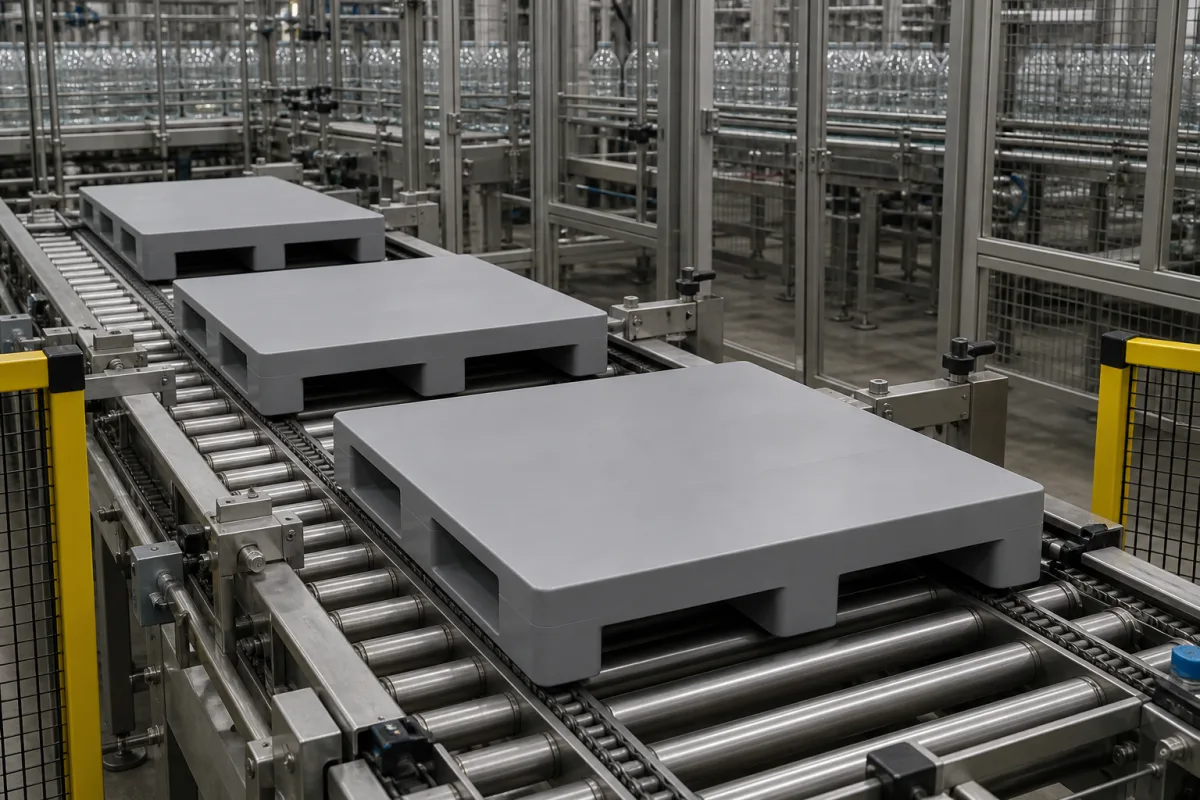
Pallet conveyor (roller and chain conveyors for loaded pallets)
Unit-load conveyors · pallet size and weight, roller pitch and diameter, load per metre, chain-driven versus motor-driven-roller modules
A pallet conveyor moves loaded or empty pallets between palletisers, depalletisers, wrappers, stores and docks on powered rollers or chains, built from modules with transfers and turntables and controlled for zero-pressure accumulation. Ask three things first: which pallets it must carry (size, type, condition and the heaviest load), what load per metre and per drive each module is rated for, and how many rollers will always sit under the pallet's bottom boards.
Powered roller and chain conveyors for loaded and empty transport pallets, including transfers and turntables, as used at the end of beverage and packaging lines. Workpiece-carrier (assembly pallet) systems, gravity pallet flow racks, loose conveyor rollers and forklift-free vehicles are outside this page.
CNFX editorial research · Sources checked October 11, 2026 · 4 sources
The European Pallet Association specifies the EPAL Euro pallet as 1,200 × 800 mm and 144 mm high, weighing about 25 kg, with a safe working load of 1,500 kg; when laden pallets are stacked on a solid, even surface, the bottom pallet must carry no more than 5,500 kg. Its deck and bottom boards are 22 to 24 mm thick, and the bottom boards are chamfered on both long upper edges. [1]
EPAL lists faults that make a Euro pallet non-exchangeable, among them a missing board or block, blocks twisted more than 10 mm, and boards broken across or diagonally. [1] Editorial note: give the supplier every pallet type and condition the line will see, including plastic pallets, and ask how damaged pallets will be detected and rejected.
Give the supplier the pallet types, sizes and conveying direction, heaviest and lightest loads, load height and stability, throughput in pallets per hour, layout with transfers and turntables, accumulation needs, interfaces to palletiser or wrapper, environment (cold store, wash-down), and safety guarding.
02
Rate each module for load per metre and roller pitch
Interroll's PM 9711 chain-driven pallet roller conveyor is rated at a maximum of 1,000 kg/m or 1,200 kg per drive at 0.22 m/s, using 80 mm zinc-plated steel rollers with 3 mm walls at a pitch of 190.5 or 222.25 mm, a 0.07 kW in-roller pallet drive at 400 V and chain transmitted roller to roller so no chain tensioning is needed; conveying widths are 860, 1,060 and 1,295 mm. [2]
Its PM 9712 module instead drives a fixed number of idlers with a 24 V or 48 V RollerDrive through PolyVee belts, rated at 415 kg/m or 500 kg per drive at 0.2 or 0.28 m/s, with 60 mm rollers of 2 mm wall at a pitch of 90 to 120 mm. Both are specified for +5 to +45 °C non-condensing, with deep-freeze applications on request. [3]
Editorial calculation: a 1,200 mm Euro pallet conveyed lengthwise spans 1,200 / 190.5 ≈ 6.3 roller pitches, so at least 6 rollers are under it, or about 5 at 222.25 mm pitch. A fully rated 1,500 kg load on 1.2 m is 1,250 kg/m, above the 1,000 kg/m and 1,200 kg-per-drive ratings of the chain-driven module, and well above the 415 kg/m of the roller-drive module. [1][2][3] Use your heaviest real pallet, not the pallet's rated load, and check the drive rating as well as the per-metre rating.
03
Use drag chain where pallets will not ride on rollers
Roller modules need a pallet bottom that bridges the rollers. Hytrol, a US conveyor maker, describes its heavy-duty drag chain conveyors as dragging loads on chains, which suits items with uneven bottoms or loads that are difficult to move on roller conveyors. It lists load capacities up to 6,000 lbs, straight and curve versions, reversible options for bi-directional flow, handling of wet, dirty or oily products and use in high-temperature areas. Its transport models are the DC-62 and DC-63 and its accumulation models the DCEZD-62 and DCEZD-63, which use EZLogic accumulation control combining photo-electric sensing with discrete electronic logic without a PLC or pneumatic logic components. [4]
Editorial calculation: 6,000 lb is about 2,722 kg, which is above the 1,500 kg safe working load EPAL gives for a Euro pallet. [4][1] Editorial note: Hytrol states its figure as a load capacity, not per metre, so ask the supplier whether it is per unit load, per section or per drive, and at what speed, before comparing it with the Interroll kg/m ratings. [4][2]
End-of-line pallet lines, motorised-roller conveyors, and chain or roller systems with turntables
Listings include automated pallet conveyor lines and heavy-duty chain conveyors from an end-of-line packaging maker, pallet conveyors with motorised drive rollers, and pallet conveyor systems with dispensers, lifts and 90° turntable transfers. Ask each for the module load ratings, roller pitch and pallet types tested.
05
Rollers, in-roller or 24/48 V drive, chain or belt, frame, stops and turntables
Roller diameter and wall go with the module rating: 80 mm rollers with 3 mm walls on the 1,000 kg/m PM 9711, 60 mm with 2 mm walls on the 415 kg/m PM 9712. Transfers and turntables have no published detail in either datasheet. [2][3]
Part
Role
Fix in the order
Rollers
Carry the pallet; diameter and wall set capacity. [2][3]
Diameter, wall, material, pitch.
Drive
In-roller pallet drive with chain, or 24/48 V roller drive with belts. [2][3]
Load per metre and per drive, pallet size, speed, voltage and width for a conveyor order
Load capacity is quoted two ways, per metre and per drive, and both limits apply; positioning accuracy, IP rating and module weight have no published value in the Interroll datasheets. [2][3]
Field
What it means and published values
Ask the supplier for
Load Capacity (kg)
Example: 1,000 kg/m or 1,200 kg per drive (chain-driven); 415 kg/m or 500 kg per drive (24/48 V). [2][3]
4 companies list this product among what they make. Company figures are quoted from each
company's own website; every card states where the relationship came from.
Changshuo Conveyor Equipment (Wuxi) Co., Ltd.
Manufacturing site to be confirmed for the order
Lists automated pallet conveyor lines and heavy-duty chain conveyor lines with end-of-line packaging machines.
Explore company information and manufacturing capabilities, then discuss the scope of your project with a relevant supplier.
Share this page
Compiled and source-reviewed by the CNFX editorial team.
Each manufacturer above links to the page on that company's own website where the product is listed, with the date we checked it. How we source and review
· Page last updated 13 October 2026
Buyer questions
How heavy can a Euro pallet load be?
EPAL gives a safe working load of 1,500 kg for the 1,200 × 800 mm EPAL Euro pallet. [1]
What load per metre does a pallet roller conveyor take?
It depends on the module; Interroll rates its chain-driven PM 9711 at 1,000 kg/m and its 24/48 V PM 9712 at 415 kg/m. [2][3]
What roller pitch is used for pallets?
Interroll lists 190.5 or 222.25 mm for its 80 mm chain-driven rollers and 90 to 120 mm for its 60 mm roller-drive module. [2][3]
When is a drag chain conveyor used for pallets?
Hytrol describes drag chain conveyors for loads with uneven bottoms or that are hard to move on rollers, with capacities up to 6,000 lbs and wet, dirty or oily products. [4]
Sources and what still needs a direct check
Sources checked 2026-10-11. EPAL is the association that licenses Euro pallets. Interroll and Hytrol are conveyor makers; their datasheets and product pages describe their own modules and are examples, not general limits.