Fill-level verification for net-content compliance: setting the bottle reject limit from OIML tolerable deficiencies and NIST MAVs
Fill-level checking set up for net-content law · the tolerable deficiencies and MAVs a reject limit protects, the lot rules that apply after the checker, and calibrating a level reading to volume
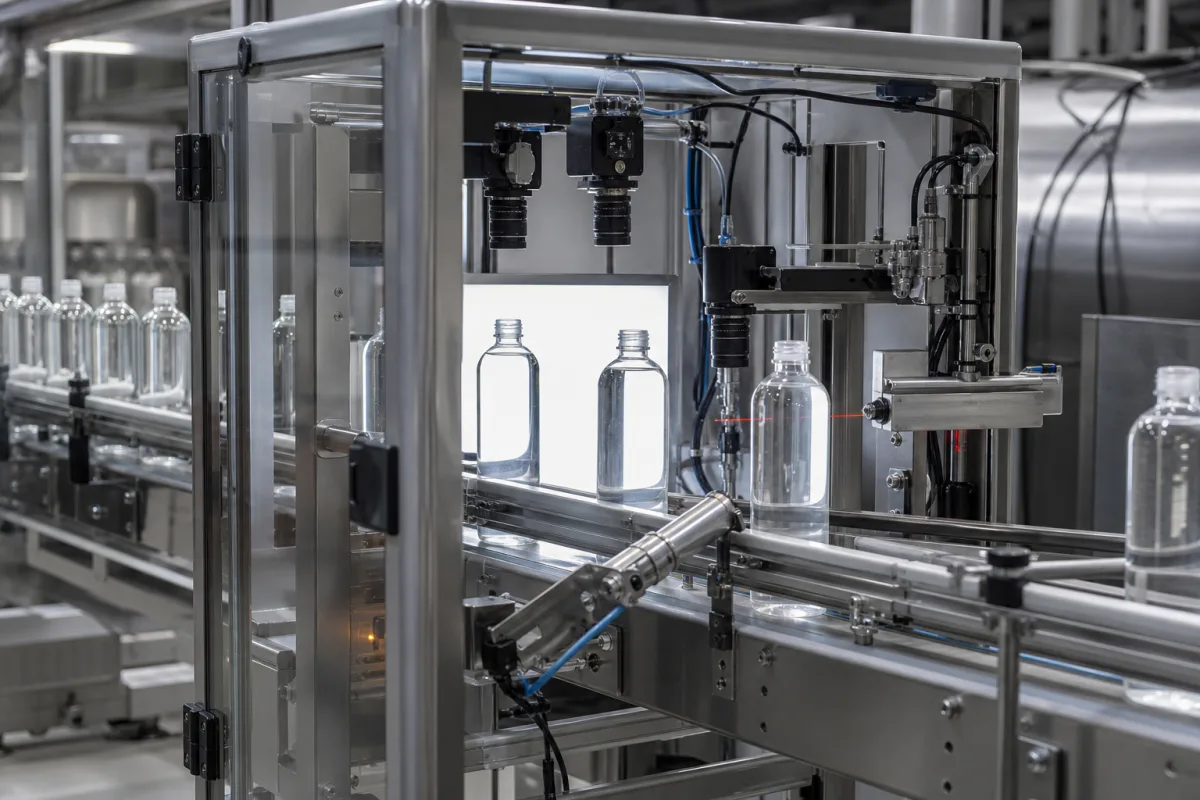
A fill-level verification system measures how high the liquid stands in each bottle and rejects those outside a set band. The technology that takes the reading — light, camera, X-ray or high-frequency — is one question; where the reject threshold sits, and how a level reading is tied back to millilitres, is another, and that second question is set by net-content law rather than by the inspection hardware. Legal metrology checks the lot that leaves the checker: the average must reach the stated volume, only a small share of bottles may fall short by more than the tolerable deficiency, and none may fall short by more than twice it. A checker set without those numbers can either pass bottles the law treats as defective or reject good product the filler could have kept.
Fill-level checking stations and their reject settings on beverage filling lines, specified for net-content compliance: reject limits derived from tolerable deficiency (OIML R 87, UK and EU average-quantity rules) or maximum allowable variation (NIST Handbook 133), conversion of level readings to volume, and the reference tests used to calibrate them. Choosing among fill-level measuring technologies, cap inspection and vision reject handling are covered on the Bottle inspection systems page; foreign object detection for wireless EV charging is covered on its own page. Checkweighers for solid packaged goods are outside this page.
CNFX editorial research · Sources checked October 12, 2026 · 3 sources
The tolerance behind the reject limit: OIML tolerable deficiency and NIST MAV for 250 mL to 2 L bottles
OIML R 87:2016 defines the tolerable deficiency T by nominal quantity: 9 mL for 200–300 mL, 3% of the nominal for 300–500 mL, 15 mL for 500–1,000 mL and 1.5% for 1,000–10,000 mL, with T rounded up to the next 0.1 mL at or below 1,000 mL and to the next whole mL above. [1] NIST Handbook 133 uses a different table of maximum allowable variations (MAVs) for packages labelled by volume. [2] The two give different numbers for the same bottle.
The UK Weights and Measures (Packaged Goods) Regulations 2006 define the minimum acceptable contents as the nominal quantity minus the tolerable negative error for that quantity. [3] Editorial calculation: for a 1 L bottle that is 1,000 − 15 = 985 mL under OIML/UK rules, while a NIST MAV of 29 mL puts the comparable US threshold at 971 mL; a line shipping to both markets has to set its checker to the tighter one.
Neither table tells the checker what liquid height corresponds to those volumes; that comes from calibrating the level reading on the actual bottle and product, covered below.
Average, T1 and T2 errors: the rules the lot must meet after the checker has removed its rejects
OIML R 87 sets three requirements on a lot: the average actual quantity must be at least the nominal quantity; no more than 2.5% of prepackages may carry a T1 error, meaning short by more than T but not more than 2T; and no prepackage may carry a T2 error, short by more than 2T. [1] It defines the inspection lot taken from a production line as all prepackages not rejected by a checking system, and requires samples to be collected after the packer's point of final checking. [1]
That definition puts the fill-level checker inside the legal test: whatever it lets through is the lot. Editorial calculation: for a 500 mL bottle, T = 15 mL and 2T = 30 mL, so any bottle below 470 mL is a T2 error that must not reach the lot, and bottles between 470 and 485 mL may make up no more than 2.5% of it; a reject limit at or above 485 mL removes both.
OIML also limits the measuring side: the expanded uncertainty (k = 2) of instruments and methods used to determine quantities shall not exceed 0.2 T, counting maximum permissible error, repeatability, packing-material variation and density changes from temperature. [1] The UK reference test says the same in its own words — the error in measuring actual contents shall not exceed one fifth of the tolerable negative error — and requires volume to be measured at, or corrected to, 20 °C. [3] Editorial calculation: for T = 15 mL, one fifth is 3 mL, which is the order of measurement error a level reading has to hold when it is used to judge whether a bottle is short.
Editorial note: ask the supplier for the checker's level repeatability expressed in millilitres on your bottle at your line speed, and compare it with T/5 for each bottle size you run.
03
Tying a level reading to millilitres: 20 °C reference, density and the MAV/6 scale rule
NIST HB 133 gives the gravimetric test that turns weighed bottles into volumes for non-viscous liquids. For soft drinks, bottled water and other liquids that need no refrigeration the reference temperature is 20 °C (68 °F). [2] The scale's division must not exceed the MAV divided by six, converted to weight through the product density: in its worked example a 1 L package with a 29 mL MAV and a density of 0.943 g/mL gives 29 × 0.943 ÷ 6 = 4.557 g, so a scale reading in 1 g steps is adequate. [2]
The procedure measures density in a volumetric flask one size smaller than the label — a 500 mL flask for a 1 L soft drink — with two drops of a defoaming agent such as hexanol or octanol for carbonated products and the density reading taken at once to limit loss of carbonation. [2] If the densities from two packages differ by more than one division, the volumetric procedure is used instead; otherwise package errors in weight are divided by the average density to give errors in volume. [2]
For a fill-level checker this gives a calibration route: fill bottles to known levels around the intended reject point, measure their contents by the reference method at 20 °C, and set the threshold from the measured relation between level and volume on that bottle. Editorial calculation: with the 1 L example above, a bottle 15 mL short weighs about 14.1 g less than nominal (15 × 0.943), well above the 1 g scale division.
04
Data for a fill-level verification enquiry
Paste it into your enquiry below or into an email to a maker, then replace every bracket.
Markets: [EU/UK average-quantity rules, US NIST HB 133, or other]
Containers: [bottle or can sizes; material; neck shapes; labelled volumes]
Product: [still or carbonated; foam; density; fill temperature]
Limits: [target fill; reject threshold in mL per size; T or MAV used]
Performance: [level repeatability in mL at line speed; rejects confirmed]
Calibration: [reference-test method; temperature correction to 20 °C; records kept]
Explore company information and manufacturing capabilities, then discuss the scope of your project with a relevant supplier.
Share this page
Compiled and source-reviewed by the CNFX editorial team.
Each manufacturer above links to the page on that company's own website where the product is listed, with the date we checked it. How we source and review
· Page last updated 13 October 2026
Buyer questions
How short can a 500 mL bottle be under OIML R 87?
T is 15 mL. No more than 2.5% of the lot may be more than 15 mL short, none may be more than 30 mL short, and the average must reach 500 mL. [1]
Is the US tolerance the same?
No. NIST HB 133 Table 2-6 gives a 14.7 mL MAV for more than 347 to 502 mL and 29 mL for more than 916 mL to 1.15 L, where OIML gives 15 mL for both 500 mL and 1 L. [2][1]
How accurate must the level measurement be?
OIML R 87 limits measurement uncertainty to 0.2 T; the UK reference test limits measuring error to one fifth of the tolerable negative error, about 3 mL for a 500 mL bottle. [1][3]
At what temperature is beverage volume judged?
At 20 °C: the UK reference test measures or corrects volume to 20 °C, and NIST HB 133 uses 20 °C for soft drinks and bottled water. [3][2]
Sources and what still needs a direct check
Sources checked 2026-10-12. Tolerable deficiencies, lot rules and the 0.2 T uncertainty limit come from OIML R 87:2016; MAVs, the 20 °C reference temperature and the gravimetric test from NIST Handbook 133 (2026); minimum acceptable contents, the one-fifth measuring-error rule and 20 °C correction from Schedule 2 of the UK Weights and Measures (Packaged Goods) Regulations 2006.