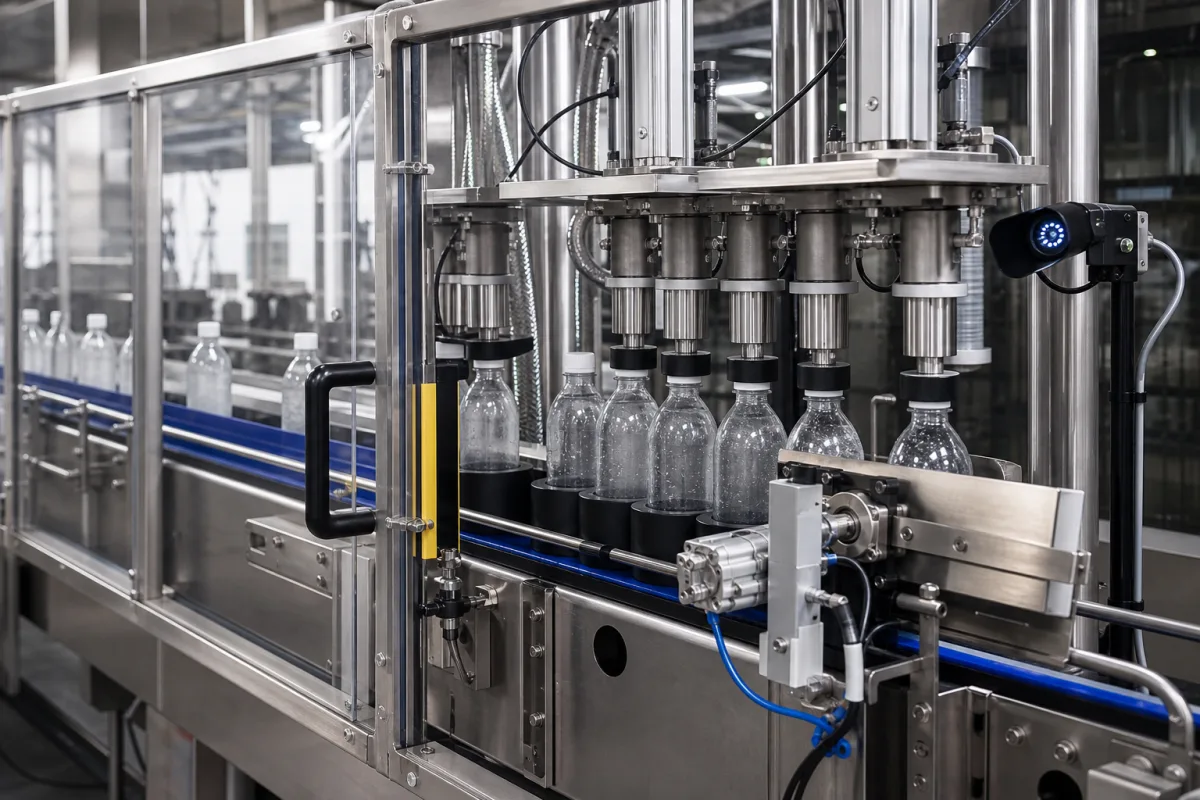
In-line leak tester for empty blow-moulded beverage bottles: mouth-seal, bottom-vacuum and tracking-head tests at blow-moulder speed
Leak testing empty blow-moulded bottles between the blow moulder and the filler · where the test pressure goes in, how fast a head must test to keep up, and what decides pass or fail
A blow-moulded bottle can leave the moulder with a pinhole, a crack or a weak preform gate that will not show until it is filled, capped and pressurised. In-line leak testers check every empty container on the conveyor between the blow moulder and the filler, which sets their design constraints: the test has to seal on a bare bottle without damaging it, it has to finish in the second or two the bottle spends under a head, and it has to keep pace with a moulder producing tens of thousands of bottles an hour. The patents below show the main ways this is done — sealing at the mouth, applying vacuum at the base, or moving heads with the conveyor — and what each one measures.
In-line leak testers for empty blow-moulded bottles, jars and canisters on beverage and packaging lines: test heads that seal on the container mouth or base, pressure-decay or vacuum measurement, head tracking on the conveyor and rejection of leaking containers. Vacuum-decay and bubble-emission testers for filled, sealed food packages are covered on the Food packaging integrity (leak) tester page; the infeed and outfeed conveyors, starwheels and reject stations of in-line testers on the Infeed/outfeed conveyor section of an in-line container leak tester page; single-file conveyors that carry bottles between machines on the Conveyor module for beverage containers page; altitude test chambers on their own page. Laboratory leak testers for closed packages are outside this page.
CNFX editorial research · Sources checked October 12, 2026 · 5 sources
Seal at the mouth, vacuum at the base, or a head that rides with the bottle
The three designs below differ in where the bottle is sealed and whether it is evacuated or pressurised. Each compares a pressure reading against what a sound bottle produces.
Editorial calculation: 0.006 in is about 0.15 mm, and the 0.008–0.010 in turntable gap is about 0.20–0.25 mm. Air Logic explains why the base gets its own test: on melt-blown PET bottles for sport drinks and bottled water, the gate area left by the preform is a source of subtle leaks, so testing that portion is particularly important. [2]
Air Logic's related patent US7266993B2 describes a mouth probe for plastic bottles that does not touch the bottle sides: a photo-eye starts the test, the probe travels with the container, introduces air, reads both the maximum pressure and the pressure decay, and the container is ejected if either is outside the acceptable range. [3]
Design (patent)
How the test is applied
Figures stated
Mouth seal with diaphragm vacuum — Owens-Illinois, US3762213A
A plug gauge fits the neck and a resilient pad seals the top; moving a flexible diaphragm away from the mouth enlarges the sealed volume and draws a partial vacuum; a sound bottle stays held on the lifted head [1]
Held for a predetermined time on the order of three seconds; detects holes as small as 0.006 in diameter [1]
Bottom vacuum on a turntable — Air Logic Power Systems, US7559232B2
Bottles stand over perforations in a rotating turntable, with vacuum drawn from a stationary plenum below to test the base, including the preform injection gate [2]
In the conventional design the gap between sealing strips and turntable is ideally 0.008–0.010 in: too large and vacuum is lost, too small and friction rises [2]
Tracking pressure-decay head — Delta Engineering, US11543323B2
A head seals on the moving container, pressurises it, disconnects the gas source and measures pressure decay while following the container, then compares the decay with stored data for acceptable containers [4]
Head connected for less than 3 s, or less than 2 s or 1 s in other embodiments [4]
Editorial note: a mouth-seal test checks the whole bottle through the neck; a base-vacuum test targets the gate area. Ask which defects the tester is validated on — pinholes in the wall, gate leaks, neck-finish damage — and with which calibrated leak.
02
Keeping up with the blow moulder: heads sealed under 3 s and rates from 100 to 1,200 bottles per minute
Delta Engineering's patent starts from throughput: state-of-the-art blow moulding machines can provide well over 10,000 containers per hour, leak testing should not become the bottleneck, and an in-line tester can take a moulder's whole output, if necessary by splitting the stream into two or more parallel lines. [4] Its claims set testing rates of at least 100 containers per minute, with embodiments of at least 600 and at least 1,200 per minute. [4]
Tracking is done from the conveyor itself: an incremental encoder on the conveyor and a laser trigger photocell register each container's position, the head synchronises with it, and after the measurement the head moves back against the conveyor direction to the next container. [4] Heads can be grouped in twos, threes, fours or more moving together, and when containers arrive closely spaced the group starts its next cycle before reaching the entry point. [4] Cincinnati Test Systems reports a rotary container tester developed by ALPS for 100% pressure-decay testing of empty bottles at up to 1,200 bottles per minute, removing suspect containers from the conveyor. [5]
Editorial calculation: 1,200 bottles per minute is 72,000 per hour, or 20 per second; if each bottle needs a head sealed for 2 s, at least 40 heads must be on bottles at any moment, before adding time to seal, release and return.
03
Pass or fail: a decay curve compared with sound bottles
All three patents judge a bottle against a reference rather than an absolute number. Delta Engineering compares the measured pressure decay with stored data for acceptable containers and issues an accept or non-accept signal; accepted containers stay on the conveyor and rejected ones are removed. [4] It notes that continuing to measure while a head is still on a container adds certainty to the decision. [4]
Air Logic's mouth probe uses two readings — the peak pressure reached and the decay that follows — so that a bottle which never builds pressure and one that loses it slowly are both caught. [3] The Owens-Illinois tester uses the bottle's own weight: a leaking bottle cannot stay held by the vacuum on the lifted head for the hold time and drops away. [1] For a buyer the questions are the same in each case: the reference curve or limit, the test time per bottle at line speed, and how rejects are confirmed.
04
Data for an empty-bottle leak tester enquiry
Paste it into your enquiry below or into an email to a maker, then replace every bracket.
Containers: [material; volumes; neck finish; base shape; empty or capped]
Rate: [bottles per minute from the blow moulder; single or split lines]
Defects: [wall pinholes, preform gate, neck finish; smallest hole to detect]
Test: [mouth seal or base vacuum; pressure or vacuum level; time under head]
Decision: [reference curve or limits; challenge bottles with calibrated leaks]
Reject: [ejector type; reject confirmation; data per bottle]
Explore company information and manufacturing capabilities, then discuss the scope of your project with a relevant supplier.
Share this page
Compiled and source-reviewed by the CNFX editorial team.
Each manufacturer above links to the page on that company's own website where the product is listed, with the date we checked it. How we source and review
· Page last updated 13 October 2026
Buyer questions
How small a hole can an empty-bottle leak tester find?
Owens-Illinois's mouth-seal tester in US3762213A states holes as small as 0.006 in (about 0.15 mm) in diameter. [1]
How long does each bottle stay under a test head?
Delta Engineering's US11543323B2 connects the head for less than 3 s, with embodiments under 2 s or 1 s; the Owens-Illinois tester holds a vacuum for about three seconds. [4][1]
Can in-line leak testing keep up with a blow moulder?
Delta Engineering claims rates of at least 100 per minute, with embodiments of 600 and 1,200; Cincinnati Test Systems reports an ALPS rotary tester at up to 1,200 bottles per minute. [4][5]
Why test the bottle base separately?
Air Logic's US7559232B2 tests the base by vacuum because the preform gate area of melt-blown PET bottles is a source of subtle leaks. [2]
Sources and what still needs a direct check
Sources checked 2026-10-12. Mouth-seal vacuum testing and hole size come from Owens-Illinois's US3762213A; base-vacuum gate testing from Air Logic Power Systems' US7559232B2 and peak-and-decay probing from its US7266993B2; tracking heads, test times and rates from Delta Engineering's US11543323B2; the 1,200 bottles per minute rotary tester from Cincinnati Test Systems.