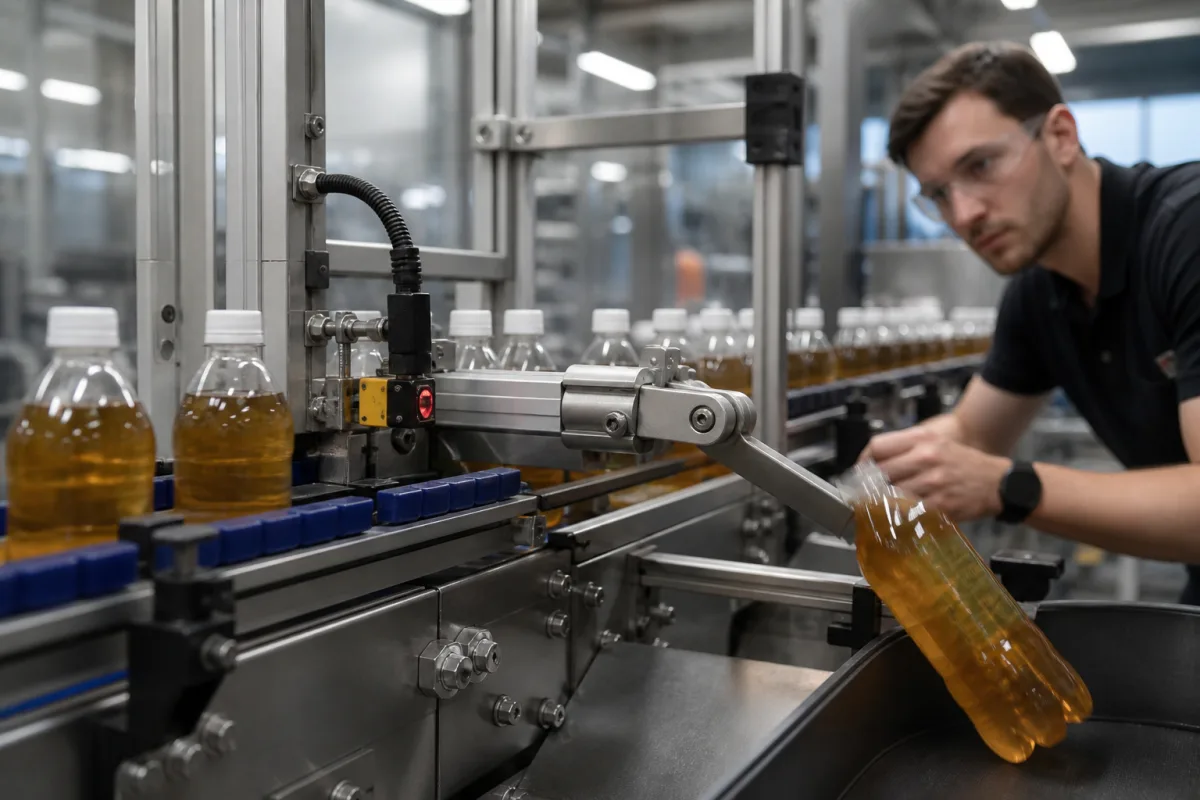
Reject arm for filled beverage bottles: pneumatic pushers, gated rams and guided ejection fingers that remove the right container
The device that physically takes a failed bottle off the line after leak or inspection · pneumatic pusher, gated ram or guided ejection fingers, the timing that hits the right bottle, and where the rejected bottle lands
Inspection only says which container is bad; the reject arm is what takes it away. On a single-file beverage line the bottles may run touching each other under line pressure, so the rejector has to strike one container, not its neighbours, push it clear without knocking it over into the next lane, and let the line close up again. That makes the choice of rejector — a pneumatic pusher into a bin, a ram through a gate onto a neck rail, or fingers that steer the bottle upright onto another conveyor — a question of container type, line speed and where the rejected bottle has to end up.
Reject arms and rejectors on beverage container lines: pneumatic pushers and rams, side gates, guided ejection fingers, the pusher pad and the tracking that times the stroke, and the reject conveyor, neck rail or bin that receives the container. The inspection systems that decide which bottle fails are covered on the Bottle inspection systems page; infeed and outfeed sections of in-line leak testers, with their own reject stations, on the Infeed/outfeed conveyor section of an in-line container leak tester page; fill-level reject limits on the Fill-level verification for net-content compliance page; the fixed guide rails that a reject gate is cut into on the Beverage bottle conveyor guide rail page.
CNFX editorial research · Sources checked October 12, 2026 · 4 sources
Pusher into a bin, ram through a gate, or fingers that steer the bottle upright
KHS sells two rejectors that show the main split. Its Innocheck PRS ejects defective PET bottles and cans into a container with a pneumatically activated cylinder triggered by an electrical signal, at up to 50,000 containers per hour, and its height can be adjusted for different container sizes. [1] Its Innocheck GRS instead ejects all containers upright onto another lane: mechanical ejection fingers running parallel to the conveyor, synchronised with belt speed, guide the container off with a minimum of impulse, and an electric trigger replaces compressed air. [2]
KHS explains the reason for guided rejection: if containers fall over during rejection they can disrupt production, while guided rather than impacted containers leave without disruption; the GRS also monitors ejection-finger position and needs no format parts at changeover. [2]
Editorial calculation: the GRS maxima cannot both apply to the largest containers. At 72,000/h (20 per second) and 1.6 m/s, the centre-to-centre spacing is 1.6 ÷ 20 = 0.08 m; 150 mm containers touching each other at 1.6 m/s give at most 1.6 ÷ 0.15 ≈ 10.7 per second, about 38,400/h. [2] Ask the supplier for the rated rate at your container diameter.
Fingers in closed stainless cassettes guide it upright onto another conveyor; versions with one or two rejection points [2]
72,000 containers/h (1,200/min); belt up to 1.6 m/s; container diameter up to 150 mm; under 80 dB(A) [2]
Gated ram (Thermedics patent)
Side gate in the guide rail opens; pneumatic ram knocks the bottle out onto a neck rail that holds it upright by its collar [3]
Ram stroke 4 in across a belt of about 3.5 in; gate opens to 70°; line 0–1,000 bottles/min, preferably about 400 [3]
Cushioned pusher (Kirin patent)
Short-stroke pusher moves the bottle sideways onto a parallel discharge conveyor running at the same speed; an oblique guard rail turns it [4]
Pusher pad of silicone tubes 8 mm ID × about 100 mm; guard rail with 10 mm sponge layer and fluoroplastic sheet [4]
Give the rejector supplier the container types and diameters, line rate and belt speed, whether bottles run touching under line pressure, where rejects must go (bin, reject conveyor, neck rail) and whether they must stay upright.
02
Hitting the right bottle: detection latency, tracking distance and the gate that holds line pressure
Thermedics' US patent 5,388,705 (1995), for rejecting bottles after a detector that samples the air in each open bottle, places the rejector station two and a half bottle diameters downstream of the sampling point, with one and a half as the minimum. The reason it gives is latency: the detection decision takes at least 200 ms after the bottle is centred under the sampler, during which a 1.5-litre bottle 3.5 inches in diameter moves nearly one and a half diameters. [3]
Because the line can run with contiguous bottles under pressure, a fixed gap in the rail would let a bottle pop out by itself, so the rail gate opens only when and for as long as a bottle is rejected; the gate assembly is kept low in mass for fast actuation, the bottles are optically tracked from detection to rejection, and the ram fires as the trailing edge of the tracked bottle passes. [3]
Kirin's US patent 6,296,102 (2001) times its stroke from a reflective light barrier upstream of the pusher: a timer started by the bottle breaking the beam fires the solenoid valve after a preset delay chosen so that pusher and bottle meet slightly off-centre, as intended. [4] Editorial calculation: at 400 bottles per minute, contiguous 3.5-inch bottles move at about 0.59 m/s, so 200 ms of latency carries a bottle about 1.3 diameters — consistent with the patent's "nearly one and a half" — and any extra delay in the valve or cylinder adds to that distance. [3]
Ask how the rejector tracks a flagged bottle (timer, encoder or optical tracking), the distance from detection to rejection, valve and cylinder response, and how a missed or extra rejection is detected.
03
Where and how the pusher strikes: centre of gravity, cushioned pads and a fast return
Kirin's patent addresses the impact itself. Its pusher moves in a short stroke so that it does not hit the next container on the way back; the cylinder axis sits slightly below the bottle's centre of gravity; and the contact face carries four vertical silicone tubes with braided glass fibre, 8 mm inside diameter and about 100 mm long, spaced so each can deform on its own. Arcuate faces suit round 500 ml PET bottles and flat faces square ones, and the front part is exchangeable. [4]
For a fast return, the Kirin cylinder keeps air at a higher pressure P2 constantly on the return side, bypassing the solenoid valve, while the extend side is fed at P1 through the valve; when the valve is de-energised the pusher snaps back. [4] Thermedics' ram, by contrast, strikes the bottle approximately at its centre of gravity. [3]
Editorial note: a filled PET bottle that is hit too high tips, and one hit too hard can split or spill; ask the supplier for the contact height relative to the container's centre of gravity, the pad material and shape for each container format, and how changeover between round and square bottles is handled.
04
Proving the reject happened: finger monitoring and where the rejected bottle goes
A reject signal is not proof that the bottle left the line. KHS lists rejection monitoring as an option for the GRS and a sensor that monitors the ejection fingers as standard equipment, and states that the GRS can be combined with all Innocheck container detection units. [2]
The destination matters as much as the push. In the Thermedics design the bottle is caught by a neck rail that holds it upright by the collar below the thread and carries it away for cleaning or disposal. [3] In the Kirin design a guard rail faced with a 10 mm sponge layer and fluoroplastic sheet turns the pushed bottle along a discharge conveyor running at the same speed as the feed conveyor. [4] The KHS PRS drops rejects into a container. [1]
Editorial note: for leak-test rejects, specify whether rejected bottles must be kept upright and intact for re-testing or root-cause checks, or may go to a bin; the answer decides between a pusher and a guided or neck-rail design.
05
What to send for a reject arm quote
Paste it into your enquiry below or into an email to a maker, then replace every bracket.
Containers: [PET, glass or can; volumes; diameters; round or square; filled or empty]
Line: [containers per hour; belt speed; contiguous or spaced]
Upstream: [leak tester or inspector; decision latency; signal type]
Tracking: [timer, encoder or optical; distance to rejector]
Rejector: [pusher, ram with gate, or guided fingers; pneumatic or electric]
Destination: [bin, reject conveyor or neck rail; upright or not]
Verification: [reject confirmation sensor; missed-reject alarm]
Explore company information and manufacturing capabilities, then discuss the scope of your project with a relevant supplier.
Share this page
Compiled and source-reviewed by the CNFX editorial team.
Each manufacturer above links to the page on that company's own website where the product is listed, with the date we checked it. How we source and review
· Page last updated 13 October 2026
Buyer questions
How fast can a bottle reject arm work?
KHS rates its Innocheck PRS pneumatic rejector at up to 50,000 containers per hour and its GRS guided rejector at up to 72,000 per hour at a belt speed of up to 1.6 m/s. [1][2]
How far after the inspection point should the rejector be?
In Thermedics' patent the rejector sits 2½ bottle diameters downstream (minimum 1½) because the detection decision takes at least 200 ms. [3]
How do you reject bottles without knocking them over?
KHS's GRS guides containers upright onto another conveyor with belt-synchronised fingers; Thermedics' design catches the bottle on a neck rail by its collar. [2][3]
What is on the face of a bottle pusher?
Kirin's patent fits four silicone tubes, 8 mm inside diameter and about 100 mm long, to an arcuate or flat face to match round or square PET bottles. [4]
Sources and what still needs a direct check
Sources checked 2026-10-12. Rejector types and rates come from KHS's Innocheck PRS product page and Innocheck GRS datasheet; detection latency, tracking distance, gate and ram from Thermedics Detection's US patent 5,388,705; pusher pad, stroke and return circuit from Kirin Techno-System's US patent 6,296,102.