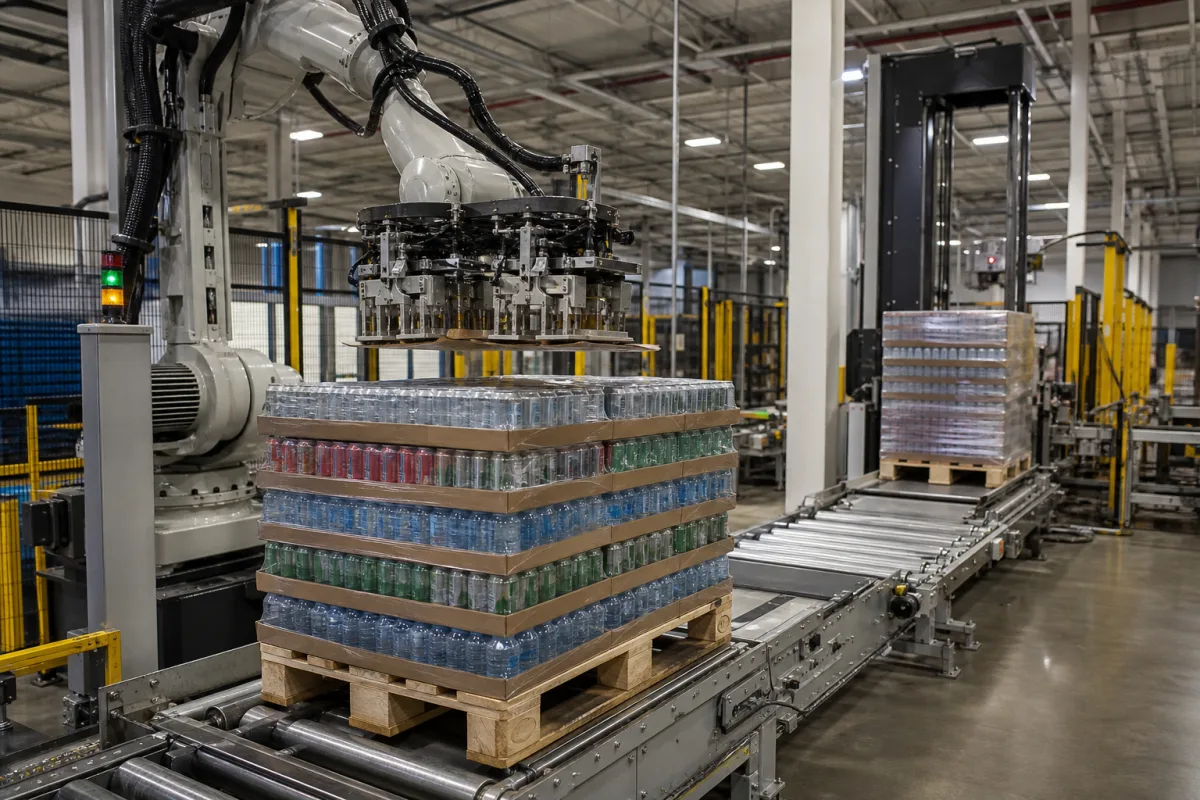
End-of-line palletizing for beverage packs · Conventional layer palletizers with low or high pack infeed against robot palletizers, layers per hour, pack and pallet size limits, layer pads, robot payload, reach and cycles per hour
An automated beverage container palletizing system takes finished packs — shrink-wrapped bottles or cans, cartons, trays or crates — from the packaging line, groups them into layer patterns, places each layer on a pallet with layer pads between them and discharges the full pallet for wrapping and storage. Ask three things first: what packs and pallet patterns the line produces, how many layers per hour it must reach, and whether a conventional layer palletizer or a robot cell fits the rate, the floor space and the operators.
Palletizers for beverage packs and containers at the end of filling and packaging lines: conventional two-column layer palletizers with low or high pack infeed, robot palletizing cells with layer or pack grippers, layer formation, layer-pad and pallet handling and their safety guarding. Depalletizers (see automated beverage container depalletizing machine), stretch wrappers and pallet conveyors (see pallet conveyor system) are outside this page except where compared.
CNFX editorial research · Sources checked October 11, 2026 · 4 sources
KHS explains that in low-level-infeed palletizing a cross conveyor places packs from the conveyor onto a stationary pallet, rising with each layer and returning down for the next, and that this travel limits capacity to about 360 layers per hour unless pallet-change time is shortened — its Innopal PB NF reaches up to 500 layers per hour; with a high pack infeed, around three metres above the floor, the pallet travels down instead, shortening travel and allowing up to 750 layers per hour on its Innopal PB HSS, but requiring two operating levels, a platform with steps and an elevator or spiral conveyor to lift packs. [2]
KHS's Innopal PLR robot palletizer keeps a low infeed and uses separate robots for pack grouping, layer formation and layer pads; it reports up to 625 layers per hour, or a nominal maximum of 135,000 cans per hour depending on diameter, with taller heads for PET and glass bottles handling up to 600 layers per hour, all-sided layer centring and automatic format changeover, and operation by one person with a clear view of the palletizing area. [2]
Editorial calculation: 135,000 cans/h ÷ 625 layers/h = 216 cans per layer, the layer size implied by KHS's two figures; your own rate equals layers per hour × packs per layer × containers per pack. [2]
Give the supplier the pack types and dimensions (with mass and stability), pallet types and patterns, layers per pallet and block height, packs per minute from each line, number of infeed lines, layer-pad and top-frame use, pallet supply and discharge, infeed height, floor space and ceiling height, operator access, safety standard, controls and remote service.
02
Set the rate, pack and pallet limits and robot capability
KHS's data sheet for the Innopal PB-N, a two-column palletizer with an elevated pack infeed for cartons, trays, shrink packs, bags and plastic crates, gives 360 layers per hour with bottom pack infeed and 385 with top pack infeed, a block height including pallet of up to 2,000 mm, pallets 750–1,300 mm across and 750–1,200 mm in the palletizing direction, packs 200–600 mm long, 200–500 mm wide and 100–400 mm high, all-sided centring of each layer before discharge onto the pallet, palletizing with or without pallet liners, and a stainless steel shuttle plate. [1]
ABB's IRB 660 data sheet describes a 4-axis floor-mounted palletizing robot in 180 kg and 250 kg versions, both with 3.15 m reach, 0.1 mm position repeatability, IP67 protection, a 200–600 V 50/60 Hz supply, 2.7 kW power consumption on the ISO cube (3.2 kW for normal movements), a 1,136 × 850 mm base, a weight of 1,650 kg, operation from +5 to +50 °C up to 95% relative humidity and a maximum noise level of 73 dB(A); it rates 2,190 cycles per hour at 60 kg on a standard palletizing cycle of 400 mm up, 2,000 mm across and 400 mm down, and says its reach can serve up to four infeed conveyors, two pallet stacks, one slip-sheet stack and four outfeed lines. [3]
KUKA's technical data for its KR QUANTEC PA palletizing robots lists the KR 140, KR 180 and KR 240 R3200-2 PA models with total loads of 140, 180 and 240 kg, all with a maximum reach of 3,195 mm, floor mounting and IP 65 protection, in standard and food (PA-HO) versions; KUKA says the slim design reaches stack heights of over 2,500 mm, the hollow wrist shaft of 60 mm diameter routes the gripper energy supply, and an Arctic variant works at minus 30 °C without a protective suit. [4]
Editorial calculation: ABB's 3.15 m and KUKA's 3,195 mm reach differ by 45 mm, while the payload steps run 180–250 kg (ABB) and 140–240 kg (KUKA); compare robots on payload at your gripper plus layer mass, not on reach alone. [3][4]
Editorial note: a robot's cycles per hour are measured on the maker's standard cycle and load; a beverage cell's real rate depends on the gripper (single pack, row or full layer), path lengths, layer pads and pallet changes, so ask for a simulation with your packs and layout.
Layer rate, pack envelope and the robot's site limits
Convert the throughput row before comparing offers: KHS quotes layers per hour, so multiply by packs per layer in your own patterns to get the packs per hour your line delivers. [1][2]
Field
What it means and published values
Ask the supplier for
Maximum throughput
360–385 layers/h in one data sheet; up to 750 layers/h on high infeed. [1][2]
Layers/h and packs/h with your patterns.
Working envelope
3.15 m reach for one robot; 3,195 mm for another, with stack heights over 2,500 mm. [3][4]
Find automated beverage container palletizing system manufacturers
Tech-Long lists palletizers and depalletizers for any packaging type; Zhangjiagang Beverage Machinery has a product page for a beverage palletizing system.
Guangzhou Tech-Long Packaging Machinery Co., Ltd.
Manufacturing site to be confirmed for the order
Its website lists “Palletizer & Depalletizer for any packaging types”.
Explore company information and manufacturing capabilities, then discuss the scope of your project with a relevant supplier.
Share this page
Compiled and source-reviewed by the CNFX editorial team.
Each manufacturer above links to the page on that company's own website where the product is listed, with the date we checked it. How we source and review
· Page last updated 13 October 2026
Buyer questions
Why are low-infeed palletizers slower than high-infeed ones?
The cross conveyor must rise with each layer and return, which KHS says limits capacity to about 360 layers/h, against up to 750 for a high infeed. [2]
Can a robot palletizer keep up with a can line?
KHS reports its robot palletizer at up to 625 layers/h, a nominal maximum of 135,000 cans/h depending on diameter. [2]
How are palletizing robot speeds rated?
ABB states cycles per hour at a given load on a standard cycle, for example 2,190 cycles/h at 60 kg over 400 mm up, 2,000 mm across and 400 mm down. [3]
Can a palletizing robot work in a cold store?
KUKA offers an Arctic variant of its KR QUANTEC PA that it says works at minus 30 °C without a protective suit; ABB's IRB 660 data sheet gives +5 to +50 °C. [4][3]
Sources and what still needs a direct check
Sources checked 2026-10-11. The KHS data sheet and article and the ABB and KUKA robot pages describe their own machines; rates and limits for your packs must come from the supplier offered.