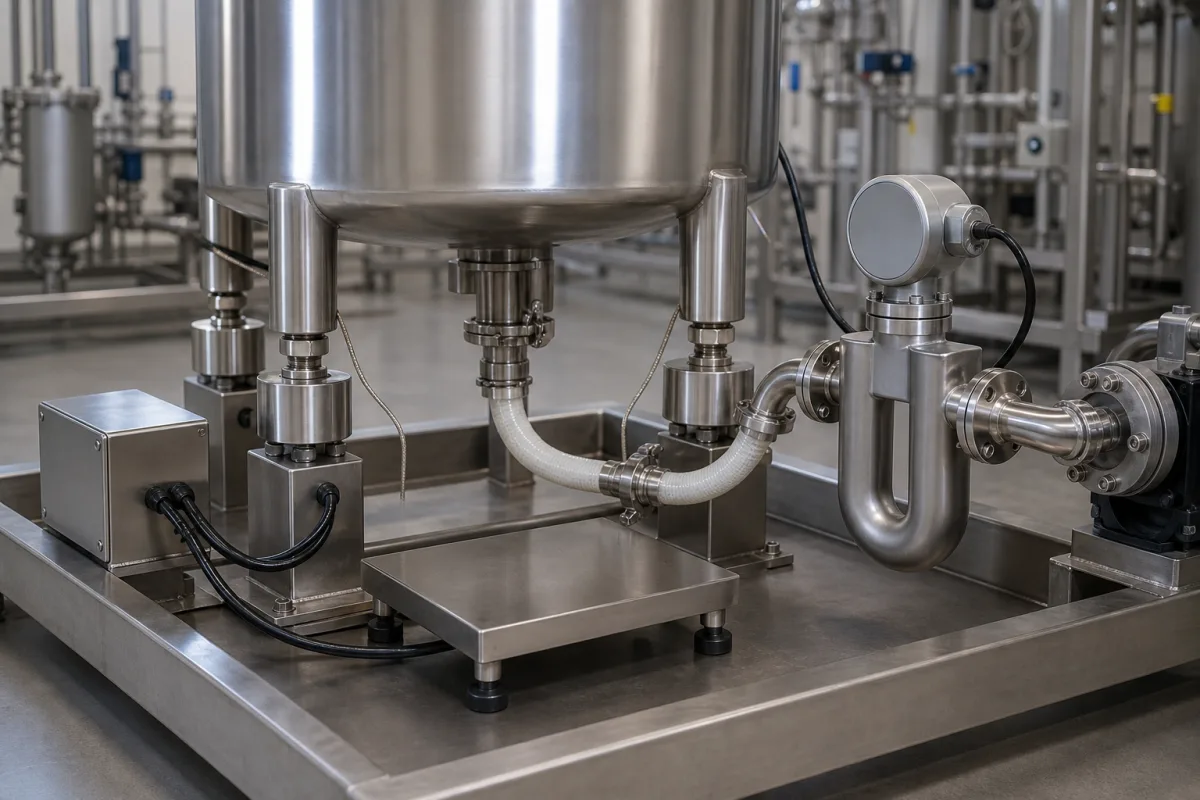
Flow meters and load cells in chemical dosing systems
Chemical dosing — flow feedback and vessel weighing
Start with the quantity the dosing controller needs to know. A feed-line instrument measures the moving liquid; vessel load cells measure the supported load. Identify the measurement point and the control task before ordering either instrument or a system that uses both.
Flow measurement and vessel-weighing components for chemical dosing installations, with emphasis on their different mounting and feedback interfaces. Fertigation injection sensors, general-purpose flow meters and laboratory flow-calibration rigs have separate guides. The pump, vessel and dosing controller require their own supply boundaries.
Mark the feed line or weighed vessel on the dosing drawing
Bürkert describes chemical dosing skids using a pump and flowmeter, and distinguishes chemical feed, dilution water and the mixed product. Mark the stream being measured so the instrument order matches the intended dosing quantity. [1]
Describe the dosing sequence, including filling, withdrawal and any return path. If vessel-weight change is used to assess a dose, specify which other material movements can occur during that interval and how the controller accounts for them.
Order the sensing hardware and its measurement electronics explicitly. A vessel load cell belongs in the mechanical support path; a flow sensor belongs to the selected fluid-measurement arrangement. A shared controller or skid does not establish that they are a single combined sensor.
Measurement arrangement
Information to settle before selection
Inline flow feedback
Liquid identity, concentration and physical properties; operating flow profile, pipe connection and pressure/temperature conditions at the meter.
Vessel weighing
Empty and filled vessel loads, support layout, the smallest required weight change and every connection to the surrounding structure.
Both measurements in one installation
Separate instrument tags and signal destinations; define whether each reading controls dosing, records consumption or provides a check. State the measured quantity and units for each channel.
02
Match the meter to the pump’s actual flow pattern
ProMinent’s DULCOFLOW is an ultrasonic instrument intended for small pulsating flows from metering pumps. Its installation guidance relies on the pulsation remaining at the measurement point. Use the chosen meter’s instructions when locating it relative to the pump and other line equipment. [2]
For DULCOFLOW, ProMinent specifies acoustic measurability and lists medium-dependent limitations; it recommends checking emulsions and suspensions. Establish suitability with the actual chemical rather than choosing a principle from electrical conductivity alone. [2]
Bürkert’s dosing-skid example separates the fluidic sensor body from the transmitter, display and batch-control functions. Specify the needed feedback and control function with the sensor, then agree the signal scaling, totalisation and valve or pump interface. [1]
Request the flow range, stated error and calibration conditions for the proposed model and chemical. Distinguish the electronics’ ambient-temperature limit from the liquid temperature, and identify every wetted material and seal in the supplied assembly.
03
Keep the process connections from bypassing the load cells
Alfa Laval’s load-cell installation guide shows how rigid tubing and other contacts can divert forces away from the weighing system. It calls for connections that accommodate vertical movement, including suitable horizontal flexible connections or an engineered pipe layout. [3]
Review inlet, outlet, vent, drain and instrument connections on the installed vessel drawing, together with electrical cables and nearby structures. Agree the load-introduction hardware and support details as part of the weighing package.
The Alfa Laval guide describes capacitive load cells. Its installation example is not evidence that every vessel sensor uses strain gauges; identify the actual sensing technology, compatible electronics and mounting parts in the proposal. [3]
Alfa Laval notes that mechanical influences such as heavy process piping can require calibration of the complete installed system even when the individual digital load cells are supplied pre-calibrated. Follow the instructions for the instrumentation supplied. [3]
Specify weighing error and repeatability for the assembled vessel under its operating conditions, separately from a load cell’s component specification. Include environmental protection, enclosure materials and the mass of the ordered assembly in the equipment schedule.
04
Dosing measurement interface schedule
Paste it into your enquiry below or into an email to a maker, then replace every bracket.
Chemical and duty: [composition, concentration, properties and dosing sequence]
Measurement point: [chemical line, dilution water, mixed product or weighed vessel]
Inline option: [flow profile/range, connection, pressure, liquid temperature, wetted materials and seals]
Weighing option: [vessel tare/full loads, support drawing, required weight change, pipes and cables]
Signals and control: [instrument tags, units, scaling, power supply, outputs, totalisation and control destination]
Acceptance: [proposed-model error conditions, installed-system checks and calibration procedure]
Environment and delivery: [ambient conditions, enclosure protection, assembly mass and included electronics/mounting hardware]
Explore company information and manufacturing capabilities, then discuss the scope of your project with a relevant supplier.
Share this page
Compiled and source-reviewed by the CNFX editorial team.
Each manufacturer above links to the page on that company's own website where the product is listed, with the date we checked it. How we source and review
· Page last updated 23 October 2026
Buyer questions
Does a dosing skid need one sensor that measures both flow and vessel weight?
Define the control task first. Bürkert’s chemical-dosing example uses inline flow measurement, while Alfa Laval’s vessel-weighing installation places load cells in the vessel support path. Specify each required measurement and its interface rather than assuming a combined sensor. [1][3]
Can pre-calibrated load cells remove the need to check the installed vessel?
Alfa Laval explains that mechanical effects from process piping and other equipment can require calibration of the complete system. Inspect the installed load path and follow the calibration procedure for the supplied instrumentation. [3]
Sources and evidence scope
Sources checked 2026-10-23T09:58:21+08:00. The flowmeter examples address chemical feed lines. Alfa Laval documents vessel weighing and its mechanical installation; its capacitive load-cell guidance has that stated product scope.