Editorial Technical Reference

Rinsing Nozzle Array

This page explains how Rinsing Nozzle Array is classified within Beverage Manufacturing. Technical values and manufacturer relationships are research references; confirm the current specification and supplier evidence for each order.

Technical Definition & Core Assembly

A precisely arranged set of nozzles designed to spray cleaning and sanitizing fluids onto beverage containers during automated rinsing processes.
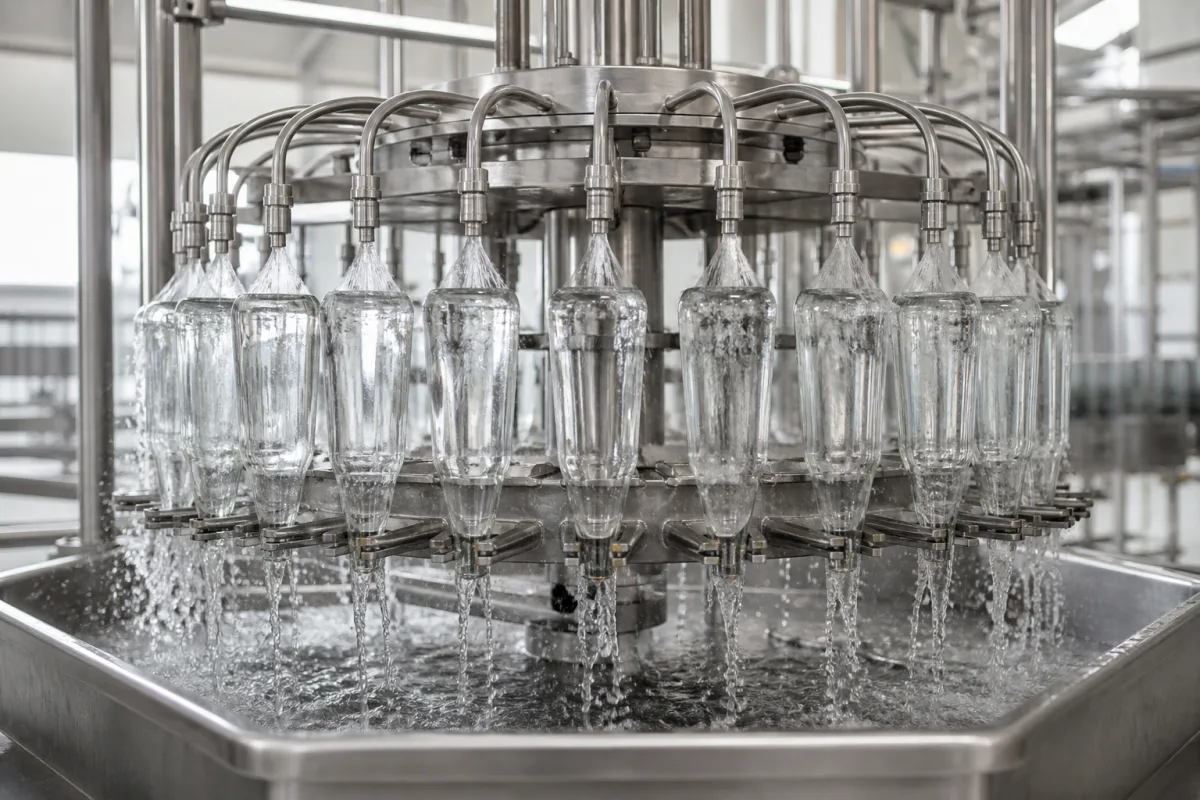
Representative product image. Confirm appearance and specifications with the manufacturer.

Product Specifications

Technical details and manufacturing context for Rinsing Nozzle Array

Definition
The Rinsing Nozzle Array is a critical component of Automated Beverage Container Rinsing and Sanitizing Machines, consisting of multiple nozzles strategically positioned to ensure complete coverage of container surfaces. It delivers high-pressure water, cleaning solutions, and sanitizing agents to remove residues, contaminants, and microorganisms from bottles, cans, or other beverage containers before filling operations. The array is engineered for integration into existing rinsing systems, with configurations typically ranging from 12 to 48 nozzles, spaced 50 to 150 mm apart, and featuring spray angles of 60 to 120 degrees. Each nozzle operates at a flow rate of 1.5 to 6.0 liters per minute, under an operating pressure of 0.3 to 0.6 MPa, and within a temperature range of 5 to 85 degrees Celsius. Constructed from stainless steel 316L (ASTM A240) and food-grade plastics, the array ensures corrosion resistance and hygienic operation. The surface finish is maintained at Ra ≤ 0.8 micrometers (ISO 4287) to prevent bacterial adhesion. Connection sizes are available in 1/4 to 1/2 inch (ISO 7-1) to match existing piping. The weight of the array ranges from 2.5 to 8.0 kg, affecting mounting and handling. These parameters are directory reference ranges; actual values must be verified with the manufacturer for specific models and applications. The array is designed to provide overlapping spray patterns that cover all interior and exterior surfaces of containers as they pass through the rinsing station, ensuring thorough cleaning and sanitization. Proper selection and verification of nozzle count, spacing, angle, and flow rate are essential to achieve optimal coverage and throughput. Maintenance signals include reduced spray pressure, uneven coverage, or visible wear on nozzles. Failure boundaries include operation above 85°C, which may damage seals, or below 0.3 MPa, which results in insufficient spray force. Always confirm model-specific specifications and compliance with relevant standards with the legal manufacturer or supplier.
Working Principle
The nozzle array operates by receiving pressurized fluids from the machine's pumping system and distributing them through multiple precisely angled nozzles. The arrangement ensures overlapping spray patterns that cover all interior and exterior surfaces of containers as they pass through the rinsing station. Nozzle spacing, angle, and flow rates are optimized for different container sizes and shapes.
Common Materials
Stainless Steel 316L, Food-grade Plastics
Technical Parameters
ParameterTypical rangeNotes & selection driver
Number of Nozzles12–48 pcsDetermines coverage and throughput
Nozzle Spacing50–150 mmAffects spray overlap and rinsing uniformity
Spray Angle60–120 °Wider angle covers larger area, narrower for precision
Flow Rate per Nozzle1.5–6.0 L/minDetermines cleaning intensity and water consumption
Operating Pressure0.3–0.6 MPaBelow 0.3 MPa insufficient spray force
Operating Temperature5–85 °CAbove 85°C may damage seals
Material316LCorrosion-resistant for food contactASTM A240
Surface FinishRa ≤ 0.8 μmSmooth finish prevents bacterial adhesionISO 4287
Connection Size1/4–1/2 inchMust match existing pipingISO 7-1
Weight2.5–8.0 kgAffects mounting and handling

Ranges are indicative industry figures for RFQ preparation, not a supplier commitment. Confirm every value and standard with the legal manufacturer before ordering.

Components / BOM
  • Nozzle Body
    Main housing that directs fluid flow and connects to supply lines
    Material: Stainless Steel 316L
  • Spray Tip Part
    Precision orifice that creates the spray pattern and controls droplet size
    Material: Ceramic or Hardened Stainless Steel
  • Mounting Bracket Part
    Secures the nozzle array to the machine frame at precise angles
    Material: Stainless Steel
  • Connection Fittings
    Fluid supply connections with quick-disconnect capability
    Material: Stainless Steel with Food-grade Seals

Applied To / Applications

This component is essential for the following industrial systems and equipment:

Industrial Ecosystem & Supply Chain Structure

Complementary Systems
Downstream Applications
Specialized Tooling

Application Fit & Sizing Matrix

Operational Limits
pressure: 0.5 to 6 bar (7 to 87 psi)
flow rate: 0.2 to 5 L/min per nozzle
temperature: 5°C to 85°C (41°F to 185°F)
slurry concentration: Up to 5% solids by weight
Media Compatibility
✓ Potable water with sanitizers (e.g., peracetic acid) ✓ CIP (Clean-in-Place) cleaning solutions ✓ Food-grade rinse aids
Unsuitable: Abrasive slurries with >5% solids or corrosive chemicals (e.g., strong acids/bases)
Sizing Data Required
  • Container dimensions and geometry
  • Production line speed (containers per minute)
  • Required spray coverage pattern and overlap

Reliability & Engineering Risk Analysis

Failure Mode & Root Cause
Abrasive erosion
Cause: Suspended particles in the fluid stream gradually wear away nozzle material, especially at high velocities or with hard contaminants.
Cavitation
Cause: Pressure drops below vapor pressure within the nozzle, forming and collapsing bubbles that cause pitting and material fatigue, often due to improper pressure regulation or flow restrictions.
Maintenance Indicators
  • Irregular or distorted spray pattern visible during operation
  • Unusual high-pitched whistling or hissing noise from the nozzle array
Engineering Tips
  • Install inline filtration upstream to remove abrasive particles and maintain fluid quality
  • Optimize operating pressure within manufacturer's specified range to prevent cavitation and reduce erosive velocities

Indicative industry ranges for design and RFQ preparation. Confirm the exact figures and applicable standard with the manufacturer before specifying.

Compliance & Manufacturing Standards

Applicable Standards
ANSI B31.3 Process Piping DIN EN 10204 Metallic Products - Types of Inspection Documents

Quoted from the published standard.

Manufacturing Precision
  • Nozzle Bore Diameter: +/-0.05mm
  • Array Mounting Surface Flatness: 0.2mm
Quality Inspection
  • Flow Rate Uniformity Test
  • Pressure Decay Leak Test

Manufacturers of Rinsing Nozzle Array

Manufacturer profiles associated with Rinsing Nozzle Array.

Sourcing Rinsing Nozzle Array from China?
Tell us your specification and target quantity — we will match it against manufacturer records and come back with the factories that fit.
Request manufacturers We manufacture this

Manufacturer listings support early research and capability understanding. They are not certification, ranking, or transaction guarantees.

Technical documentation
Request current drawings, revision history, and a signed specification sheet.
Manufacturing capability
Verify equipment lists, process limits, capacity, and representative production evidence.
Inspection readiness
Confirm test methods, calibrated equipment, sampling plans, and traceable reports.
Supplier transparency
Check the legal entity, factory address, ownership, certifications, and direct contacts.

CNFX does not score or rank suppliers. Buyers must verify all claims and documents with the legal manufacturer before ordering.

Supply Chain Compatible Machinery & Devices

Automated Beverage Container Leak Detection System

The Automated Beverage Container Leak Detection System is an industrial device designed for integration into bottling or canning lines.

Explore Specs →
Automated Beverage Container Depalletizing Machine

Industrial machine that automatically removes beverage containers from pallets for production line feeding

Explore Specs →
Regeneration Section

A dedicated section within an industrial system designed to restore or renew the functional properties of materials, media, or components through controlled processes.

Explore Specs →
High-Speed Rotary Bottle Filling Machine

Automated industrial machine for precise liquid filling of beverage containers at high production rates.

Explore Specs →

Frequently Asked Questions

What is the typical number of nozzles in a Rinsing Nozzle Array?

The number of nozzles typically ranges from 12 to 48, depending on the container size and desired throughput. The exact count should be confirmed with the manufacturer for your specific application.

What materials are used in the construction of the Rinsing Nozzle Array?

The array is typically made from stainless steel 316L (ASTM A240) and food-grade plastics. These materials provide corrosion resistance and are suitable for food contact. Always verify material specifications with the supplier.

What operating pressure is required for effective rinsing?

The operating pressure range is 0.3 to 0.6 MPa. Pressures below 0.3 MPa may result in insufficient spray force, while higher pressures may be acceptable but should be verified with the manufacturer.

How should I verify that the Rinsing Nozzle Array meets my requirements?

You should confirm the nozzle count, spacing, spray angle, flow rate, operating pressure, temperature range, connection size, and material with the legal manufacturer or supplier. Also, check compliance with relevant standards such as ASTM A240, ISO 4287, and ISO 7-1.

Data Basis

Editorial classification, named public sources where available, and source-reviewed manufacturer records.

Preliminary Technical Classification
This page supports structured research, RFQ preparation, and supplier evaluation. It does not replace buyer-led supplier qualification, standards review, or technical approval.
Buyer enquiry

Request manufacturing insight for Rinsing Nozzle Array

Ask for use case, specification boundaries, supplier type, and RFQ preparation information for this product.

Where it goes
Straight to the CNFX editorial desk, and to the manufacturer if this product is linked to a claimed profile. Nothing is broadcast to a supplier list.
Your details stay here
We do not sell or rent enquiry data, and we do not add you to a mailing list. Used only to answer this request.
No commission, no middleman
CNFX is a directory. We take no cut of any order and never negotiate on a supplier's behalf.
What we don't claim
A listing is not an endorsement. Qualify every supplier and verify every figure yourself before ordering.

Your business information is used only to process this request.

Thank you! Your message has been sent. We'll respond within 1–3 business days.
Sorry, we couldn't send your message. Please try again, or email us at contact@cnfx.com.

Need to Manufacture Rinsing Nozzle Array?

Compare manufacturer profiles with relevant product and process capability.

Previous Product
Vacuum Gripper End-Effector
Last Product
Get QuotesChat