Industry-Verified Manufacturing Data (2026)

Agitator/Mixer (if applicable)

Based on aggregated insights from multiple verified factory profiles within the CNFX directory, the standard Agitator/Mixer (if applicable) used in the Chemical Manufacturing sector typically supports operational capacities ranging from standard industrial configurations to heavy-duty production requirements.

Technical Definition & Core Assembly

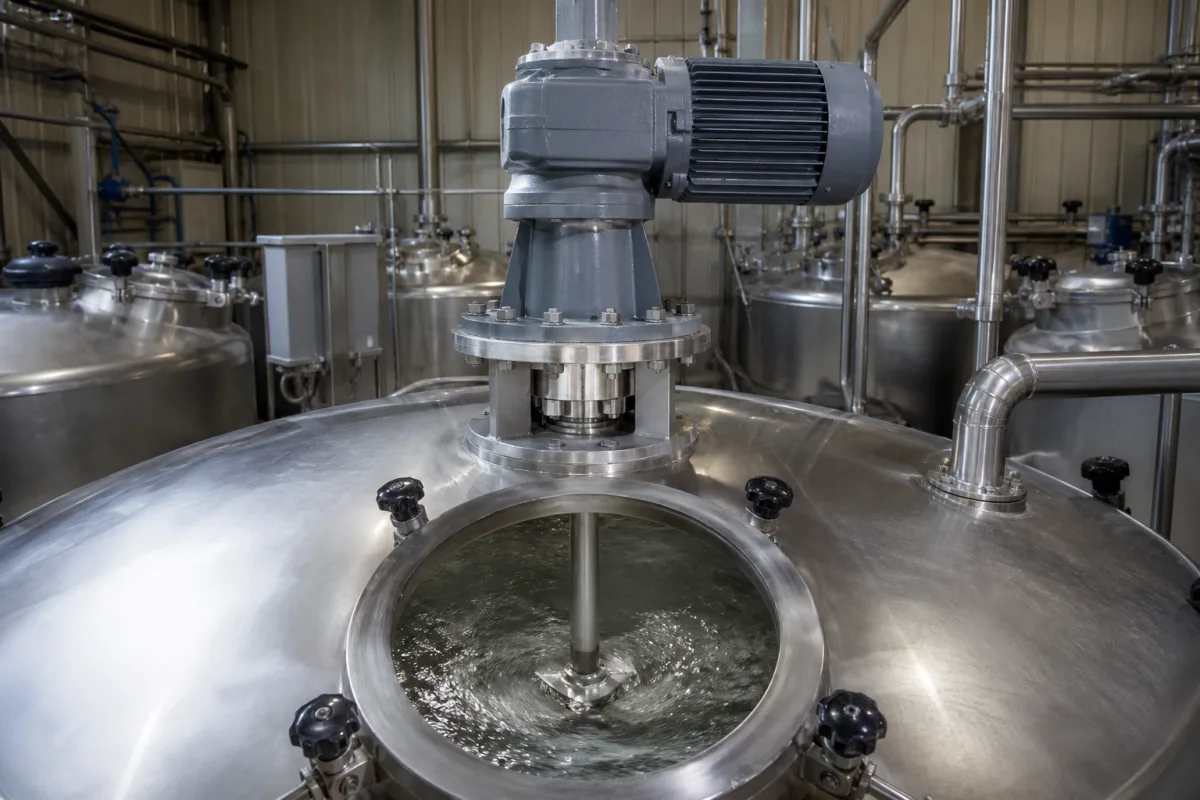
A canonical Agitator/Mixer (if applicable) is characterized by the integration of Motor and Shaft. In industrial production environments, manufacturers listed on CNFX commonly emphasize Stainless Steel (316L/304) construction to support stable, high-cycle operation across diverse manufacturing scenarios.

A mechanical device used to mix, blend, or agitate chemical substances within storage tanks to maintain homogeneity, prevent sedimentation, or facilitate reactions.
Product Specifications

Technical details and manufacturing context for Agitator/Mixer (if applicable)

Definition
An agitator or mixer is an essential component of chemical storage tanks designed to ensure uniform distribution of chemical components, prevent phase separation, maintain consistent temperature and concentration gradients, and enhance chemical reactions when required. It operates within the tank's interior to provide mechanical mixing action.
Working Principle
Typically consists of a motor-driven shaft with impellers or blades that rotate within the tank, creating fluid motion through shear forces, turbulence, or laminar flow patterns to achieve mixing objectives.
Common Materials
Stainless Steel (316L/304), Carbon Steel, Hastelloy, Titanium, Fiberglass Reinforced Plastic
Technical Parameters
  • Impeller diameter and shaft length dimensions (mm) Standard Spec
Components / BOM
  • Motor
    Provides rotational power to drive the agitator shaft
    Material: Cast iron/Stainless steel housing
  • Shaft
    Transmits torque from motor to impeller, submerged in chemical media
    Material: Stainless steel/Alloy steel
  • Impeller
    Creates fluid motion and mixing action through blade design
    Material: Stainless steel/Plastic/Composite
  • Seal Assembly
    Prevents leakage of chemicals from tank at shaft penetration point
    Material: PTFE/Ceramic/Carbon
  • Mounting Bracket
    Secures agitator assembly to tank structure
    Material: Carbon steel/Stainless steel
Engineering Reasoning
0.5-3.0 m/s impeller tip speed, 0.1-5.0 kW power input, 10-1000 Pa shear stress
Impeller tip speed exceeding 3.5 m/s causes shaft deflection >0.1 mm, bearing temperature >120°C, or fluid cavitation number <0.5
Design Rationale: Cavitation-induced erosion at vapor pressure threshold (2.34 kPa at 20°C water), fatigue failure from cyclic bending stress exceeding 200 MPa yield strength, thermal degradation of seals above 150°C
Risk Mitigation (FMEA)
Trigger Solid particle concentration exceeding 15% by volume in Newtonian fluids
Mode: Impeller blade erosion reducing mixing efficiency by >40%, shaft imbalance vibration >4.5 mm/s RMS
Strategy: Hard-faced tungsten carbide coating (1500 HV hardness), dual mechanical seals with flush fluid at 0.2 MPa above process pressure
Trigger Motor phase imbalance exceeding 5% voltage differential at 50 Hz supply
Mode: Stator winding insulation breakdown at 155°C Class F limit, bearing current arcing >5 V peak-to-peak
Strategy: VFD with 3% impedance line reactors, insulated bearing sleeves with 100 MΩ resistance at 500 V DC

Industry Taxonomies & Aliases

Commonly used trade names and technical identifiers for Agitator/Mixer (if applicable).

Applied To / Applications

This component is essential for the following industrial systems and equipment:

Industrial Ecosystem & Supply Chain DNA

Complementary Systems
Downstream Applications
Specialized Tooling

Application Fit & Sizing Matrix

Operational Limits
pressure: Atmospheric to 10 bar (standard), up to 50 bar for pressurized vessels
temperature: -20°C to 150°C (standard), up to 300°C with special seals/materials
viscosity range: 1 cP to 50,000 cP (standard), higher with specialized impellers
tank volume range: 100L to 100,000L (standard), custom designs available
slurry concentration: Up to 60% solids by weight (standard), higher with bottom-entry or side-entry designs
Media Compatibility
✓ Water-based solutions and emulsions ✓ Organic solvents in closed systems ✓ Food-grade slurries and suspensions
Unsuitable: Highly corrosive media like concentrated sulfuric acid without specialized metallurgy
Sizing Data Required
  • Tank geometry (diameter, height, bottom shape)
  • Fluid properties (viscosity, density, solids content)
  • Process requirements (mixing intensity, blend time, suspension criteria)

Reliability & Engineering Risk Analysis

Failure Mode & Root Cause
Bearing failure
Cause: Inadequate lubrication, contamination ingress, or misalignment leading to excessive vibration and wear.
Shaft seal leakage
Cause: Wear from abrasive media, improper installation, or thermal cycling causing seal degradation.
Maintenance Indicators
  • Excessive vibration or unusual noise during operation
  • Visible leakage around the shaft seal or housing
Engineering Tips
  • Implement condition-based monitoring with vibration analysis and thermography to detect early bearing issues.
  • Use appropriate seal materials compatible with the process media and maintain proper alignment during installation.

Compliance & Manufacturing Standards

Reference Standards
ISO 2858:2012 - End-suction centrifugal pumps (Designation, nominal duty point and dimensions) ANSI/ASME B73.1-2012 - Specification for Horizontal End Suction Centrifugal Pumps for Chemical Process DIN 28136 - Agitators for mixing vessels; main dimensions
Manufacturing Precision
  • Shaft runout: ≤ 0.05 mm at coupling end
  • Impeller blade thickness: ± 0.5 mm
Quality Inspection
  • Hydrostatic pressure test (1.5x design pressure)
  • Vibration analysis (ISO 10816 compliance)

Factories Producing Agitator/Mixer (if applicable)

Verified manufacturers with capability to produce this product in China

✓ 98% Supplier Capability Match Found

P Procurement Specialist from Singapore Feb 16, 2026
★★★★★
"The technical documentation for this Agitator/Mixer (if applicable) is very thorough, especially regarding technical reliability."
Technical Specifications Verified
T Technical Director from Germany Feb 13, 2026
★★★★★
"Reliable performance in harsh Chemical Manufacturing environments. No issues with the Agitator/Mixer (if applicable) so far."
Technical Specifications Verified
P Project Engineer from Brazil Feb 10, 2026
★★★★★
"Testing the Agitator/Mixer (if applicable) now; the technical reliability results are within 1% of the laboratory datasheet."
Technical Specifications Verified
Verification Protocol

“Feedback is collected from verified sourcing managers during RFQ (Request for Quote) and factory evaluation processes on CNFX. These reports represent historical performance data and technical audit summaries from our B2B manufacturing network.”

6 sourcing managers are analyzing this specification now. Last inquiry for Agitator/Mixer (if applicable) from UAE (13m ago).

Supply Chain Compatible Machinery & Devices

Modular Distillation Column System

Pre-engineered modular system for continuous separation of chemical mixtures via distillation.

Explore Specs →
Automated Batch Crystallization System

Automated system for controlled crystallization of chemical compounds in batch processes.

Explore Specs →
Automated pH Monitoring and Dosing System

Automated system for continuous pH monitoring and chemical dosing in process streams.

Explore Specs →
Automated Powder Dispensing and Blending System

Automated system for precise dispensing and homogeneous blending of powdered chemicals.

Explore Specs →

Frequently Asked Questions

What materials are best for chemical agitators in corrosive environments?

For corrosive chemical environments, 316L stainless steel, Hastelloy, and titanium offer excellent resistance. Material selection depends on the specific chemicals, temperature, and concentration levels in your process.

How do I choose between different impeller types for chemical mixing?

Impeller selection depends on your application: axial flow impellers for blending and homogenization, radial flow for shear-sensitive materials, and specialized designs for high-viscosity chemicals or gas dispersion.

What maintenance is required for chemical processing agitators?

Regular maintenance includes seal inspection/replacement, bearing lubrication, shaft alignment checks, and impeller inspection for wear or corrosion. Proper maintenance ensures optimal performance and prevents contamination.

Can I contact factories directly on CNFX?

CNFX is an open directory, not a transaction platform. Each factory profile provides direct contact information and production details to help you initiate direct inquiries with Chinese suppliers.

Get Quote for Agitator/Mixer (if applicable)

Request technical pricing, lead times, or customized specifications for Agitator/Mixer (if applicable) directly from verified manufacturing units.

Your business information is encrypted and only shared with verified Agitator/Mixer (if applicable) suppliers.

Thank you! Your message has been sent. We'll respond within 1–3 business days.

Need to Manufacture Agitator/Mixer (if applicable)?

Connect with verified factories specializing in this product category

Add Your Factory Contact Us
Previous Product
Agitator/Mixer
Next Product
Agitator/Stirrer Assembly