Editorial Technical Reference

Automated Chemical Drum Agitation and Homogenization System

This page explains how Automated Chemical Drum Agitation and Homogenization System is classified within Chemical Manufacturing. Technical values and manufacturer relationships are research references; confirm the current specification and supplier evidence for each order.

Technical Definition & Core Assembly

Automated system for consistent agitation and homogenization of chemicals in standard drums.

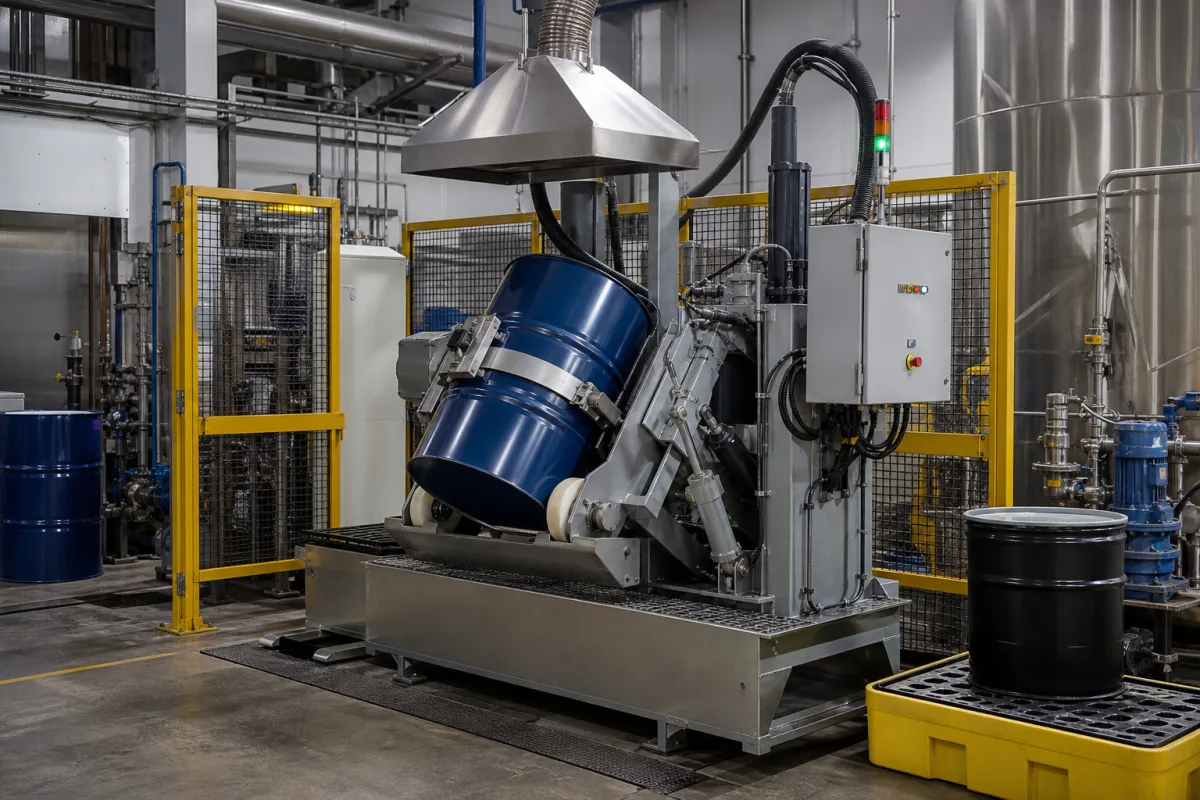
Representative product image. Confirm appearance and specifications with the manufacturer.

Product Specifications

Technical details and manufacturing context for Automated Chemical Drum Agitation and Homogenization System

Definition
The Automated Chemical Drum Agitation and Homogenization System is an industrial automation solution designed to provide controlled, repeatable agitation and homogenization of liquid or slurry chemical products stored in standard 55-gallon (or similar) drums. It addresses the common industrial problem of product settling, stratification, or phase separation during storage, which can compromise batch consistency and quality. The system integrates mechanical agitation with process control to ensure uniform product properties before downstream use, transfer, or sampling. It is particularly valuable for paints, coatings, adhesives, resins, and specialty chemicals where viscosity and component distribution are critical.

The system consists of a programmable motor-driven agitator head that is automatically positioned and lowered into a standard drum. It rotates specialized impellers at controlled speeds and durations to create fluid motion, ensuring all contents are uniformly mixed. The system monitors parameters like torque and time to confirm homogenization is complete.

Key specifications include a motor power range of 0.75–2.2 kW (IEC 60034), adjustable speed range of 50–300 RPM, maximum torque of 50–150 Nm, and typical cycle time of 5–15 minutes. The system is rated IP54–IP65 (IEC 60529) and operates within a temperature range of -10 to 60 °C. It requires a three-phase power supply of 380–480 V AC (IEC 60038) and frequency of 50–60 Hz. The wetted parts are made of stainless steel 316L (ASTM A240) with food-grade PTFE seals, and the frame uses industrial-grade aluminum alloy. The system weighs between 80–150 kg and has a compact footprint of 600×600×1200 to 800×800×1500 mm.

All values are reference ranges and must be verified with the legal manufacturer for the specific model and application. Standards listed are for procurement and verification purposes only and do not imply certification or compliance of any particular product.
Working Principle
The system uses a programmable motor-driven agitator head that is automatically positioned and lowered into a standard drum. The head rotates specialized impellers at controlled speeds and durations to create fluid motion, ensuring all contents are uniformly mixed. The system monitors parameters like torque and time to confirm homogenization is complete. The control system allows adjustment of speed and cycle time based on product characteristics. The agitator is designed to handle a range of viscosities and densities. The system is equipped with safety interlocks to prevent operation when the drum is not properly positioned. The process is repeatable and can be integrated into automated production lines.
Common Materials
stainless steel (316L), food-grade PTFE, industrial-grade aluminum alloy, IP65-rated electrical components
Technical Parameters
ParameterTypical rangeNotes & selection driver
Motor PowerRequired0.75–2.2 kWRated power of the agitation motorIEC 60034
Speed RangeRequired50–300 RPMAdjustable rotational speed range
Max TorqueRequired50–150 NmMaximum output torque
Cycle Time5–15 minTypical agitation cycle duration
IP RatingRequiredIP54–IP65 IPXXIngress protection ratingIEC 60529
Operating Temperature-10–60 °COutside this range, seals may fail
Voltage380–480 V ACThree-phase; other voltages available on requestIEC 60038
Frequency50–60 HzAuto-sensing or manual selectionIEC 60038
MaterialSS316LCorrosion-resistant for chemical serviceASTM A240
Weight80–150 kgDepends on configuration and options
Dimensions (L×W×H)600×600×1200–800×800×1500 mmCompact footprint for standard drum sizes

Ranges are indicative industry figures for RFQ preparation, not a supplier commitment. Confirm every value and standard with the legal manufacturer before ordering.

Components / BOM

Industry Taxonomies & Aliases

Commonly used trade names and technical identifiers for Automated Chemical Drum Agitation and Homogenization System.

Industrial Ecosystem & Supply Chain Structure

Complementary Systems
Downstream Applications
Specialized Tooling

Application Fit & Sizing Matrix

Operational Limits
pressure: Atmospheric to 2 bar (sealed drum operation)
flow rate: 0-100 RPM (variable speed agitation)
temperature: 5°C to 60°C (ambient to moderate heating)
slurry concentration: Up to 60% solids by weight (non-abrasive)
Media Compatibility
✓ Water-based chemical solutions ✓ Polymer emulsions and suspensions ✓ Food-grade viscous liquids (e.g., syrups, sauces)
Unsuitable: Highly corrosive acids (e.g., concentrated sulfuric acid) due to material degradation risks
Sizing Data Required
  • Drum volume and dimensions (e.g., 55-gallon standard)
  • Viscosity range of media (cP or Pa·s)
  • Required homogenization time per batch (minutes/hours)

Reliability & Engineering Risk Analysis

Failure Mode & Root Cause
Seal failure and leakage
Cause: Chemical incompatibility leading to seal degradation, or abrasive particle accumulation causing seal wear and eventual breach.
Motor or drive system overload failure
Cause: Viscosity changes in the chemical mixture causing increased torque demand, or mechanical binding from crystallized or settled solids jamming the agitator.
Maintenance Indicators
  • Unusual grinding or scraping noises from the agitation mechanism, indicating mechanical interference or bearing failure.
  • Visible chemical leakage around seals or joints, or unexpected changes in agitation speed or power consumption.
Engineering Tips
  • Implement a preventive maintenance schedule for seal inspection and replacement based on chemical exposure hours, using seals specifically rated for the chemicals being agitated.
  • Install torque monitoring on the drive system to detect abnormal load increases, and program automatic shutdowns to prevent catastrophic failure when thresholds are exceeded.

Indicative industry ranges for design and RFQ preparation. Confirm the exact figures and applicable standard with the manufacturer before specifying.

Compliance & Manufacturing Standards

Applicable Standards
ANSI/ASME B46.1 Surface Texture DIN EN 13445-3 Unfired Pressure Vessels

Quoted from the published standard.

Manufacturing Precision
  • Agitator Shaft Runout: +/-0.05mm
  • Drum Mounting Surface Flatness: 0.2mm
Quality Inspection
  • Non-Destructive Testing (NDT) - Ultrasonic Weld Inspection
  • Material Composition Verification - X-Ray Fluorescence (XRF) Analysis

Manufacturers of Automated Chemical Drum Agitation and Homogenization System

Manufacturer profiles associated with Automated Chemical Drum Agitation and Homogenization System.

Sourcing Automated Chemical Drum Agitation and Homogenization System from China?
Tell us your specification and target quantity — we will match it against manufacturer records and come back with the factories that fit.
Request manufacturers We manufacture this

Manufacturer listings support early research and capability understanding. They are not certification, ranking, or transaction guarantees.

Technical documentation
Request current drawings, revision history, and a signed specification sheet.
Manufacturing capability
Verify equipment lists, process limits, capacity, and representative production evidence.
Inspection readiness
Confirm test methods, calibrated equipment, sampling plans, and traceable reports.
Supplier transparency
Check the legal entity, factory address, ownership, certifications, and direct contacts.

CNFX does not score or rank suppliers. Buyers must verify all claims and documents with the legal manufacturer before ordering.

Supply Chain Commonly Integrated Components

Temperature Control

A system or device that regulates and maintains the temperature of materials within a specified range during industrial processes.

Explore Specs →
Dust Collection Unit

A filtration system component that captures and contains airborne particulate matter generated during catalyst handling operations

Explore Specs →
Inert Gas Purge System

A safety system that uses inert gases to displace oxygen and flammable vapors from catalyst handling equipment to prevent combustion and oxidation during loading/unloading operations.

Explore Specs →
Drum Conveyor

A mechanical handling device designed to transport chemical drums through an automated filling and sealing system.

Explore Specs →

Frequently Asked Questions

What types of chemicals can this system handle?

The system is designed for liquid or slurry chemical products stored in standard 55-gallon drums, including paints, coatings, adhesives, resins, and specialty chemicals. The wetted parts are made of stainless steel 316L and food-grade PTFE, which are corrosion-resistant for many chemical services. However, compatibility must be verified with the manufacturer for specific chemicals.

How is the homogenization process controlled?

The system uses a programmable controller to set agitation speed and cycle time. It monitors torque and time to ensure complete mixing. The operator can adjust parameters based on product viscosity and other characteristics. The system can be integrated into automated lines for repeatable processing.

What are the installation requirements?

The system requires a three-phase power supply of 380–480 V AC and 50–60 Hz. It should be installed on a level surface with adequate clearance for drum loading and agitator movement. The operating temperature range is -10 to 60 °C. The system weighs 80–150 kg, so appropriate lifting equipment may be needed.

How do I verify that the system meets my requirements?

You must confirm model-specific values such as motor power, speed range, torque, and dimensions with the legal manufacturer. Also verify that the materials of construction are compatible with your chemicals. Standards like IEC 60034, IEC 60529, and ASTM A240 are references for procurement, not guarantees of compliance.

Data Basis

Editorial classification, named public sources where available, and source-reviewed manufacturer records.

Preliminary Technical Classification
This page supports structured research, RFQ preparation, and supplier evaluation. It does not replace buyer-led supplier qualification, standards review, or technical approval.
Buyer enquiry

Request manufacturing insight for Automated Chemical Drum Agitation and Homogenization System

Ask for use case, specification boundaries, supplier type, and RFQ preparation information for this product.

Where it goes
Straight to the CNFX editorial desk, and to the manufacturer if this product is linked to a claimed profile. Nothing is broadcast to a supplier list.
Your details stay here
We do not sell or rent enquiry data, and we do not add you to a mailing list. Used only to answer this request.
No commission, no middleman
CNFX is a directory. We take no cut of any order and never negotiate on a supplier's behalf.
What we don't claim
A listing is not an endorsement. Qualify every supplier and verify every figure yourself before ordering.

Your business information is used only to process this request.

Thank you! Your message has been sent. We'll respond within 1–3 business days.
Sorry, we couldn't send your message. Please try again, or email us at contact@cnfx.com.

Need to Manufacture Automated Chemical Drum Agitation and Homogenization System?

Compare manufacturer profiles with relevant product and process capability.

Previous Product
Twin-Screw Polymer Compounding Extruder
Last Product
Get QuotesChat