Industry-Verified Manufacturing Data (2026)

Automated Catalyst Loading and Unloading System

Based on aggregated insights from multiple verified factory profiles within the CNFX directory, the standard Automated Catalyst Loading and Unloading System used in the Chemical Manufacturing sector typically supports operational capacities ranging from standard industrial configurations to heavy-duty production requirements.

Technical Definition & Core Assembly

A canonical Automated Catalyst Loading and Unloading System is characterized by the integration of Loading Hopper and Pneumatic Conveyor. In industrial production environments, manufacturers listed on CNFX commonly emphasize stainless steel 316L construction to support stable, high-cycle operation across diverse manufacturing scenarios.

Automated system for safe catalyst handling in chemical reactors

Product Specifications

Technical details and manufacturing context for Automated Catalyst Loading and Unloading System

Definition
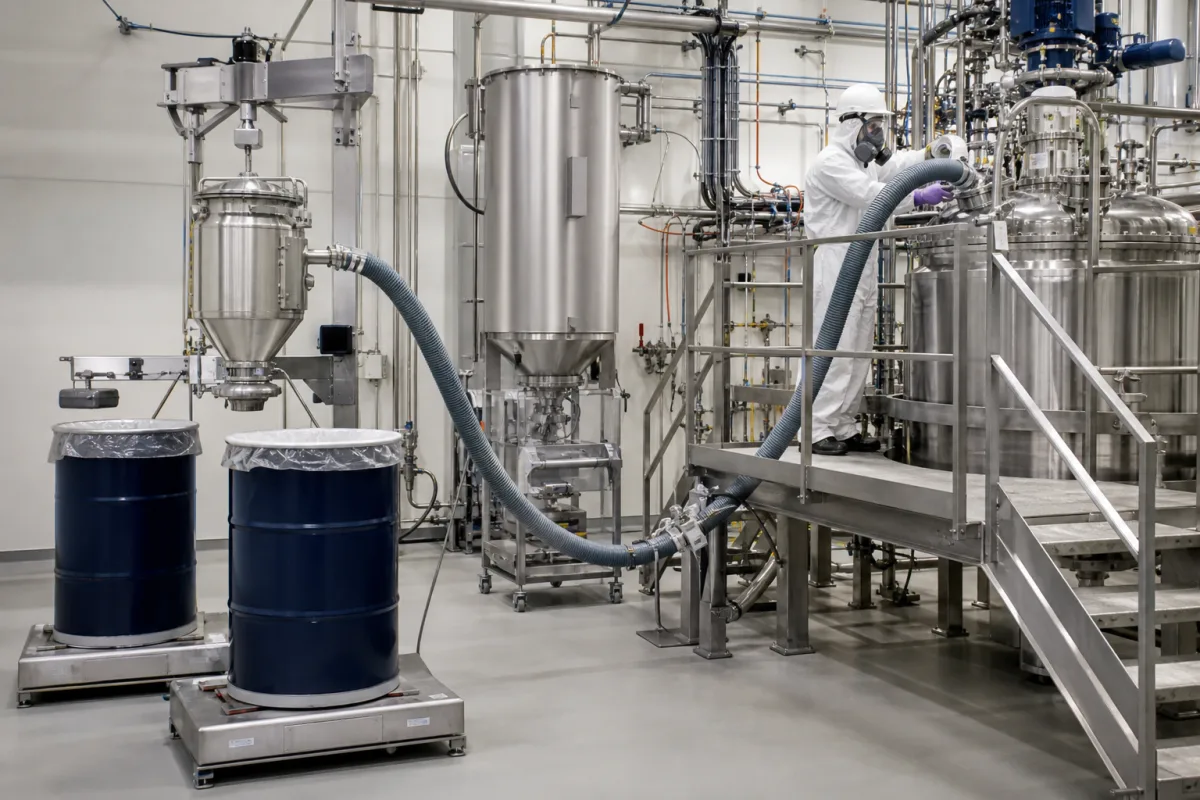
An integrated automation system designed for the precise loading and unloading of catalyst materials in fixed-bed reactors, continuous stirred-tank reactors, and other catalytic process vessels. It combines material handling, dust control, and process integration capabilities to minimize manual intervention, reduce catalyst loss, and maintain consistent reactor performance. The system is engineered for hazardous environments with explosion-proof components and can be integrated with existing plant control systems for seamless operation.
Working Principle
Uses pneumatic conveying or mechanical transfer mechanisms with precise weight measurement and flow control to load/unload catalyst materials while maintaining inert atmosphere and dust containment.
Common Materials
stainless steel 316L, explosion-proof motors, PTFE seals, polycarbonate viewing windows, aluminum structural frames
Technical Parameters
  • Weight measurement accuracy (%) Standard Spec
  • Maximum catalyst handling capacity (kg/h) Standard Spec
  • System pressure containment rating (bar) Standard Spec
Components / BOM
Engineering Reasoning
0.1-5.0 bar differential pressure across catalyst bed
7.5 bar differential pressure across catalyst bed
Design Rationale: Catalyst particle fluidization and entrainment exceeding terminal velocity of 0.3 m/s in reactor gas stream
Risk Mitigation (FMEA)
Trigger Pneumatic conveying line pressure drop below 0.05 bar/m
Mode: Catalyst bridging in transfer lines
Strategy: Install redundant pressure sensors with 0.01 bar resolution and automated purge cycles
Trigger Locking mechanism torque exceeding 450 N·m during loading
Mode: Reactor flange seal deformation exceeding 0.1 mm
Strategy: Torque-limiting couplings with 5 N·m precision and strain gauge feedback

Industry Taxonomies & Aliases

Commonly used trade names and technical identifiers for Automated Catalyst Loading and Unloading System.

Industrial Ecosystem & Supply Chain DNA

Complementary Systems
Downstream Applications
Specialized Tooling

Application Fit & Sizing Matrix

Operational Limits
pressure: Up to 10 bar (standard), 25 bar (maximum design pressure)
flow rate: 0.5 to 20 m³/h (slurry handling capacity)
temperature: -20°C to 150°C (operating), -40°C to 180°C (material limits)
particle size: 50 μm to 25 mm (handling range)
system accuracy: ±0.5% of catalyst mass (loading/unloading precision)
slurry concentration: Up to 60% solids by weight (maximum)
Media Compatibility
✓ Zeolite-based catalysts (FCC, hydrocracking) ✓ Supported metal catalysts (Ni, Pt, Pd on alumina/silica) ✓ Activated carbon and molecular sieve materials
Unsuitable: Pyrophoric catalysts requiring inert atmosphere containment (e.g., Raney nickel in reactive state)
Sizing Data Required
  • Reactor volume and catalyst bed dimensions (for capacity calculation)
  • Required catalyst change-out frequency and batch size
  • Plant layout constraints (vertical/horizontal clearance, connection points)

Reliability & Engineering Risk Analysis

Failure Mode & Root Cause
Catalyst particle abrasion in transfer lines
Cause: High-velocity catalyst flow causing erosion of pipe bends, elbows, and valve seats, accelerated by improper particle size distribution or excessive system pressure
Pneumatic system valve failure
Cause: Catalyst dust ingress into pneumatic actuators and control valves, leading to seal degradation, sticking mechanisms, and loss of pressure control due to inadequate filtration or seal maintenance
Maintenance Indicators
  • Audible hissing or grinding noises from transfer lines indicating erosion or blockages
  • Visible catalyst dust leakage at connection points or valves signaling seal failure or excessive pressure
Engineering Tips
  • Implement regular particle size analysis and adjust transfer velocities to minimize erosive wear in high-flow areas
  • Establish a preventive maintenance schedule for pneumatic system filters and seals, including frequent inspection of valve actuators for dust contamination

Compliance & Manufacturing Standards

Reference Standards
ISO 13849-1: Safety of machinery - Safety-related parts of control systems ANSI/ASME B46.1: Surface Texture (Surface Roughness, Waviness, and Lay) DIN EN 1090-2: Execution of steel structures and aluminium structures - Part 2: Technical requirements for steel structures
Manufacturing Precision
  • Positioning Accuracy: +/-0.05mm
  • Sealing Surface Flatness: 0.08mm
Quality Inspection
  • Helium Leak Test for Vacuum Integrity
  • Load Cycle Endurance Test (10,000 cycles minimum)

Factories Producing Automated Catalyst Loading and Unloading System

Verified manufacturers with capability to produce this product in China

✓ 94% Supplier Capability Match Found

T Technical Director from United Arab Emirates Feb 07, 2026
★★★★★
"Great transparency on the Automated Catalyst Loading and Unloading System components. Essential for our Chemical Manufacturing supply chain."
Technical Specifications Verified
P Project Engineer from Australia Feb 04, 2026
★★★★☆
"The Automated Catalyst Loading and Unloading System we sourced perfectly fits our Chemical Manufacturing production line requirements. (Delivery took slightly longer than expected, but technical support was excellent.)"
Technical Specifications Verified
S Sourcing Manager from Singapore Feb 01, 2026
★★★★★
"Found 52+ suppliers for Automated Catalyst Loading and Unloading System on CNFX, but this spec remains the most cost-effective."
Technical Specifications Verified
Verification Protocol

“Feedback is collected from verified sourcing managers during RFQ (Request for Quote) and factory evaluation processes on CNFX. These reports represent historical performance data and technical audit summaries from our B2B manufacturing network.”

18 sourcing managers are analyzing this specification now. Last inquiry for Automated Catalyst Loading and Unloading System from Germany (1h ago).

Supply Chain Commonly Integrated Components

Temperature Control Unit

A precision thermal management component that regulates and maintains specific temperature conditions within a continuous flow pharmaceutical reactor system.

Explore Specs →
Process Analytics

Real-time monitoring and analysis system for pharmaceutical manufacturing processes

Explore Specs →
Dust Containment System

A safety and environmental control system designed to capture, contain, and prevent the escape of airborne pharmaceutical powder particles during blending operations.

Explore Specs →
Feed Tank & Pump

A combined unit consisting of a storage tank and pump for feeding solvent into an automated recovery and purification system.

Explore Specs →

Frequently Asked Questions

What safety features does this automated catalyst handling system include?

The system features explosion-proof motors, PTFE seals, inert gas purge system, and dust collection unit to ensure safe catalyst transfer in hazardous chemical environments.

What materials are used in construction for chemical resistance?

Constructed with stainless steel 316L for corrosion resistance, PTFE seals for chemical compatibility, polycarbonate viewing windows, and aluminum structural frames for durability.

How does the system ensure accurate catalyst loading?

The system incorporates precision load cells with high weight accuracy percentage, controlled through an automated panel with pneumatic conveyor for consistent throughput in kg/h.

Can I contact factories directly on CNFX?

CNFX is an open directory, not a transaction platform. Each factory profile provides direct contact information and production details to help you initiate direct inquiries with Chinese suppliers.

Get Quote for Automated Catalyst Loading and Unloading System

Request technical pricing, lead times, or customized specifications for Automated Catalyst Loading and Unloading System directly from verified manufacturing units.

Your business information is encrypted and only shared with verified Automated Catalyst Loading and Unloading System suppliers.

Thank you! Your message has been sent. We'll respond within 1–3 business days.

Need to Manufacture Automated Catalyst Loading and Unloading System?

Connect with verified factories specializing in this product category

Add Your Factory Contact Us
Previous Product
Automated Batch Crystallization System
Next Product
Automated Chemical Drum Agitation and Homogenization System