Industry-Verified Manufacturing Data (2026)

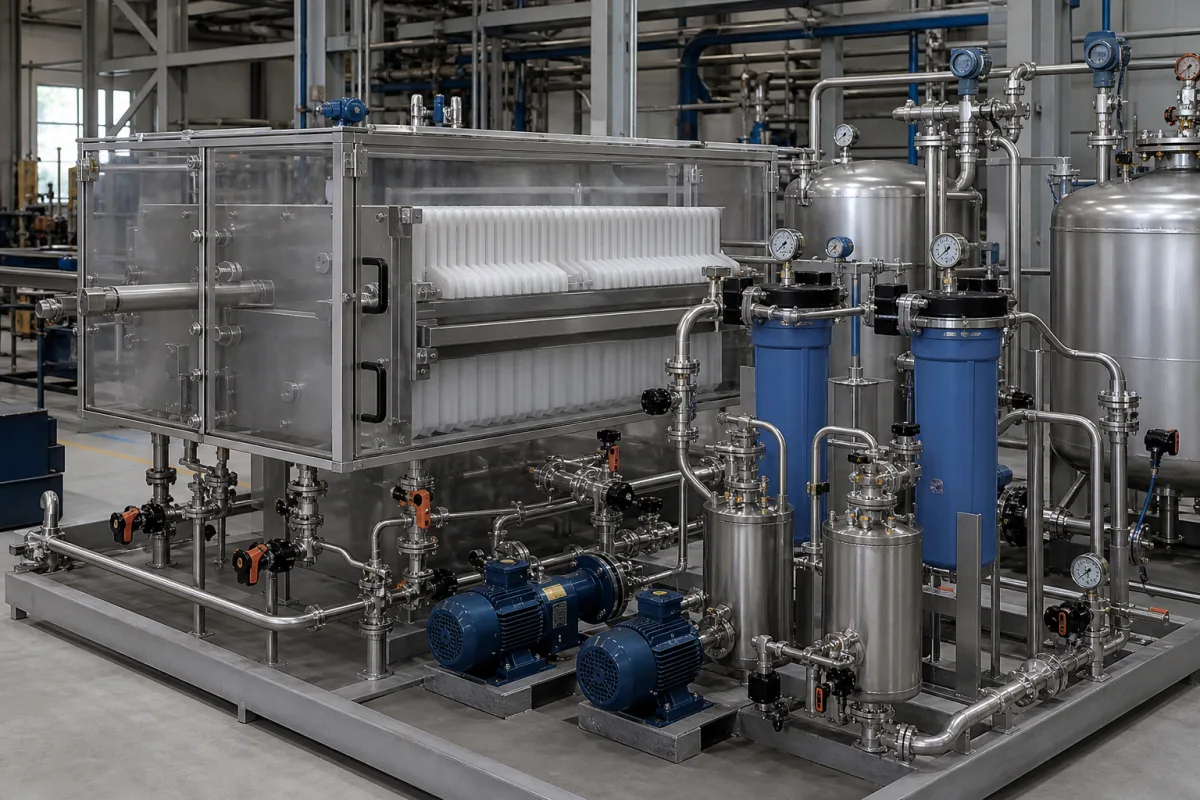
Automated Chemical Filtration and Separation System

Based on aggregated insights from multiple verified factory profiles within the CNFX directory, the standard Automated Chemical Filtration and Separation System used in the Chemical Manufacturing sector typically supports operational capacities ranging from standard industrial configurations to heavy-duty production requirements.

Technical Definition & Core Assembly

A canonical Automated Chemical Filtration and Separation System is characterized by the integration of Filter Housing and Filter Media/Cartridge. In industrial production environments, manufacturers listed on CNFX commonly emphasize stainless steel 316L construction to support stable, high-cycle operation across diverse manufacturing scenarios.

Automated system for continuous filtration and separation of chemical mixtures.

Product Specifications

Technical details and manufacturing context for Automated Chemical Filtration and Separation System

Definition
An integrated industrial system designed for the continuous, automated filtration and separation of chemical process streams. It handles various separation tasks including solid-liquid separation, liquid-liquid separation, and particle removal from chemical solutions. The system is engineered for high-throughput chemical manufacturing environments, featuring automated control, real-time monitoring, and self-cleaning capabilities to maintain consistent separation efficiency and minimize downtime.
Working Principle
Process fluid is pumped through specialized filter media or separation membranes under controlled pressure and flow conditions. Automated valves and sensors regulate the process, while integrated cleaning cycles maintain system performance. Separation occurs based on particle size, density differences, or membrane selectivity.
Common Materials
stainless steel 316L, PTFE membranes, polypropylene filter media, ceramic filter elements, industrial-grade sensors
Technical Parameters
  • Maximum process flow capacity (m³/h) Standard Spec
  • Maximum system operating pressure (bar) Standard Spec
  • Minimum particle size retention (μm) Standard Spec
  • Target separation efficiency for specified particles (%) Standard Spec
Components / BOM
  • Filter Housing
    Contains filter media and withstands process pressure
    Material: Stainless Steel 316L
  • Filter Media/Cartridge
    Primary separation element
    Material: PTFE/Polypropylene/Ceramic
  • Process Pump
    Moves fluid through the filtration system
    Material: Stainless Steel/PTFE
  • Control System
    Automated process control and monitoring
    Material: Electronic components
  • Pressure Sensors
    Monitor differential pressure across filter
    Material: Stainless Steel with sensing elements
  • Automated Valves
    Control flow direction and system isolation
    Material: Stainless Steel/PTFE
  • Backwash System Optional
    Automated cleaning of filter media
    Material: Stainless Steel
  • Pre-filtration Unit Optional
    Removes large particles before main filtration
    Material: Stainless Steel with coarse media
Engineering Reasoning
0.5-6.0 bar differential pressure across filter media
8.2 bar differential pressure causing membrane rupture
Design Rationale: Exceeding the yield strength (35 MPa) of polyethersulfone membrane material, leading to plastic deformation and pore structure collapse
Risk Mitigation (FMEA)
Trigger Crystallization fouling from supersaturated calcium sulfate (CaSO₄·2H₂O) at >150% saturation index
Mode: Permeate flux decline below 15 L/m²·h at constant transmembrane pressure
Strategy: Antiscalant injection system maintaining saturation index <120% with polyacrylic acid dispersant at 5 ppm concentration
Trigger Electrostatic discharge (ESD) accumulation exceeding 25 kV in non-conductive PTFE filter housings
Mode: Spark ignition of flammable solvent vapors (e.g., acetone with LEL 2.5% v/v)
Strategy: Intrinsically safe design with conductive carbon-filled PTFE (surface resistivity <10⁶ Ω/sq) and grounding to <1.0 Ω resistance

Industry Taxonomies & Aliases

Commonly used trade names and technical identifiers for Automated Chemical Filtration and Separation System.

Industrial Ecosystem & Supply Chain DNA

Complementary Systems
Downstream Applications
Specialized Tooling

Application Fit & Sizing Matrix

Operational Limits
pressure: 0 to 10 bar (g)
flow rate: 0.5 to 50 m³/h
temperature: -20°C to 150°C
slurry concentration: Up to 40% solids by weight
Media Compatibility
✓ 316L stainless steel wetted parts ✓ PTFE membrane filters ✓ Ceramic filter elements
Unsuitable: Hydrofluoric acid environments
Sizing Data Required
  • Required filtration area (m²)
  • Feed slurry solids concentration (% w/w)
  • Required filtrate clarity (microns)

Reliability & Engineering Risk Analysis

Failure Mode & Root Cause
Filter media blinding
Cause: Accumulation of fine particulates or chemical precipitates on filter surfaces, reducing flow rates and increasing pressure differentials due to inadequate pre-filtration or improper chemical compatibility.
Seal and gasket degradation
Cause: Chemical attack or thermal cycling compromising elastomeric components, leading to leaks and contamination from incompatible materials or operating outside design temperature ranges.
Maintenance Indicators
  • Abrupt increase in system pressure differential exceeding 20% above baseline
  • Visible chemical leaks or discoloration around seals and connections
Engineering Tips
  • Implement real-time pressure differential monitoring with automated alerts at 15% increase thresholds to enable predictive maintenance before complete failure
  • Establish quarterly material compatibility audits, including gasket material verification and chemical resistance testing under actual operating conditions

Compliance & Manufacturing Standards

Reference Standards
ISO 9001:2015 Quality Management Systems ANSI/ASME BPE-2019 Bioprocessing Equipment DIN EN 13445-5:2021 Unfired pressure vessels - Part 5: Inspection and testing
Manufacturing Precision
  • Filter element pore size: +/- 0.5 μm
  • Pressure vessel weld alignment: +/- 1.0 mm
Quality Inspection
  • Pressure Decay Leak Test
  • Material Composition Verification via X-ray Fluorescence (XRF) Analysis

Factories Producing Automated Chemical Filtration and Separation System

Verified manufacturers with capability to produce this product in China

✓ 95% Supplier Capability Match Found

P Procurement Specialist from Brazil Jan 23, 2026
★★★★★
"The technical documentation for this Automated Chemical Filtration and Separation System is very thorough, especially regarding Flow Rate (m³/h)."
Technical Specifications Verified
T Technical Director from Canada Jan 20, 2026
★★★★★
"Reliable performance in harsh Chemical Manufacturing environments. No issues with the Automated Chemical Filtration and Separation System so far."
Technical Specifications Verified
P Project Engineer from United States Jan 17, 2026
★★★★★
"Testing the Automated Chemical Filtration and Separation System now; the Flow Rate (m³/h) results are within 1% of the laboratory datasheet."
Technical Specifications Verified
Verification Protocol

“Feedback is collected from verified sourcing managers during RFQ (Request for Quote) and factory evaluation processes on CNFX. These reports represent historical performance data and technical audit summaries from our B2B manufacturing network.”

15 sourcing managers are analyzing this specification now. Last inquiry for Automated Chemical Filtration and Separation System from Turkey (1h ago).

Supply Chain Commonly Integrated Components

Temperature Control Unit

A precision thermal management component that regulates and maintains specific temperature conditions within a continuous flow pharmaceutical reactor system.

Explore Specs →
Process Analytics

Real-time monitoring and analysis system for pharmaceutical manufacturing processes

Explore Specs →
Dust Containment System

A safety and environmental control system designed to capture, contain, and prevent the escape of airborne pharmaceutical powder particles during blending operations.

Explore Specs →
Feed Tank & Pump

A combined unit consisting of a storage tank and pump for feeding solvent into an automated recovery and purification system.

Explore Specs →

Frequently Asked Questions

What materials are compatible with this automated filtration system?

The system is constructed with corrosion-resistant stainless steel 316L and features PTFE membranes, polypropylene filter media, and ceramic filter elements, making it compatible with a wide range of chemical solutions across various pH levels.

How does the automated backwash system improve filtration efficiency?

The integrated automated backwash system periodically cleans the filter media by reversing the flow, removing accumulated contaminants without interrupting the continuous filtration process, maintaining optimal separation efficiency and reducing maintenance downtime.

What industrial sensors are included for process monitoring?

The system includes industrial-grade pressure sensors and a comprehensive control system that monitors flow rate, operating pressure, and filtration accuracy in real-time, ensuring consistent performance and automated adjustment of filtration parameters.

Can I contact factories directly on CNFX?

CNFX is an open directory, not a transaction platform. Each factory profile provides direct contact information and production details to help you initiate direct inquiries with Chinese suppliers.

Get Quote for Automated Chemical Filtration and Separation System

Request technical pricing, lead times, or customized specifications for Automated Chemical Filtration and Separation System directly from verified manufacturing units.

Your business information is encrypted and only shared with verified Automated Chemical Filtration and Separation System suppliers.

Thank you! Your message has been sent. We'll respond within 1–3 business days.

Need to Manufacture Automated Chemical Filtration and Separation System?

Connect with verified factories specializing in this product category

Add Your Factory Contact Us
Previous Product
Automated Chemical Drum Labeling and Tracking System
Next Product
Automated Chemical Storage and Retrieval System