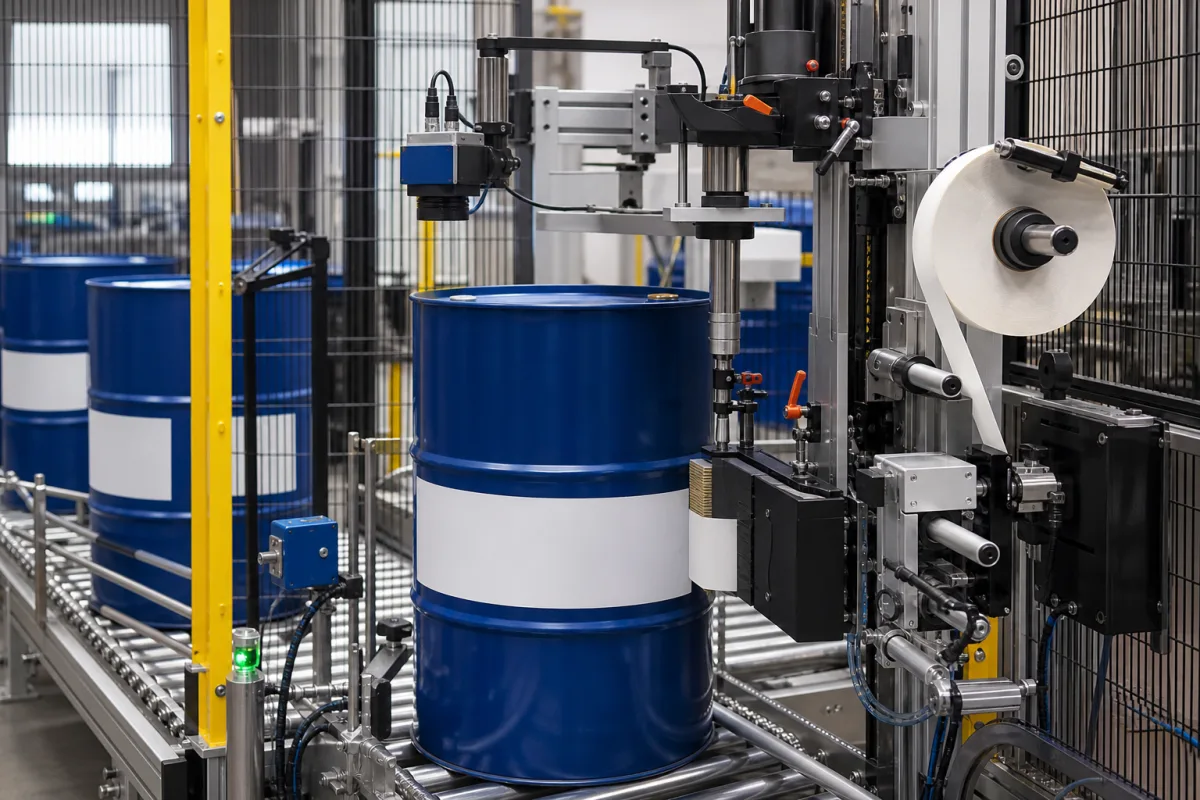
Print-and-apply drum labelling station for filled chemical drums: GHS hazard labels printed on demand, applied to the drum side and verified
Chemical drums on a conveyor · hazard label size by drum volume, on-demand printing of product, dangerous-goods and logistics labels, height adjustment, scanner or camera check
After filling and capping, each chemical drum has to leave the line carrying the right hazard label for what is inside it, and b+b automation lists a dangerous-goods label and a logistics label as further labels that can go on the same drum. A drum print-and-apply station does this without a pre-printed label stock for every product: it receives the data for the drum in front of it, prints the labels, applies them to the curved side at the right height, and reads them back before the drum moves on.
Print-and-apply labelling stations and labelling machines for filled chemical drums and pails on conveyors, including on-demand printers, applicators for curved drum sides, height adjustment for different drum sizes, and barcode or camera verification that ties each label to the drum. Self-adhesive labellers for bottles, cans and cartons are covered on the Labeling systems for packaging lines page; roll-fed wrap-around bottle labellers on the Labeling unit page; bench label dispensers on the Automatic label dispenser page; robots that palletise drums on the Conveyor and robotic arm cell for drums page; and the filling and capping line upstream on the Automated chemical drum filling and sealing system page.
CNFX editorial research · Sources checked October 12, 2026 · 4 sources
How big the hazard label has to be on a 200-litre drum or a 1,000-litre IBC
The station's label width and the printer's print width are set by the largest label it has to place. Under GB CLP, the minimum size rises with package capacity.
The same annex requires each hazard pictogram to be a square set on a point, with a black symbol on a white background inside a red frame, to cover at least one fifteenth of the minimum label area given over to the Article 17 hazard information, and never to be smaller than 1 cm². [1]
Editorial calculation: a 200-litre drum falls in the 50 to 500 L band, so its hazard label must be at least 105 × 148 mm = 15,540 mm²; one fifteenth of that is about 1,036 mm², close to the 32 × 32 mm (1,024 mm²) pictogram the table gives. A label carrying three pictograms needs at least about 3 × 1,036 ≈ 3,100 mm² for pictograms alone, about one fifth of the minimum label area. The red frame also means the printer, or the pre-printed label stock, must handle red as well as black.
PPG states that chemicals shipped by ocean freight need BS 5609-certified pressure-sensitive labels under the IMDG Code, and that its Teslin face stock is certified to BS 5609 sections 2 and 3 and prints by thermal transfer, laser or inkjet. [4] Editorial note: PPG's statement covers its face stock; ask the label supplier with which printing method and ribbon or ink the BS 5609 certification of the finished label was obtained, and use that method on the station.
List the drum and IBC sizes, the largest label and the number of pictograms, whether the frame red is pre-printed or printed on demand, and whether the drums are shipped by sea.
02
Printing, applying and checking at the drum: labels per drum, application height and verification
b+b automation describes its BLM drum labeller as built for GHS labelling, at 3 to 5 large cylindrical products per minute. [2]
Editorial calculation: 3 to 5 drums per minute is 180 to 300 drums per hour, or 12 to 20 seconds per drum, the time available to print and apply every label the drum carries and to read them back. [2] Where three labels go on one drum, ask whether they are printed in parallel by separate units or one after another by a single printer, and quote the rate with that number of labels.
Cobalt describes its Nexus 20 drum applicator as GS1 and GHS compliant and says it removes the need to synchronise application with drum rotation. [3] b+b automation points to separate software for passing print data from an ERP system to the printing and dispensing units. [2] Editorial note: the tracking part of the system is that data link plus the read-back; agree which identifier (batch, drum serial, SSCC) the scanner must confirm before the drum is released.
Station function
What the reviewed makers describe
Labels per drum
Product label, dangerous-goods label(s) and logistics label, from more than one label dispenser and/or more than one printing and dispensing system [2]; multiple labels each with unique real-time data, applied to a rotating drum [3]
Printing
TTO print module as an option [2]; simultaneous print and application [3]
Application
Simple applicators, vacuum belts or robots with a vacuum plate sized to the label [2]; side application with a roller that works the label onto the curved surface [3]
Drum motion
Continuous or at standstill; or a separate drum labelling station [2]
Height
Manual spindles or automatic actuators move the dispensers to the recipe height; height traversing unit for different drum sizes [2]
Verification
Stationary barcode scanners or camera systems check label presence and print data; label ejection station as an option [2]
Line signals
2 volt-free inputs (E-stop, applicator reset) and 3 volt-free outputs (applicator healthy, apply complete, media low) [3]
Give the drum sizes and heights on the line, the conveyor speed and whether drums may stop at the station, the labels per drum and their sizes, the print data source (ERP, MES or label software), and the signals the line controller expects.
03
What to send for a drum print-and-apply station
Paste it into your enquiry below or into an email to a maker, then replace every bracket.
Drums: [types; volumes; heights; steel, plastic or fibre; surface]
Labels: [hazard, transport, logistics; sizes; pictograms; colours]
Stock: [BS 5609 needed; face stock; adhesive]
Rate: [drums per hour; labels per drum; continuous or stop]
Data: [ERP/MES source; identifiers to print and verify]
Verification: [barcode or camera; reject or eject]
Line: [conveyor; signals; guarding]
Explore company information and manufacturing capabilities, then discuss the scope of your project with a relevant supplier.
Share this page
Compiled and source-reviewed by the CNFX editorial team.
Each manufacturer above links to the page on that company's own website where the product is listed, with the date we checked it. How we source and review
· Page last updated 13 October 2026
Buyer questions
How big must a GHS label be on a 200-litre drum?
Under GB CLP Annex I Table 1.3, packages over 50 L and up to 500 L need a label of at least 105 × 148 mm with pictograms of at least 32 × 32 mm. [1]
How fast can drums be labelled automatically?
b+b automation lists its BLM drum labeller at 3 to 5 large cylindrical products per minute. [2]
Why do chemical drum labels need BS 5609?
PPG states that the IMDG Code requires BS 5609-certified pressure-sensitive labels for chemicals shipped by ocean freight. [4]
Sources and what still needs a direct check
Sources checked 2026-10-12. The label and pictogram sizes come from the GB CLP text on legislation.gov.uk; b+b automation and Cobalt describe their own drum labelling machines; PPG describes its own BS 5609 label face stock.