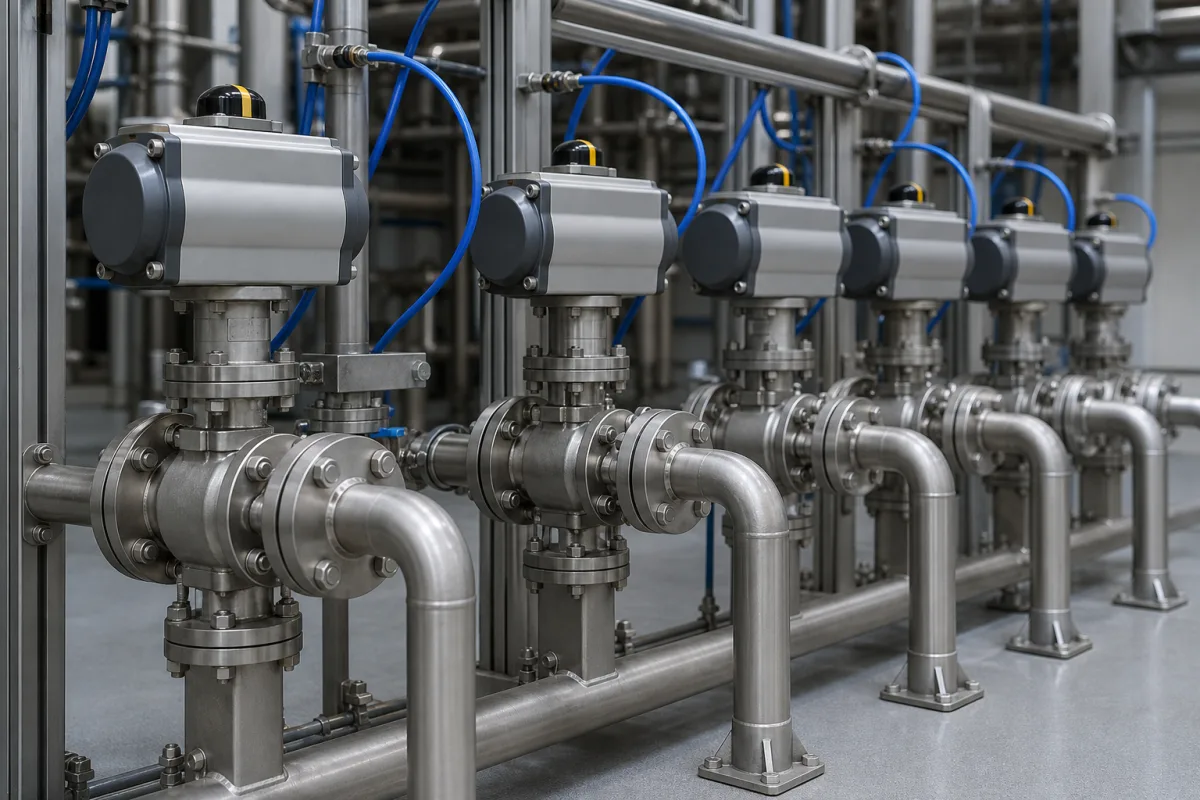
Automated valves (group of pneumatically actuated on/off valves on a chemical process skid, piloted from one valve island and switched in sequence)
Pneumatically actuated on/off valve groups on chemical process and filtration skids · valve islands and terminals that pilot the actuators, exhaust non-return protection, diagnostics at the controller, sequenced switching of several valves, backwash-path flows
Automated valves here are the actuated on/off valves on a chemical process or filtration skid, each with a pneumatic quarter-turn actuator, piloted together from one valve terminal or valve island and opened and closed by the skid controller in a set order. Ask three things first: what each valve does in each step and what flow it carries then, how the pilot valves are grouped, networked and diagnosed, and what stops an actuator moving when it should not.
Groups of pneumatically actuated on/off valves on chemical process and filtration skids, with their valve islands or valve terminals, pilot air protection and switching sequence. Backwash and control valves for water filters and softeners, including multi-cycle heads and valve nests, are covered on the Backwash valve assemblies page; modulating globe control valves on the Pneumatic globe control valve page; single quarter-turn actuators on the Pneumatic actuator page; ball valves and limit switch boxes have their own pages.
CNFX editorial research · Sources checked October 12, 2026 · 3 sources
Valve by valve, step by step: the flow each valve sees
Applied Membranes describes its multi-media filters with AquaMatic valve nests: instead of a single control-valve head, "a set of five valves controls service, backwash and rinse flows at different points in the system", which removes the centre riser tube and distributor for better flow distribution and lower pressure drop. All the valves "are automated by a central electronic controller", with electromechanical or PLC controllers on request, and one controller can automate up to four filter tanks. Its table rates each filter at 5 gpm/ft² in service and 15 gpm/ft² in backwash, from a 24 × 72 in tank at 15 gpm service and 47 gpm backwash to a 42 × 72 in tank at 48 gpm and 144 gpm. [1]
Editorial calculation: backwash runs at three times the service loading (15 ÷ 5 gpm/ft²), so in the 36 × 72 in filter the valves on the backwash path pass 106 gpm against 35 gpm in service (106 ÷ 35 ≈ 3.0). Size the backwash inlet and drain valves for the backwash flow, not the service flow. [1]
Give the skid builder the number of filters and valves per filter, the valve type, size and material for each position, service and backwash flows, the step table (which valves open in each step and for how long), the controller and how backwash is triggered, actuator type and fail position, position feedback, and the pilot valve arrangement.
02
Valve islands and terminals that pilot the actuators
A trade report on Festo's VTUG describes an aluminium sub-base valve terminal taking 4 to 24 valve positions in a fixed grid, in 10, 14 and 18 mm sizes with air flow up to 1,200 l/min, connected by multi-pin plug or by IO-Link to a master, with fieldbus or industrial Ethernet added through a module on the IO-Link port, and protection classes IP40, IP65 or IP67. [2]
Bürkert's AirLINE Type 8652 valve island, listed by the EtherCAT Technology Group, was "especially developed for applications in process automation": diagnostics appear on an LC display and at the controller, the hardware is optimised for mounting at the bottom of a control cabinet or on a top-hat rail, and "the non-return valves in the exhaust air ducts make sure there is no unplanned actuation due to pressure peaks". [3]
03
What to write into the step table for each valve
Item
Why it matters
Source
Valve function per step
Which flow each valve opens or closes in service, backwash and rinse.
12 companies list this product among what they make. Company figures are quoted from each
company's own website; every card states where the relationship came from.
Explore company information and manufacturing capabilities, then discuss the scope of your project with a relevant supplier.
Share this page
Compiled and source-reviewed by the CNFX editorial team.
Each manufacturer above links to the page on that company's own website where the product is listed, with the date we checked it. How we source and review
· Page last updated 13 October 2026
Buyer questions
How is this different from filter backwash valves?
This page covers actuated valve groups on chemical process skids and the valve islands that drive them; backwash heads and valve nests for water filters and softeners are on the Backwash valve assemblies page. [1][3]
How many valves does a filter need?
Applied Membranes' valve nest uses five valves per filter for service, backwash and rinse. [1]
Why size some valves bigger?
Backwash runs at 15 gpm/ft² against 5 gpm/ft² in service, so backwash-path valves see about three times the flow. [1]
What stops an actuator moving on a pressure peak?
Bürkert's AirLINE 8652 uses non-return valves in the exhaust air ducts. [3]
Sources and what still needs a direct check
Sources checked 2026-10-12. Applied Membranes publishes its multi-media filters with AquaMatic valve nests; Design Engineering reported Festo's VTUG valve terminal; the EtherCAT Technology Group lists Bürkert's AirLINE 8652 valve island.