Industry-Verified Manufacturing Data (2026)

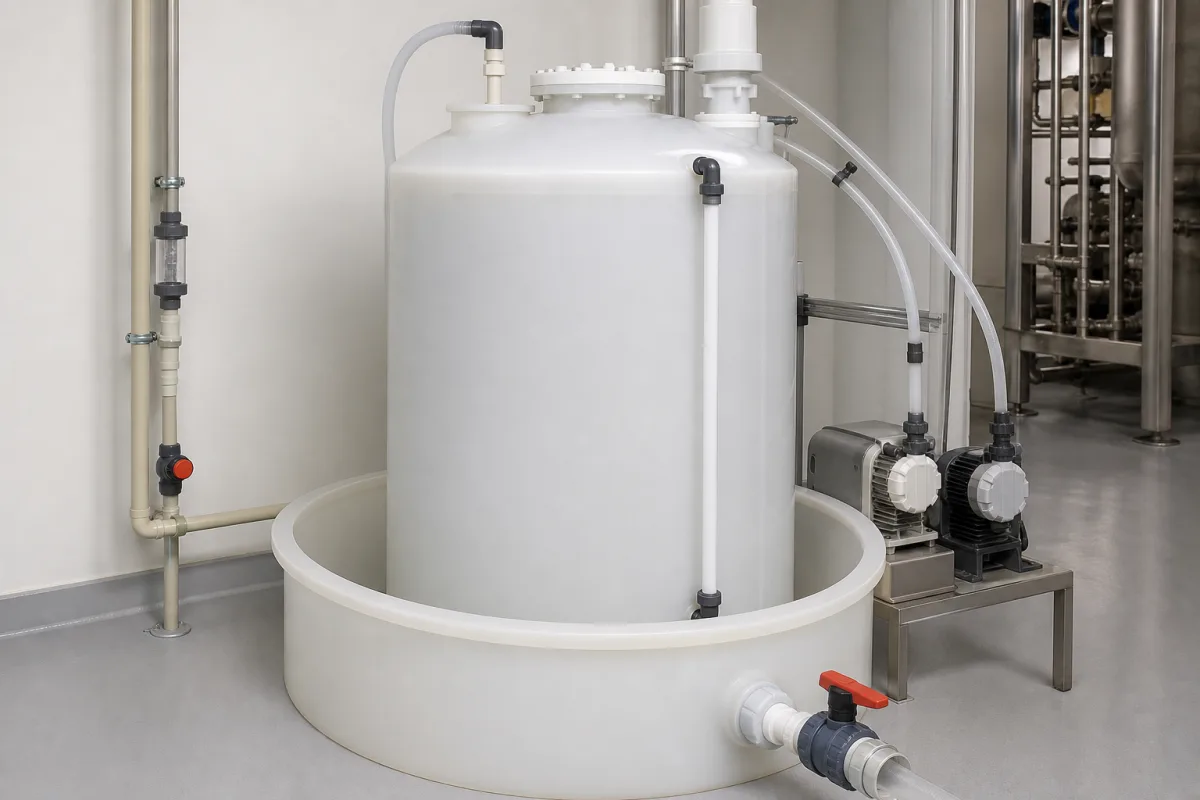
Chemical Storage Tank

Based on aggregated insights from multiple verified factory profiles within the CNFX directory, the standard Chemical Storage Tank used in the Chemical Manufacturing sector typically supports operational capacities ranging from standard industrial configurations to heavy-duty production requirements.

Technical Definition & Core Assembly

A canonical Chemical Storage Tank is characterized by the integration of Tank Body / Shell and Lid / Manway. In industrial production environments, manufacturers listed on CNFX commonly emphasize Polyethylene (PE) construction to support stable, high-cycle operation across diverse manufacturing scenarios.

A container designed for the safe storage of chemicals within a dosing system.

Product Specifications

Technical details and manufacturing context for Chemical Storage Tank

Definition
A specialized vessel that stores liquid or powdered chemicals before they are precisely metered and injected into a process stream by the chemical dosing system. It ensures chemical integrity, prevents contamination, and provides a buffer between bulk supply and the dosing pumps.
Working Principle
The tank provides a contained, often sealed, environment for chemical storage. It may include features like level indicators, agitation systems, or temperature control to maintain the chemical in a suitable state for the dosing pumps to draw from. It acts as the primary reservoir in the dosing system's supply chain.
Common Materials
Polyethylene (PE), Polypropylene (PP), Stainless Steel (e.g., 304, 316L), Fiberglass Reinforced Plastic (FRP)
Technical Parameters
  • The total volumetric capacity of the tank. (L) Per Request
Components / BOM
  • Tank Body / Shell
    The primary containment structure that holds the chemical.
    Material: PE, PP, Stainless Steel, FRP
  • Lid / Manway
    Provides access for filling, inspection, and cleaning; often includes a vent.
    Material: Same as tank body or compatible polymer/metal
  • Outlet Port / Valve
    Connection point for the suction line to the dosing pump.
    Material: PVC, PP, PVDF, Stainless Steel
  • Level Indicator
    Visual or electronic gauge to monitor the chemical volume inside the tank.
    Material: Glass, Plastic, Stainless Steel (with sensor)
  • Agitator (optional)
    Mixing mechanism to prevent chemical settling or stratification.
    Material: Stainless Steel shaft with plastic/SS impeller
Engineering Reasoning
0-2.5 bar gauge pressure, -10°C to 40°C ambient temperature, 0-95% relative humidity
Material yield strength at 0.2% offset: 250 MPa for 316L stainless steel, burst pressure: 6.25 bar (2.5x design pressure), brittle fracture temperature: -196°C for 316L
Design Rationale: Stress corrosion cracking due to chloride ion concentration exceeding 25 ppm at temperatures above 60°C, following NACE MR0175/ISO 15156 standards for sulfide stress cracking
Risk Mitigation (FMEA)
Trigger Chloride concentration exceeding 25 ppm in stored chemical at temperatures above 60°C
Mode: Intergranular stress corrosion cracking initiating at weld heat-affected zones
Strategy: Implement duplex stainless steel (UNS S31803) construction with maximum 0.03% carbon content and post-weld heat treatment at 1050°C followed by rapid quenching
Trigger Thermal cycling between -10°C and 40°C at frequency exceeding 5 cycles per hour
Mode: Low-cycle fatigue crack propagation from nozzle-to-shell junctions following Coffin-Manson relationship with exponent n=0.3
Strategy: Design with integral reinforcement pads (ASME BPVC Section VIII Div.1 Appendix 2) and maintain minimum radius of 50 mm at all discontinuities

Industry Taxonomies & Aliases

Commonly used trade names and technical identifiers for Chemical Storage Tank.

Applied To / Applications

This component is essential for the following industrial systems and equipment:

Industrial Ecosystem & Supply Chain DNA

Complementary Systems
Downstream Applications
Specialized Tooling

Application Fit & Sizing Matrix

Operational Limits
pressure: Atmospheric to 0.5 bar gauge
flow rate: 0-100 L/min (dosing dependent)
temperature: -20°C to 80°C
slurry concentration: Up to 40% solids by weight
Media Compatibility
✓ Polyethylene (HDPE) for acids/bases ✓ Stainless Steel 316L for solvents ✓ Fiberglass Reinforced Plastic (FRP) for corrosives
Unsuitable: Hydrofluoric acid storage (requires specialized materials)
Sizing Data Required
  • Required chemical volume (L)
  • Maximum dosing rate (L/min)
  • Chemical specific gravity and viscosity

Reliability & Engineering Risk Analysis

Failure Mode & Root Cause
Corrosion-induced wall thinning
Cause: Chemical attack from stored substances, especially acids or chlorides, combined with moisture ingress or improper material selection for tank construction.
Stress corrosion cracking (SCC)
Cause: Tensile stresses from welding, fabrication, or operational loads combined with corrosive environment, often accelerated by chlorides or sulfides in stored chemicals.
Maintenance Indicators
  • Visible external corrosion, bulging, or weeping/seepage at seams/welds indicating potential wall failure
  • Unusual audible hissing, popping, or cracking sounds from the tank shell, suggesting stress or crack propagation
Engineering Tips
  • Implement regular ultrasonic thickness testing (UTT) at high-risk areas to monitor wall thinning and schedule proactive repairs before failure
  • Apply cathodic protection systems and high-performance linings/coatings compatible with stored chemicals to prevent corrosion initiation

Compliance & Manufacturing Standards

Reference Standards
ISO 28300: Petroleum, petrochemical and natural gas industries - Shell-and-tube heat exchangers ASME Boiler and Pressure Vessel Code (BPVC) Section VIII: Rules for Construction of Pressure Vessels DIN 28018: Vertical cylindrical steel tanks for the storage of liquids above ground - Nominal capacities, main dimensions
Manufacturing Precision
  • Wall thickness: +/-10% of nominal thickness
  • Out-of-roundness: Maximum 1% of nominal diameter
Quality Inspection
  • Hydrostatic Pressure Test
  • Ultrasonic Thickness Testing

Factories Producing Chemical Storage Tank

Verified manufacturers with capability to produce this product in China

✓ 93% Supplier Capability Match Found

P Procurement Specialist from Germany Jan 07, 2026
★★★★★
"Standard OEM quality for Chemical Manufacturing applications. The Chemical Storage Tank arrived with full certification."
Technical Specifications Verified
T Technical Director from Brazil Jan 04, 2026
★★★★★
"Great transparency on the Chemical Storage Tank components. Essential for our Chemical Manufacturing supply chain."
Technical Specifications Verified
P Project Engineer from Canada Jan 01, 2026
★★★★★
"The Chemical Storage Tank we sourced perfectly fits our Chemical Manufacturing production line requirements."
Technical Specifications Verified
Verification Protocol

“Feedback is collected from verified sourcing managers during RFQ (Request for Quote) and factory evaluation processes on CNFX. These reports represent historical performance data and technical audit summaries from our B2B manufacturing network.”

16 sourcing managers are analyzing this specification now. Last inquiry for Chemical Storage Tank from UAE (1h ago).

Supply Chain Compatible Machinery & Devices

Automated Batch Crystallization System

Automated system for controlled crystallization of chemical compounds in batch processes.

Explore Specs →
Automated pH Monitoring and Dosing System

Automated system for continuous pH monitoring and chemical dosing in process streams.

Explore Specs →
Automated Powder Dispensing and Blending System

Automated system for precise dispensing and homogeneous blending of powdered chemicals.

Explore Specs →
Automated Solvent Recovery and Purification System

Automated system for recovering and purifying industrial solvents.

Explore Specs →

Frequently Asked Questions

What materials are best for corrosive chemical storage?

For corrosive chemicals, polyethylene (PE), polypropylene (PP), and stainless steel grades like 316L offer excellent resistance. FRP tanks are also suitable for many aggressive chemicals, depending on the specific chemical compatibility.

Can these tanks be customized with agitators?

Yes, agitators are available as an optional component in the BOM to ensure proper mixing and homogeneity of stored chemicals, preventing sedimentation or separation in the dosing system.

How do I choose between PE, PP, stainless steel, or FRP?

Selection depends on chemical compatibility, temperature, pressure requirements, and budget. PE and PP are cost-effective for many chemicals, stainless steel (304/316L) offers durability for high-purity applications, and FRP provides strength and corrosion resistance for large-scale storage.

Can I contact factories directly on CNFX?

CNFX is an open directory, not a transaction platform. Each factory profile provides direct contact information and production details to help you initiate direct inquiries with Chinese suppliers.

Get Quote for Chemical Storage Tank

Request technical pricing, lead times, or customized specifications for Chemical Storage Tank directly from verified manufacturing units.

Your business information is encrypted and only shared with verified Chemical Storage Tank suppliers.

Thank you! Your message has been sent. We'll respond within 1–3 business days.

Need to Manufacture Chemical Storage Tank?

Connect with verified factories specializing in this product category

Add Your Factory Contact Us
Previous Product
Chemical Reactor Temperature Sensor Probe
Next Product
Chemical Storage Tanks