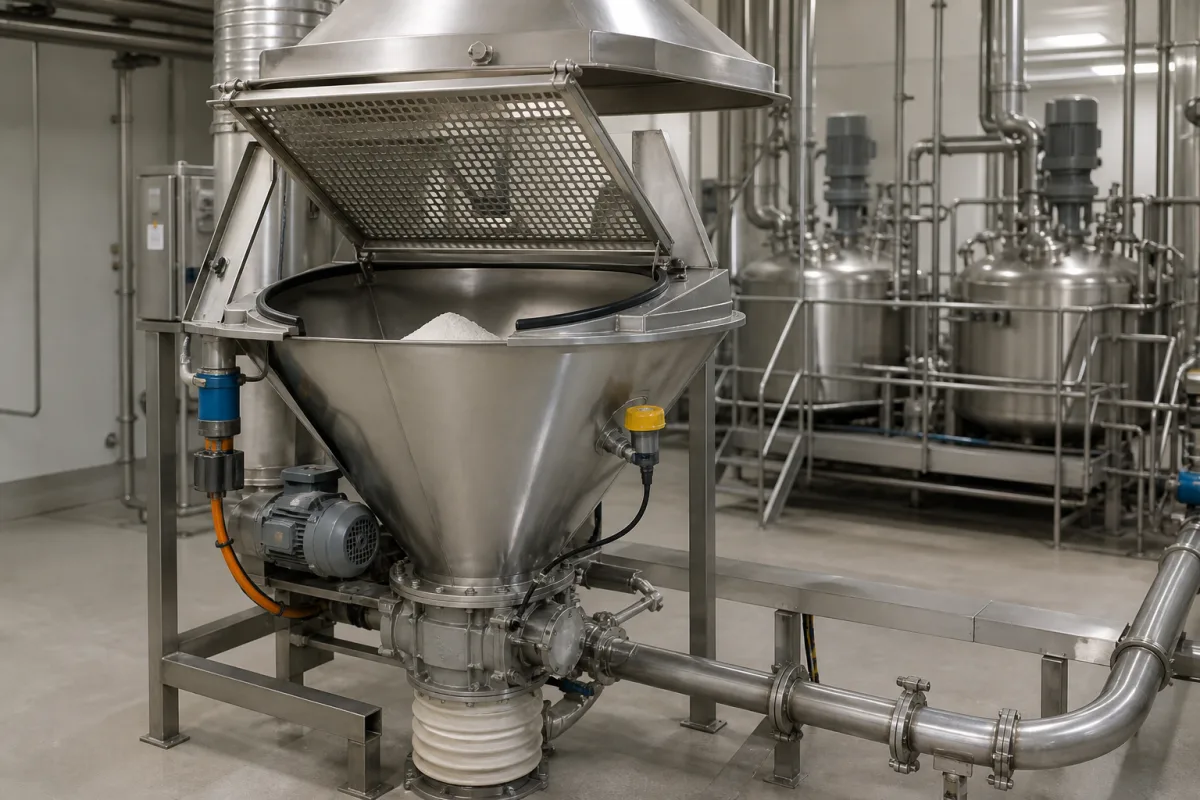
Loading hopper for manual bag tipping (bag dump station)
Manual bag loading hoppers · Grate size and hopper volume, dust hood and extraction airflow, filter area, discharge to conveying
A loading hopper for manual bag tipping, also called a bag dump or bag emptying station, is the point where operators slit and empty bags of powder, granules or catalyst into a process: a hopper with a grate that holds the bag and keeps packaging out, a hood or door that contains dust, a fan and filter that pull dust back into the product, and a discharge to a rotary valve, screw or pneumatic conveying line. Ask three things first: the hopper volume and grate size for your bag size and tipping rate, the extraction airflow and filter area that keep dust inside, and what the hopper discharges into.
Manual bag-tipping loading hoppers and bag dump stations for powders, granules and catalysts in chemical, food, pharmaceutical and plastics plants, including grate, dust hood, integrated filter and fan, and discharge to feeders or conveying. Fluidised powder feed hoppers that supply electrostatic coating guns are covered on the Powder feed hopper page. Big-bag (FIBC) dischargers, silos and the conveying lines themselves are outside this page.
CNFX editorial research · Sources checked October 12, 2026 · 3 sources
Schrage's bag emptying stations come in 100-litre and 200-litre hopper volumes with 800 × 600 mm and 1050 × 700 mm grate inserts respectively, special sizes on request. The grate keeps packaging material out of the hopper, a support bench at working height takes the bag, and options include hopper weighing, a dispersing agitator, beater or vibrator, ATEX-compliant versions and a range of metering and conveying devices under the hopper. [2]
Nol-Tec's Model 256 manual bag dump station has a 5 ft³ collecting hopper under a 20.5 × 36 in grate, with an 8 in flanged discharge (150 lb drilling) and options for hopper aeration, various discharge designs, a bag cutter and a bag compactor. [1] Editorial calculation: 5 ft³ × 28.32 L/ft³ ≈ 142 L; the 20.5 × 36 in grate is about 521 × 914 mm, or 0.48 m², the same area as Schrage's 800 × 600 mm grate (0.48 m²). [1][2]
Editorial note: the hopper only buffers between tipping and the feeder below it; give the supplier the bag weight, bags per hour and the downstream feed rate so the volume holds at least one bag's contents without overfilling the grate.
Give the supplier the material, bulk density, particle size and flow behaviour, whether it is toxic, combustible or hygroscopic, bag size and weight, bags per hour, the downstream feeder or conveying system and its rate, construction material and finish, dust class and filter requirements, ATEX or hazardous-area needs, and options such as weighing, aeration, bag compaction or a magnetic grate.
02
Contain the dust with extraction airflow and filter area
Nol-Tec specifies its manual bag dump station as a complete work station with an exhauster fan, cartridge dust collector and collecting hopper: 180 ft² of filter area, a dust capture velocity of 200 FPM, an 800 CFM, 1.5 HP TEFC exhauster at 230–460 V three-phase, and manual push-button cartridge cleaning with clean, dry compressed air at 80 psig minimum, and lists 100% material recovery. [1]
Editorial calculation: 800 CFM ≈ 800 × 1.699 ≈ 1,359 m³/h, 180 ft² ≈ 16.7 m² of filter, and the air-to-cloth ratio is 800 / 180 ≈ 4.4 ft/min. [1] Schrage offers either a top filter on the station or connection to external dust removal. [2]
VAC-U-MAX describes its bag dump stations as built in carbon steel or 304/316 stainless steel with 3-A/USDA sanitary design options, integrated dust collection, empty bag compaction, and a magnetic grate that captures ferrous material, with an optional vacuum lifter to place heavy bags on the grate. [3] Editorial note: if the material is combustible, ask how the filter and fan are protected and which hazardous-area classification the station is built for.
03
Hopper volume, grate opening, fan airflow and filter area to request with a quote
Ask any supplier for the hopper volume, grate size and opening, fan airflow, filter area and cleaning method, discharge connection, and material certificates for product-contact parts.
04
Grate, hopper body, hood and door, cartridge filter, exhauster fan, flow aids and discharge
Component
Role
Fix in the order
Grate (bar or magnetic)
Supports bags; keeps packaging and tramp iron out. [2][3]
Hopper volume, grate size, outlet flange and contact material for a bag tipping station
Hopper wall angle and discharge rate have no published values here: the first depends on how your powder flows and the second on the feeder below the hopper.
Field
What it means and published values
Ask the supplier for
Capacity (L)
Examples: 100 L and 200 L; 5 ft³ (about 142 L). [2][1]
Explore company information and manufacturing capabilities, then discuss the scope of your project with a relevant supplier.
Share this page
Compiled and source-reviewed by the CNFX editorial team.
Each manufacturer above links to the page on that company's own website where the product is listed, with the date we checked it. How we source and review
· Page last updated 13 October 2026
Buyer questions
How big is a bag dump hopper?
Schrage offers 100 L and 200 L hoppers with 800 × 600 mm and 1050 × 700 mm grates; Nol-Tec's Model 256 has a 5 ft³ hopper under a 20.5 × 36 in grate. [2][1]
How much extraction does a bag dump station need?
Nol-Tec lists an 800 CFM exhauster, 180 ft² of filter and 200 FPM capture velocity for its manual station. [1]
What materials are bag dump stations made of?
VAC-U-MAX lists carbon steel or 304/316 stainless steel with 3-A/USDA sanitary options. [3]
Sources and what still needs a direct check
Sources checked 2026-10-12. Nol-Tec, Schrage and VAC-U-MAX are makers of bulk handling equipment describing their own bag dump and bag emptying stations; values are their published specifications.