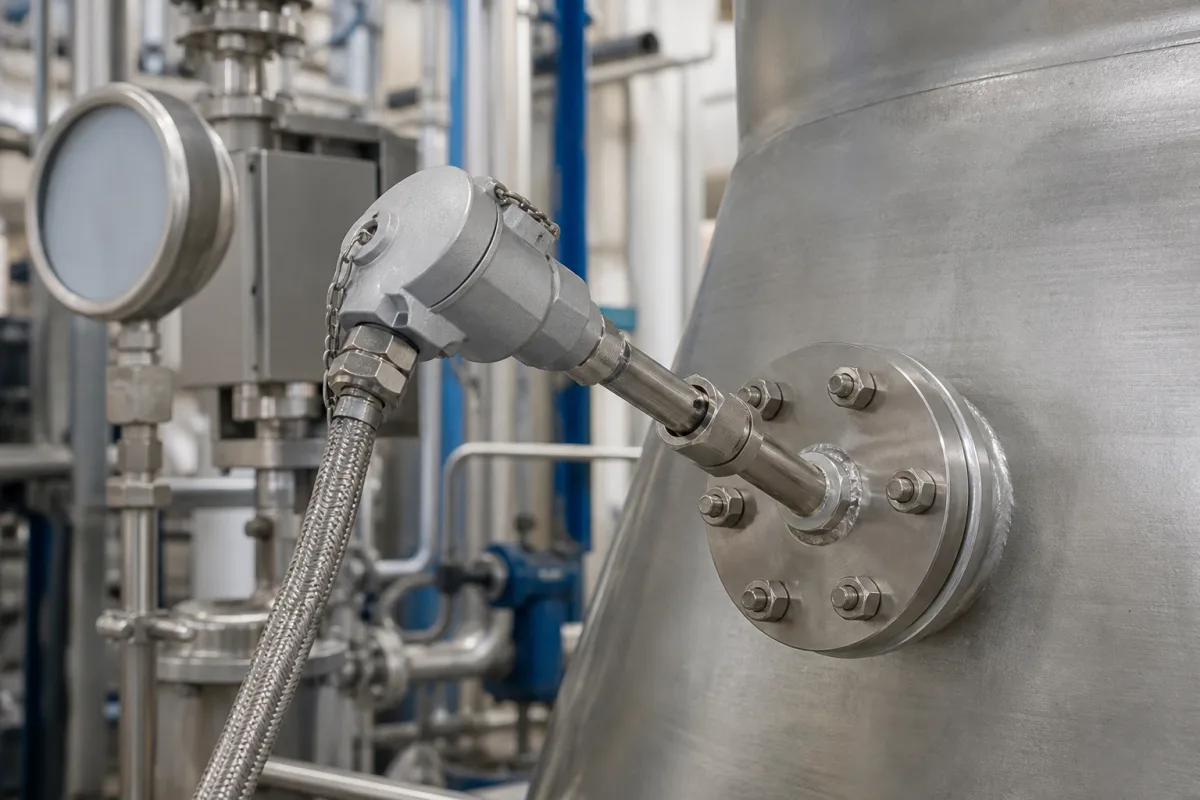
Industrial temperature probe (RTD and thermocouple assemblies)
Process temperature probes · IEC 60751 RTD tolerance classes, element data, thermowell wake-frequency checks under ASME PTC 19.3 TW
An industrial temperature probe is a sensing element (a platinum RTD such as Pt100, or a thermocouple) in a protective sheath with a connection head or cable, which can be inserted into a thermowell that seals the process and takes the flow load. Ask three things first: which tolerance class the element meets across your measuring range, how fast the assembly responds in your medium, and whether the thermowell has been checked against your flow velocity.
RTD and thermocouple probe assemblies for process vessels and pipes, with sheath, connection head, optional transmitter and thermowell. Food, medical and appliance thermistor probes, handheld thermometers, wafer probe stations and stand-alone transmitters are outside this page.
CNFX editorial research · Sources checked October 11, 2026 · 4 sources
Emerson, summarising IEC 60751, gives the platinum RTD tolerance classes as Class A: ±(0.15 + 0.002 × |t|) °C and Class B: ±(0.30 + 0.005 × |t|) °C, where t is the temperature, and notes that individually calibrated sensors with Callendar–Van Dusen coefficients used in a transmitter can improve accuracy beyond the standard classes. [1]
A distributor's datasheet for wire-wound Pt100 elements (100 Ω at 0 °C, nominal 38.5 Ω fundamental interval from 0 to 100 °C) shows that the class also limits the range: W0.15 (Class A) from −100 °C to +450 °C, and W0.3 (Class B) from −196 °C to +660 °C. The same sheet gives a self-heating of 0.02 to 0.3 °C/mW, a 1 mA measuring current and a response of under 0.4 s to 63% of final value in water at 1 m/s, for the bare element. [2]
Editorial calculation: at 100 °C, Class A allows ±(0.15 + 0.2) = ±0.35 °C and Class B ±(0.30 + 0.5) = ±0.8 °C; at 450 °C, Class A allows ±1.05 °C. The element's response figure is for the bare element; a sheath and thermowell slow it, so ask for the assembly's response time in your medium. For thermocouple probes, ask for the IEC 60584-1 tolerance class and range instead. [1][2]
Give the supplier the medium, normal and maximum temperature and pressure, flow velocity, pipe or vessel connection, insertion length, required class or calibration, response time needed, transmitter output, hazardous-area and IP requirements, and materials in contact with the process.
02
Check the thermowell against the flow
Emerson's thermowell white paper explains that flow past a thermowell sheds alternating vortices; as the shedding (Strouhal) frequency approaches the thermowell's natural frequency, displacement and stress are greatly magnified and fatigue failure can follow. In-line (drag) vibration occurs at about twice the frequency of transverse (lift) vibration, so its critical velocity is about half. ASME PTC 19.3-1974 limited the frequency ratio to 0.8 and did not cover in-line resonance; ASME PTC 19.3 TW-2010 does. [3]
The ASME PTC 19.3 TW example problem lists four acceptance criteria: frequency limit, dynamic stress limit, static stress limit (von Mises) and hydrostatic pressure limit, plus material suitability. In its steam example, a Strouhal number of 0.22, a velocity of 295 ft/s and a 1.0 in tip give a shedding rate of 778.8 Hz, which is below 0.4 times the installed natural frequency of 2176 Hz, so in the example's words the thermowell "passes the most stringent frequency limit". It notes that shorter unsupported length, larger root diameter and smaller tip diameter raise natural frequency. [4]
Emerson lists conditions under which the frequency calculation is not needed, including velocity below 0.64 m/s, wall thickness of at least 9.55 mm, unsupported length up to 0.61 m and root and tip diameters of at least 12.7 mm, and says it declines to advise on velocity collar sizing. [3] Editorial calculation: water at 2 m/s past a 20 mm tip with a Strouhal number of 0.22 sheds at 0.22 × 2 / 0.020 = 22 Hz; compare it, and twice it for in-line vibration, with the installed natural frequency the supplier calculates. Velocity and tip diameter are assumed examples.
03
Compare what suppliers offer
Suppliers linked to this page list temperature probes; each card links to the page reviewed.
Listings include probe-type and tri-clamp sanitary Pt100 RTDs with thermocouples and transmitters, and temperature probes sold with humidity probes. Ask each for the element class, sheath and thermowell design and any calibration certificate.
04
Trace the probe components
This is a functional reference built from the sources cited; it is not one maker's specification.
Converts to 4–20 mA; can use calibration coefficients. [1]
Output, isolation, sensor matching.
05
Fill the specification fields with values for your process
A temperature probe quotation needs values for your process. The table explains each field, gives published values where a reviewed source states them, and says what to obtain from the supplier.
Field
What it means and published values
Ask the supplier for
Measuring Range (°C)
Example Pt100 element: Class A −100 to +450 °C; Class B −196 to +660 °C. [2]
Range at the class quoted.
Accuracy (°C)
Class A ±(0.15 + 0.002|t|); Class B ±(0.30 + 0.005|t|). [1]
Class or calibration certificate.
Response Time (s)
Example bare element: <0.4 s to 63% in water at 1 m/s. [2]
Assembly value in your medium.
Probe Diameter (mm)
Sheath or tip size; affects response and thermowell loading. [4]
Diameter and tolerance.
Insertion Length (mm)
Longer favours thermal performance but lowers natural frequency. [4]
Explore company information and manufacturing capabilities, then discuss the scope of your project with a relevant supplier.
Share this page
Compiled and source-reviewed by the CNFX editorial team.
Published product pages show what a company offers, not tested performance. Confirm the legal seller, factory and scope for your order. How we source and review
· Page last updated 13 October 2026
Buyer questions
What is the difference between Class A and Class B RTDs?
Per IEC 60751 as quoted by Emerson, Class A allows ±(0.15 + 0.002|t|) °C and Class B ±(0.30 + 0.005|t|) °C. [1]
Why do thermowells fail?
Emerson explains that vortex shedding near the thermowell's natural frequency greatly magnifies stress, causing fatigue; in-line resonance occurs at about half the transverse critical velocity. [3]
What does ASME PTC 19.3 TW check?
Its example lists four criteria: frequency limit, dynamic stress, static stress and hydrostatic pressure, plus material suitability. [4]
Sources and what still needs a direct check
Sources checked 2026-10-11. Emerson is a temperature instrument maker; its RTD page quotes IEC 60751 and its white paper explains ASME PTC 19.3 TW. The ASME example problem is published by the standard's owner. The Pt100 element datasheet is a distributor's product sheet.