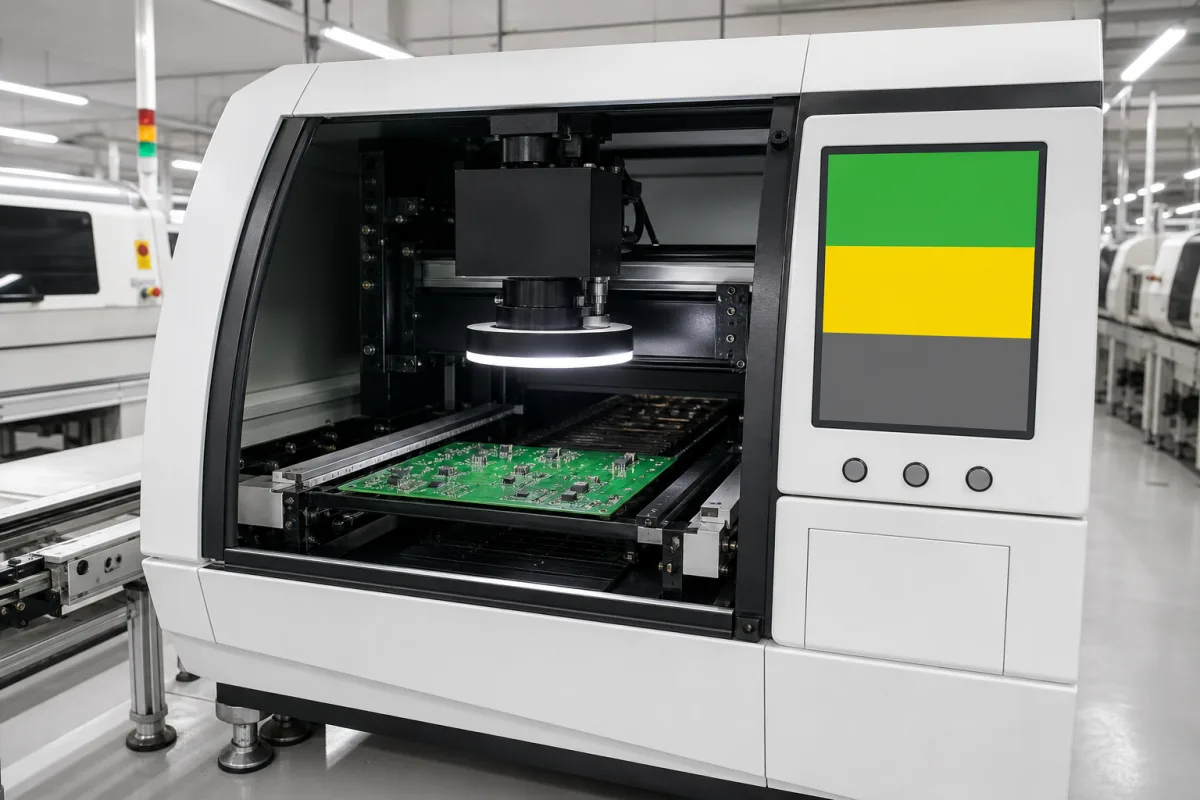
Post-placement, pre-reflow optical inspection system for printed circuit boards
Post-placement, pre-reflow AOI · placed parts checked for presence, position and polarity while they can still be moved by hand, before shields and the oven
A post-placement, pre-reflow optical inspection system sits in the SMT line after the pick-and-place machines and before the reflow oven. It sees components sitting on wet solder paste, so missing, shifted and reversed parts can be corrected with tweezers at a repair station instead of being desoldered later, and its position data can be fed back to the placement machine that caused the error. What it cannot judge is the solder joint, which does not exist yet.
In-line optical inspection stations placed between component placement and reflow soldering: what they measure on placed parts, how pass/fail limits on part position are set, how false calls are handled, and how inspection data is fed back to the placement machine or forward from paste inspection. General 2D and 3D AOI machines for assembled boards, chosen by pixel resolution, height range and imaging speed after reflow, are covered on the Automated optical inspection (AOI) system for PCB assembly page; solder-side AOI for through-hole joints is covered on the Bottom-side and double-sided AOI system page, and coating checks on the Conformal coating inspection (CCI) AOI system page.
CNFX editorial research · Sources checked October 12, 2026 · 4 sources
Where the station goes: after the last placer, ahead of RF shields, hand-load parts and the oven
Two published line studies explain why the inspection was put before reflow rather than after it.
A North American maker of car radios, building about 7,500 boards a day of 120 parts each at roughly one board every seven seconds, placed an RF shield on the board before the oven, which hid some of the parts from optical inspection after reflow. It also had an eight-hour wait between functional and final electrical test, so bad boards could keep being built for hours before defects were found. A Landrex Optima 7200 was installed in line before the shield placement machine; it reported attribute data (part missing, misplaced, wrong orientation) and variable data (measured X, Y and theta against the expected position). Boards with gross faults went to a review-and-repair station and were sent back through the inspection until they passed. [1]
Before the station, roughly 10% of boards had a gross defect or major fault and the weekly defect average was roughly 7,000 ppm, led by missing parts and then mispositioned parts. Over five months and roughly 500,000 boards, end-of-line defects fell to approximately 700 ppm, with a week-to-week standard deviation of roughly 400 ppm. [1]
At a Celestica contract-manufacturing site, a 3D paste inspection system alone had left first-pass yield at in-circuit test (ICT) at 75%, and analysis traced the failures to placement and hand insertion. The site chose in-line component measurement before reflow because defects are easy to repair there, because placement was its largest source of random failures, and because, in its engineers' view, pre-reflow systems are easier to program and give fewer false fails. The requirement was 100% inspection in under 90 seconds per assembly, handling 0402 chips, 0.020-inch-pitch QFPs and BGAs. [2]
Celestica later found that placed parts were being bumped during manual hand-load, which at the time came after the inspection; it moved hand-load ahead of the inspection station so that disturbed parts were flagged before reflow. [2]
Decide what must happen before the station (all placement, hand-load, odd-form parts) and what comes after it (shields, covers), and plan a repair station with a return path into the inspection.
02
Off-pad limits for placed parts: lead-to-pad coverage, lead-to-paste coverage and the 50% versus 70% trade-off
A pre-reflow station decides pass or fail on a part's measured position against user-defined limits, so the limit and the measurement accuracy matter more here than for missing-part checks.
Motorola's patent US6047084 describes placement inspection that models each lead and its pad as polygons and computes the percentage of the ideal overlap actually covered. In its worked example the lead covers 42.145 of an ideal 75.74 area units, 55.6%, and passes a threshold given as 50%; the same lead covers only 38.1% of the area where paste and pad overlap, so the part is judged defectively placed, the board is removed, and the placement or paste step is adjusted. The paste-to-pad coverage in that example is 58.2%. [3]
The car-radio study shows what the limit does in production: with failure limits as tight as 50% off-pad, small discretes and SOT packages tended to fail, translating to about 50% of boards failing inspection; programmers relaxed the criterion to 70% off-pad, which cut the operator load but let real defects escape. In the same study one of four placement machines was responsible for 71% of defects, and placement set-up issues were found on 0402 resistors and capacitors and SOT-23 parts. [1]
The study's author states that the measuring system should have resolution and repeatability ten times better than the placement machine, and gives 100 µm accuracy and 10 µm repeatability as the desired specification for measuring a 0402 component. [1]
Check before reflow
Data the station reports
Published example
Missing part
Attribute: present or absent.
Missing parts were the largest defect class before the car-radio station was installed. [1]
Part offset and rotation
Variable: X, Y and theta against CAD or expected position.
Celestica recalibrated placement X/Y offsets from these measurements. [2]
Tracked with missing and offset defects at Celestica's repair stations. [2]
Agree the off-pad or coverage limit per package family with the line owner before acceptance, and ask the supplier for gauge repeatability data on your smallest chip size.
03
False calls against real defects: 375 ppm found, 230 ppm false, and a stop rule at the repair station
Celestica's numbers show how false calls arise on placed-but-unsoldered boards and what reduced them.
After more systems and new products were added, false error detection rose above 1% because of dull-leaded components and bright pads with cut-back paste. Separate component databases per product and a multi-variable image classifier brought the false-failure rate below 0.5%; the system then reported 375 ppm real against 230 ppm false failures. [2] Editorial calculation: 230 / (375 + 230) = 38% of all flagged calls were false at that point.
Line set-up figures from the same site: seven days to reconfigure a line and train staff, one to two hours of additional operator training, three-minute changeovers between products, about four hours to set up a new board needing a new component database, and under 30 minutes for a new board using an established database. [2]
On two lines with inspection and repair just before reflow, operators tracked missing, offset and polarity defects; if quality fell below 90%, or three errors of the same type appeared on consecutive boards, the process was halted for corrective action. ICT first-pass yield went from under 75% to over 93% and stayed there. [2]
What pre-reflow inspection leaves open: in the car-radio study solder bridges made up 7% of defects produced before repair, and that maker ran no separate paste inspection; the author notes that combining paste and placement inspection before reflow could have reduced that share considerably. [1]
04
Paste-position feed-forward: inspecting the print before placement so parts follow the paste
An inspection station can also sit between the printer and the placement machine, so that the placer is told where the paste actually is.
Panasonic Factory Solutions of America describes its APC system as a 2D inspection machine between screen printer and placer that measures every paste deposit's area and position against its land, feeds stencil cleaning and print-position corrections back to the printer, and feeds paste positions, skip data and bad marks forward so components are placed on the paste rather than on the land. [4]
Its paper puts the allowable paste misalignment at about 30 µm for 40 µm component spacing, and gives the reason: six M0603 parts 300 ± 30 µm wide in a row with 40 µm gaps leave only 10 µm if all are oversized, while placement accuracy is 25 µm. By offsetting print apertures by 30 µm to either side and placing on the paste, it reports 40 µm spacing on parts 0.401 mm long and 0.191 mm wide, relying on paste self-alignment during reflow. [4]
If the line already has paste inspection, ask whether the pre-reflow station can receive its data and whether both can pass corrections to the placement machines in use.
05
Line data for a pre-reflow inspection station
Paste it into your enquiry below or into an email to a maker, then replace every bracket.
Line: [placement machines and makes; boards per hour; board size]
Position: [after last placer; before hand-load, shields or oven]
Parts: [smallest chip; finest pitch; BGAs; odd-form parts]
Limits: [off-pad or coverage limit by package family]
Data: [CAD or placement file format; feedback to placers; link to paste inspection]
Repair: [repair station; re-inspection loop]
Acceptance: [false-call rate target; repeatability study]
Explore company information and manufacturing capabilities, then discuss the scope of your project with a relevant supplier.
Share this page
Compiled and source-reviewed by the CNFX editorial team.
Each manufacturer above links to the page on that company's own website where the product is listed, with the date we checked it. How we source and review
· Page last updated 13 October 2026
Buyer questions
Why inspect a PCB before the reflow oven?
Placed parts can be corrected by hand before soldering, and shields fitted before reflow can hide parts afterwards; a car-radio line cut end-of-line defects from about 7,000 ppm to about 700 ppm this way. [1]
What off-pad limit should a pre-reflow AOI use?
It is user-defined: one study saw about half of boards fail at 50% off-pad and found real defects escaping at 70%; a Motorola patent example uses a 50% lead-to-pad coverage threshold. [1][3]
How low can false calls go on pre-reflow AOI?
At one Celestica site, false fails fell from over 1% to under 0.5% after per-product databases and a multi-variable classifier, leaving 375 ppm real against 230 ppm false. [2]
Sources and what still needs a direct check
Sources checked 2026-10-12. Two of the sources are published line studies (Celestica in SMT magazine; a car-radio OEM using a Landrex system, written by Pamela Lipson), one is a Motorola patent on placement-accuracy checks, and one is a Panasonic conference paper on its own paste feed-forward system.