Editorial Technical Reference

I/O Interface Board

This page explains how I/O Interface Board is classified within Computer, Electronic and Optical Product Manufacturing. Technical values and manufacturer relationships are research references; confirm the current specification and supplier evidence for each order.

Technical Definition & Core Assembly

A printed circuit board that provides input/output connectivity between a control computer and external devices.
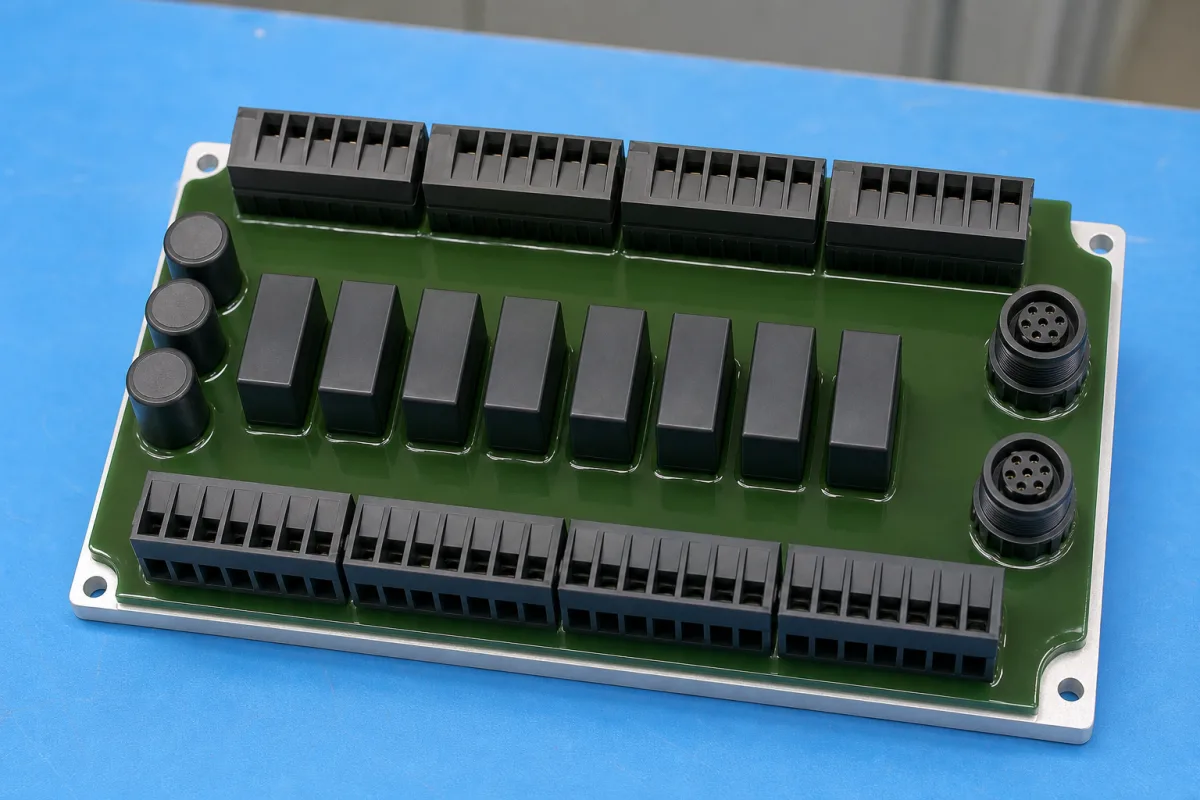
Representative product image. Confirm appearance and specifications with the manufacturer.

Product Specifications

Technical details and manufacturing context for I/O Interface Board

Definition
An I/O Interface Board is a specialized printed circuit board that serves as the intermediary between a control computer's central processing unit and various external devices, sensors, and actuators. It facilitates the conversion, conditioning, and routing of digital and analog signals, enabling the computer to monitor inputs and control outputs within an industrial automation or embedded system. The board is designed for integration into control cabinets or embedded systems, typically following the 3U Eurocard form factor (160×100 mm) as per IEEE 1101.1. It provides configurable digital I/O channels (16–32 channels) with a digital input voltage range of 0–24 V DC, accepting 24 V logic levels. Digital outputs are short-circuit protected per channel, with a current range of 0.5–2 A. Analog inputs offer selectable resolution of 12–16 bits and an accuracy of ±0.1% FSR at 25 °C, including linearity. Communication is via Ethernet with auto-negotiation at 10/100/1000 Mbps, conforming to IEEE 802.3. The board operates over an extended temperature range of -40 to 85 °C (storage: -55 to 125 °C) and a relative humidity of 5–95% non-condensing, tested per IEC 60068-2-1, IEC 60068-2-2, and IEC 60068-2-78. The ingress protection rating depends on the enclosure, ranging from IP40 to IP65 per IEC 60529. Power is supplied at 24 V DC ±10% with reverse polarity protection, and power consumption is 5–15 W without external loads. The board weighs 150–250 g without connectors. Materials include FR-4 PCB substrate, copper traces, and electronic components such as ICs, resistors, capacitors, and connectors. All listed parameters are reference ranges; verify model-specific values and standards with the legal manufacturer or supplier.
Working Principle
The board receives low-voltage digital signals from the computer's bus (e.g., PCI, PCIe, ISA). Its onboard circuitry, including microcontrollers, signal conditioners, and drivers, processes these commands. For outputs, it converts digital commands into appropriate signals (digital, analog, PWM) to drive external devices. For inputs, it receives signals from sensors, conditions them (e.g., filtering, amplification, analog-to-digital conversion), and presents the data to the computer for processing.
Common Materials
FR-4 PCB substrate, Copper traces, Electronic components (ICs, resistors, capacitors, connectors)
Technical Parameters
ParameterTypical rangeNotes & selection driver
Number of I/O Channels16–32 channelsConfigurable digital I/O channels
Digital Input Voltage Range0–24 V DCAccepts 24 V logic levels
Digital Output Current0.5–2 APer channel, short-circuit protected
Analog Input Resolution12–16 bitSelectable per channel
Analog Input Accuracy±0.1 % FSRAt 25 °C, includes linearity
Communication Interface10/100/1000 MbpsEthernet, auto-negotiationIEEE 802.3
Operating Temperature Range-40–85 °CExtended temperature gradeIEC 60068-2-1, IEC 60068-2-2
Storage Temperature Range-55–125 °CNon-operatingIEC 60068-2-1, IEC 60068-2-2
Relative Humidity5–95 % RHNon-condensingIEC 60068-2-78
Ingress Protection RatingIP40–IP65Depends on enclosureIEC 60529
Supply Voltage24 ±10% V DCReverse polarity protected
Power Consumption5–15 WWithout external loads
Board Dimensions160×100 mmStandard 3U EurocardIEEE 1101.1
Weight150–250 gWithout connectors

Ranges are indicative industry figures for RFQ preparation, not a supplier commitment. Confirm every value and standard with the legal manufacturer before ordering.

Components / BOM
  • PCB (Printed Circuit Board) Part
    Provides the physical substrate and electrical pathways (traces) that interconnect all electronic components.
    Material: FR-4 laminate with copper cladding
  • Bus Interface Connector Part
    Connects the board to the control computer's internal bus (e.g., PCIe edge connector, USB port).
    Material: Gold-plated copper alloy
  • Field-Side I/O Connectors
    Terminal blocks, D-sub, or other connectors for wiring external sensors, actuators, and devices.
    Material: Plastic housing with brass or phosphor bronze terminals
  • Microcontroller / FPGA
    Manages communication with the host computer, handles signal processing, and controls I/O operations.
    Material: Silicon semiconductor
  • Signal Conditioning Circuitry
    Includes components like opto-isolators, amplifiers, filters, and ADCs/ DACs to prepare signals for the microcontroller and field devices.
    Material: Various (ICs, resistors, capacitors, optocouplers)
  • Power Regulation Circuit
    Converts and regulates power from the computer bus or external source to the voltages required by the board's components.
    Material: Various (voltage regulators, capacitors, inductors)

Applied To / Applications

This component is essential for the following industrial systems and equipment:

Industrial Ecosystem & Supply Chain Structure

Complementary Systems
Downstream Applications
Specialized Tooling

Application Fit & Sizing Matrix

Operational Limits
voltage: 3.3V or 5V DC ±5%
temperature: -40°C to +85°C
isolation voltage: 2500V RMS
operating humidity: 5% to 95% non-condensing
current per channel: Up to 500mA
Media Compatibility
✓ Industrial control systems (PLCs, DCS) ✓ Laboratory instrumentation ✓ Building automation systems
Unsuitable: High-voltage switching environments (>2500V)
Sizing Data Required
  • Number of I/O channels required
  • Communication protocol (e.g., Modbus, Profibus, Ethernet/IP)
  • Environmental protection rating (IP class)

Reliability & Engineering Risk Analysis

Failure Mode & Root Cause
Electrical Overstress (EOS)
Cause: Voltage spikes or transients from power supply fluctuations, electrostatic discharge (ESD) during handling, or improper grounding, damaging sensitive components like ICs or capacitors.
Corrosion or Contamination
Cause: Exposure to moisture, dust, or chemical vapors in industrial environments, leading to short circuits, contact degradation, or oxidation on connectors and traces.
Maintenance Indicators
  • Intermittent or erratic communication errors (e.g., data dropouts, signal noise) reported by connected systems.
  • Visible signs like discoloration, bulging capacitors, or burnt components on the board, or audible buzzing/hissing from the unit.
Engineering Tips
  • Implement surge protection and proper grounding in the electrical system, and use ESD-safe procedures during installation or maintenance to prevent electrical damage.
  • Ensure the board is housed in a sealed or controlled environment with adequate ventilation, and perform regular cleaning with approved methods to avoid contamination buildup.

Indicative industry ranges for design and RFQ preparation. Confirm the exact figures and applicable standard with the manufacturer before specifying.

Compliance & Manufacturing Standards

Applicable Standards
IEC 61000-6-2 Electromagnetic Compatibility CE Marking (EU Directive 2014/35/EU Low Voltage Directive)

Quoted from the published standard.

Manufacturing Precision
  • Connector Pin Alignment: +/-0.05mm
  • PCB Flatness: 0.15mm
Quality Inspection
  • In-Circuit Test (ICT)
  • Environmental Stress Screening (ESS)

Manufacturers of I/O Interface Board

Manufacturer profiles associated with I/O Interface Board.

Sourcing I/O Interface Board from China?
Tell us your specification and target quantity — we will match it against manufacturer records and come back with the factories that fit.
Request manufacturers We manufacture this

Manufacturer listings support early research and capability understanding. They are not certification, ranking, or transaction guarantees.

Technical documentation
Request current drawings, revision history, and a signed specification sheet.
Manufacturing capability
Verify equipment lists, process limits, capacity, and representative production evidence.
Inspection readiness
Confirm test methods, calibrated equipment, sampling plans, and traceable reports.
Supplier transparency
Check the legal entity, factory address, ownership, certifications, and direct contacts.

CNFX does not score or rank suppliers. Buyers must verify all claims and documents with the legal manufacturer before ordering.

Supply Chain Compatible Machinery & Devices

Modular Industrial Edge Computing Device

This modular industrial edge computing device is a ruggedized system designed for deployment in harsh industrial environments to perform real-time data processing, analytics, and control functions at the network edge.

Explore Specs →
Industrial Smart Camera Module

The Industrial Smart Camera Module is a compact, self-contained vision processing unit designed for integration into industrial machinery and production lines.

Explore Specs →
Surface Mount Resistor

Passive electronic component for current limiting and voltage division in circuits

Explore Specs →
Surface Mount Capacitor

A surface mount capacitor is a fundamental electronic component used for energy storage, filtering, coupling, and decoupling in electronic circuits.

Explore Specs →

Frequently Asked Questions

What is the typical application of an I/O Interface Board?

It is used in industrial automation and embedded systems to connect a control computer to sensors, actuators, and other external devices, enabling monitoring and control.

What communication interface does the board support?

The board supports Ethernet with auto-negotiation at 10/100/1000 Mbps, conforming to IEEE 802.3.

What is the operating temperature range?

The operating temperature range is -40 to 85 °C, with a storage range of -55 to 125 °C, per IEC 60068-2-1 and IEC 60068-2-2.

How many I/O channels are available?

The board provides 16–32 configurable digital I/O channels, with analog input resolution selectable from 12 to 16 bits.

Data Basis

Editorial classification, named public sources where available, and source-reviewed manufacturer records.

Preliminary Technical Classification
This page supports structured research, RFQ preparation, and supplier evaluation. It does not replace buyer-led supplier qualification, standards review, or technical approval.
Buyer enquiry

Request manufacturing insight for I/O Interface Board

Ask for use case, specification boundaries, supplier type, and RFQ preparation information for this product.

Where it goes
Straight to the CNFX editorial desk, and to the manufacturer if this product is linked to a claimed profile. Nothing is broadcast to a supplier list.
Your details stay here
We do not sell or rent enquiry data, and we do not add you to a mailing list. Used only to answer this request.
No commission, no middleman
CNFX is a directory. We take no cut of any order and never negotiate on a supplier's behalf.
What we don't claim
A listing is not an endorsement. Qualify every supplier and verify every figure yourself before ordering.

Your business information is used only to process this request.

Thank you! Your message has been sent. We'll respond within 1–3 business days.
Sorry, we couldn't send your message. Please try again, or email us at contact@cnfx.com.

Need to Manufacture I/O Interface Board?

Compare manufacturer profiles with relevant product and process capability.

Previous Product
XY Positioning Stage
Last Product
Get QuotesChat