Industry-Verified Manufacturing Data (2026)

Optical Inspection Unit

Based on aggregated insights from multiple verified factory profiles within the CNFX directory, the standard Optical Inspection Unit used in the Computer, Electronic and Optical Product Manufacturing sector typically supports operational capacities ranging from standard industrial configurations to heavy-duty production requirements.

Technical Definition & Core Assembly

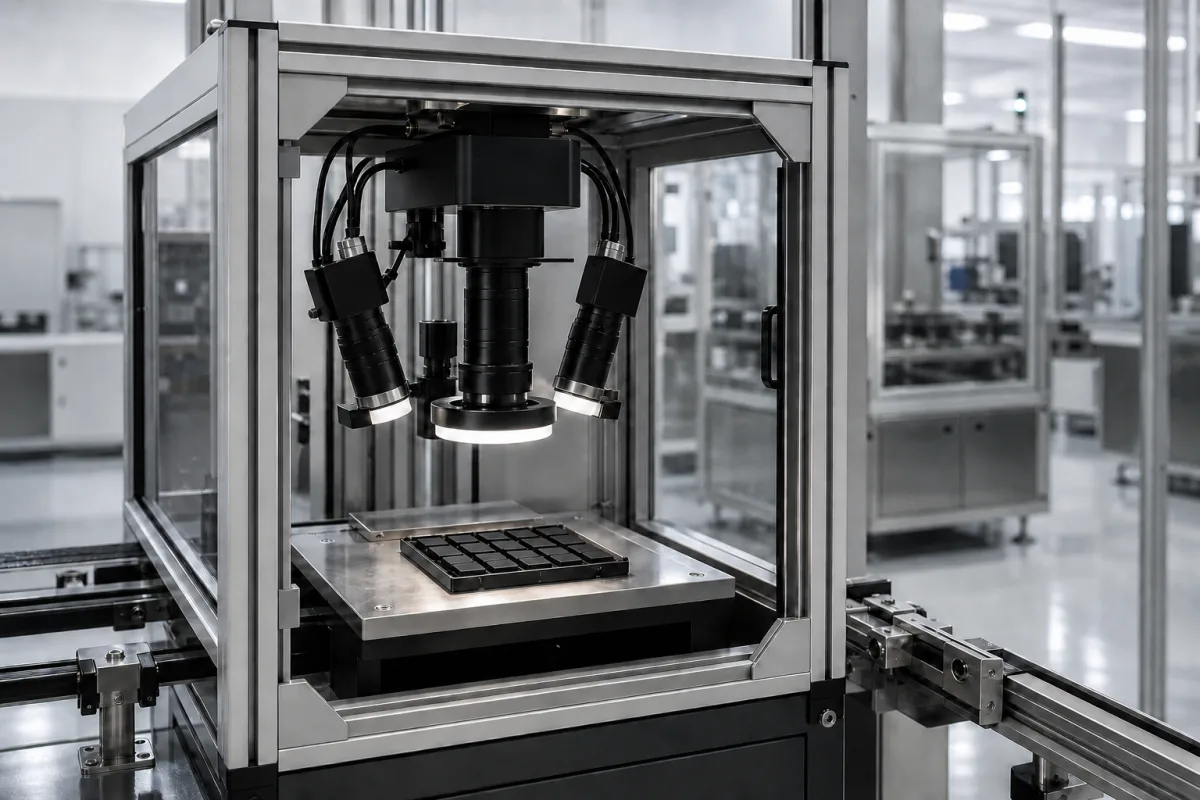
A canonical Optical Inspection Unit is characterized by the integration of Industrial Camera and Lighting System. In industrial production environments, manufacturers listed on CNFX commonly emphasize Aluminum alloy construction to support stable, high-cycle operation across diverse manufacturing scenarios.

A specialized component within the Quality Verification Module that uses optical systems to detect defects, measure dimensions, and verify product quality through non-contact visual inspection.
Product Specifications

Technical details and manufacturing context for Optical Inspection Unit

Definition
The Optical Inspection Unit is a critical part of the Quality Verification Module that employs cameras, lenses, lighting systems, and image processing algorithms to perform automated visual inspection of manufactured products. It identifies surface defects, verifies assembly completeness, measures critical dimensions, and checks for contamination or irregularities without physical contact with the product, ensuring consistent quality standards are maintained throughout the manufacturing process.
Working Principle
The unit operates by illuminating the target product with controlled lighting, capturing high-resolution images using industrial cameras, processing these images through computer vision algorithms to extract features and compare against predefined quality criteria, and generating pass/fail decisions or measurement data for quality control purposes.
Common Materials
Aluminum alloy, Optical glass, Stainless steel, Industrial-grade plastics
Technical Parameters
  • Minimum detectable defect size (mm) Customizable
Components / BOM
  • Industrial Camera
    Captures high-resolution images of products for analysis
    Material: Aluminum housing with glass lens
  • Lighting System
    Provides controlled illumination to highlight features and defects
    Material: LED arrays with aluminum heat sinks
  • Lens Assembly
    Focuses light onto camera sensor with appropriate magnification
    Material: Optical glass with metal housing
  • Processing Unit
    Runs image processing algorithms to analyze captured images
    Material: Electronic components with aluminum enclosure
  • Mounting Frame
    Provides structural support and precise positioning of optical components
    Material: Stainless steel
Engineering Reasoning
0.5-3.0 m focal distance, 10-1000 lux illumination intensity, 5-40°C ambient temperature
Lens thermal expansion exceeding 15 μm at 60°C, CCD sensor temperature exceeding 50°C, illumination intensity drop below 5 lux
Design Rationale: Thermal expansion mismatch between borosilicate glass lens (α=3.3×10⁻⁶/K) and aluminum housing (α=23×10⁻⁶/K) causing optical misalignment; CCD quantum efficiency degradation above 50°C due to increased dark current (doubles every 7°C)
Risk Mitigation (FMEA)
Trigger Condensation forming on lens surface at dew point (100% relative humidity at 25°C)
Mode: Optical scattering causing 85% reduction in contrast ratio
Strategy: Hermetic sealing with desiccant cartridge maintaining <30% RH, active Peltier heating maintaining lens 5°C above ambient
Trigger Vibration exceeding 2.5 g RMS at 100-500 Hz from conveyor system resonance
Mode: Image blur exceeding 5 pixel displacement at 1 ms exposure
Strategy: Kinematic mounting with 8 Hz natural frequency isolation, active piezoelectric stabilization compensating 200 μm displacement

Industry Taxonomies & Aliases

Commonly used trade names and technical identifiers for Optical Inspection Unit.

Applied To / Applications

This component is essential for the following industrial systems and equipment:

Industrial Ecosystem & Supply Chain DNA

Complementary Systems
Downstream Applications
Specialized Tooling

Application Fit & Sizing Matrix

Operational Limits
pressure: Atmospheric to 1.5 bar (sealed enclosure rating)
other spec: Ambient light tolerance: < 1000 lux, Vibration: < 2G RMS, Particle concentration: < 1 mg/m³ for optical clarity
temperature: 0°C to 50°C (operating), -10°C to 60°C (storage)
Media Compatibility
✓ Clear plastics (PET, polycarbonate) ✓ Metallic surfaces (aluminum, stainless steel) ✓ Printed circuit boards (PCBs)
Unsuitable: High-viscosity opaque fluids or environments with continuous oil mist/steam
Sizing Data Required
  • Maximum inspection area dimensions (mm)
  • Minimum detectable defect size (μm)
  • Required inspection speed (parts per minute)

Reliability & Engineering Risk Analysis

Failure Mode & Root Cause
Lens Contamination
Cause: Accumulation of dust, oil mist, or particulates on optical surfaces from the industrial environment, degrading image quality and measurement accuracy.
LED/Light Source Degradation
Cause: Thermal stress and prolonged operation leading to reduced light output, color shift, or complete failure, impairing illumination consistency.
Maintenance Indicators
  • Blurry or inconsistent inspection images despite cleaning
  • Audible cooling fan failure or unusual humming from the unit
Engineering Tips
  • Implement positive air pressure or sealed enclosures with clean, dry air supply to minimize particulate ingress onto optical components.
  • Schedule periodic light source intensity calibration and thermal management checks to preemptively replace LEDs before critical failure.

Compliance & Manufacturing Standards

Reference Standards
ISO 9001:2015 Quality Management Systems ANSI/ASME B46.1-2019 Surface Texture DIN EN ISO 10360-7:2011 Coordinate Measuring Machines
Manufacturing Precision
  • Lens Centration: +/-0.005mm
  • Surface Roughness: Ra 0.4μm max
Quality Inspection
  • MTF (Modulation Transfer Function) Measurement
  • Environmental Sealing Test (IP67)

Factories Producing Optical Inspection Unit

Verified manufacturers with capability to produce this product in China

✓ 94% Supplier Capability Match Found

S Sourcing Manager from United Arab Emirates Feb 17, 2026
★★★★★
"The Optical Inspection Unit we sourced perfectly fits our Computer, Electronic and Optical Product Manufacturing production line requirements."
Technical Specifications Verified
P Procurement Specialist from Australia Feb 14, 2026
★★★★☆
"Found 22+ suppliers for Optical Inspection Unit on CNFX, but this spec remains the most cost-effective. (Delivery took slightly longer than expected, but technical support was excellent.)"
Technical Specifications Verified
T Technical Director from Singapore Feb 11, 2026
★★★★★
"The technical documentation for this Optical Inspection Unit is very thorough, especially regarding technical reliability."
Technical Specifications Verified
Verification Protocol

“Feedback is collected from verified sourcing managers during RFQ (Request for Quote) and factory evaluation processes on CNFX. These reports represent historical performance data and technical audit summaries from our B2B manufacturing network.”

5 sourcing managers are analyzing this specification now. Last inquiry for Optical Inspection Unit from Germany (1h ago).

Supply Chain Compatible Machinery & Devices

Industrial IoT Gateway

Edge computing device connecting industrial equipment to cloud platforms.

Explore Specs →
Modular Industrial Edge Computing Device

Rugged computing platform for industrial data processing at the network edge

Explore Specs →
Industrial Smart Camera Module

Embedded vision system for industrial automation and quality inspection.

Explore Specs →
Industrial Wireless Power Transfer Module

Wireless power transfer module for industrial equipment applications

Explore Specs →

Frequently Asked Questions

What types of defects can this optical inspection unit detect?

This optical inspection unit can detect surface defects like scratches, cracks, and contamination, dimensional inaccuracies, component misalignment, and assembly errors in electronic and optical products through high-resolution visual analysis.

How does the non-contact inspection benefit manufacturing processes?

Non-contact inspection eliminates physical contact with products, preventing damage to delicate components, maintaining hygiene for sensitive applications, and enabling continuous inline inspection without interrupting production flow.

What industries benefit most from this optical inspection technology?

Computer, electronic, and optical product manufacturing industries benefit most, particularly for inspecting circuit boards, semiconductor components, optical lenses, precision mechanical parts, and assembled electronic devices requiring high-quality standards.

Can I contact factories directly on CNFX?

CNFX is an open directory, not a transaction platform. Each factory profile provides direct contact information and production details to help you initiate direct inquiries with Chinese suppliers.

Get Quote for Optical Inspection Unit

Request technical pricing, lead times, or customized specifications for Optical Inspection Unit directly from verified manufacturing units.

Your business information is encrypted and only shared with verified Optical Inspection Unit suppliers.

Thank you! Your message has been sent. We'll respond within 1–3 business days.

Need to Manufacture Optical Inspection Unit?

Connect with verified factories specializing in this product category

Add Your Factory Contact Us
Previous Product
Optical Encoders
Next Product
Optical Isolators