Industry-Verified Manufacturing Data (2026)

Photodetector array

Based on aggregated insights from multiple verified factory profiles within the CNFX directory, the standard Photodetector array used in the Computer, Electronic and Optical Product Manufacturing sector typically supports operational capacities ranging from standard industrial configurations to heavy-duty production requirements.

Technical Definition & Core Assembly

A canonical Photodetector array is characterized by the integration of Photodiode elements and Interconnection matrix. In industrial production environments, manufacturers listed on CNFX commonly emphasize Silicon construction to support stable, high-cycle operation across diverse manufacturing scenarios.

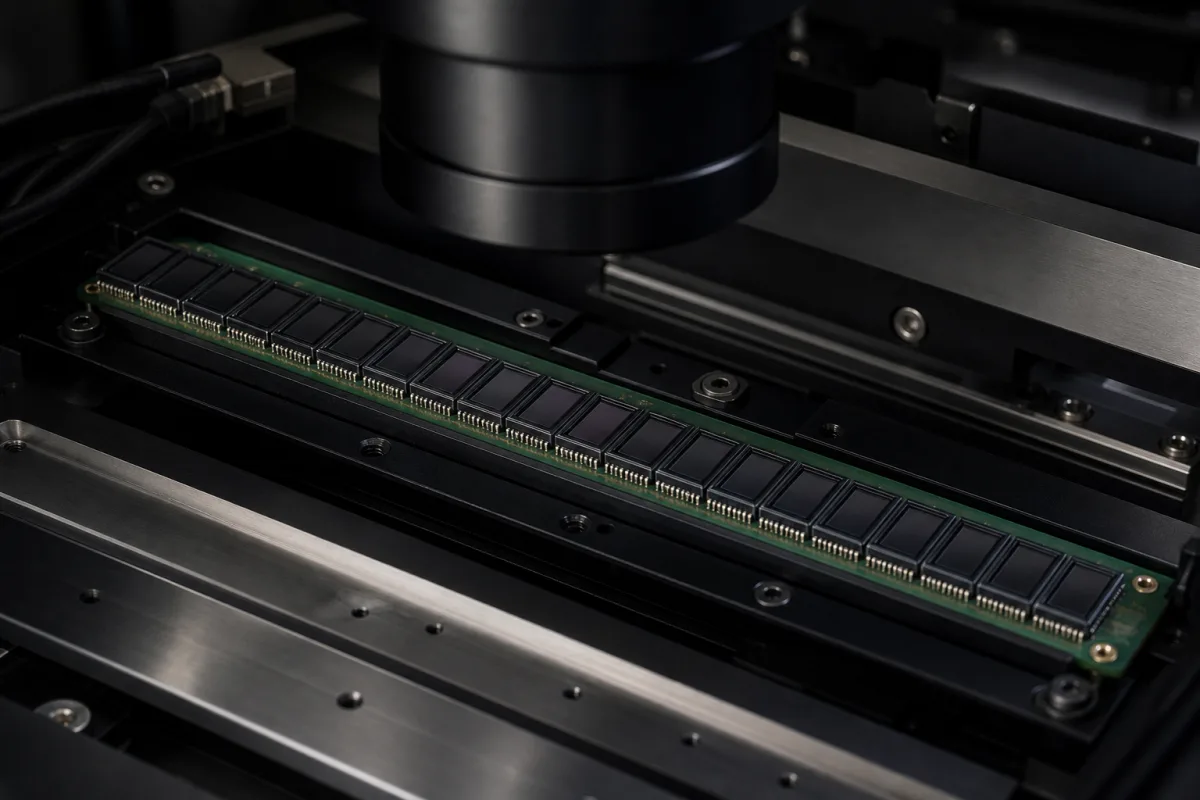
An array of photodetectors that converts optical signals into electrical signals for position or motion detection.
Product Specifications

Technical details and manufacturing context for Photodetector array

Definition
A photodetector array is a critical component within an encoder system, consisting of multiple light-sensitive elements arranged in a pattern. It detects light patterns from an encoder disk or scale and converts them into electrical signals that are processed to determine precise position, speed, or direction of motion.
Working Principle
The photodetector array receives modulated light (typically from an LED or laser) that passes through or reflects off an encoder pattern. Each photodetector element generates an electrical current proportional to the incident light intensity. The array's spatial arrangement allows detection of phase-shifted signals (e.g., quadrature signals) for accurate position interpolation and direction sensing.
Common Materials
Silicon, Gallium arsenide (GaAs), Indium gallium arsenide (InGaAs)
Technical Parameters
  • Pixel pitch or element spacing within the array (mm) Customizable
Components / BOM
  • Photodiode elements
    Convert incident photons into electrical current through the photoelectric effect
    Material: Semiconductor materials (Si, GaAs, InGaAs)
  • Interconnection matrix
    Routes electrical signals from individual photodetectors to output terminals
    Material: Aluminum or copper metallization
  • Protective window
    Shields sensitive photodetector elements from environmental contaminants while transmitting light
    Material: Glass or optical-grade polymer
Engineering Reasoning
0.1-1000 μW/cm² optical power density, -40°C to +85°C ambient temperature
Saturation at 1500 μW/cm² optical input causing nonlinear response, permanent damage at 2000 μW/cm² due to photodiode junction breakdown
Design Rationale: Photodiode reverse bias junction breakdown under excessive photon flux, exceeding semiconductor bandgap energy absorption capacity (1.12 eV for silicon)
Risk Mitigation (FMEA)
Trigger Electrostatic discharge (ESD) exceeding 1000V HBM
Mode: Photodiode junction short circuit, dark current increase to >10 μA
Strategy: Integrated ESD protection diodes with 500V clamping voltage, antistatic handling procedures
Trigger Thermal cycling between -40°C and +125°C at 10 cycles/hour
Mode: Solder joint fatigue failure, interconnect resistance increase >100 mΩ
Strategy: Gold-tin eutectic solder with 96.5Sn-3.0Ag-0.5Cu composition, thermal stress relief structures

Industry Taxonomies & Aliases

Commonly used trade names and technical identifiers for Photodetector array.

Applied To / Applications

This component is essential for the following industrial systems and equipment:

Industrial Ecosystem & Supply Chain DNA

Complementary Systems
Downstream Applications
Specialized Tooling

Application Fit & Sizing Matrix

Operational Limits
pressure: Atmospheric to 1.5 bar
other spec: Wavelength range: 400-1100 nm, Response time: <10 ns
temperature: -40°C to +85°C
Media Compatibility
✓ Clean air environments ✓ Optical glass interfaces ✓ Non-corrosive gas atmospheres
Unsuitable: High particulate or abrasive slurry environments
Sizing Data Required
  • Required spatial resolution (pixel pitch)
  • Signal wavelength range
  • Minimum detectable light intensity (NEP)

Reliability & Engineering Risk Analysis

Failure Mode & Root Cause
Pixel degradation
Cause: Thermal stress from prolonged operation or environmental temperature fluctuations causing material fatigue and reduced sensitivity.
Signal drift
Cause: Contamination accumulation on optical surfaces or aging of electronic components leading to calibration loss.
Maintenance Indicators
  • Inconsistent output readings or signal noise under stable lighting conditions
  • Visible particulate contamination or condensation on optical windows
Engineering Tips
  • Implement controlled thermal management with proper heat sinking and avoid rapid temperature cycling
  • Establish regular optical cleaning protocols using approved materials and maintain dust-free operating environment

Compliance & Manufacturing Standards

Reference Standards
ISO 9022-11:2015 (Optical components - Environmental test methods) ANSI/ESD S20.20-2021 (Electrostatic discharge control program) DIN EN 60747-5-2:2003 (Discrete semiconductor devices - Optoelectronic devices)
Manufacturing Precision
  • Pixel pitch uniformity: +/-0.5% across array
  • Spectral response deviation: +/-3nm from specified wavelength
Quality Inspection
  • Dark current uniformity test (measurement of leakage current across all pixels)
  • Quantum efficiency verification (spectral response measurement at specified wavelengths)

Factories Producing Photodetector array

Verified manufacturers with capability to produce this product in China

✓ 96% Supplier Capability Match Found

T Technical Director from Australia Jan 30, 2026
★★★★★
"The Photodetector array we sourced perfectly fits our Computer, Electronic and Optical Product Manufacturing production line requirements."
Technical Specifications Verified
P Project Engineer from Singapore Jan 27, 2026
★★★★☆
"Found 20+ suppliers for Photodetector array on CNFX, but this spec remains the most cost-effective. (Delivery took slightly longer than expected, but technical support was excellent.)"
Technical Specifications Verified
S Sourcing Manager from Germany Jan 24, 2026
★★★★★
"The technical documentation for this Photodetector array is very thorough, especially regarding technical reliability."
Technical Specifications Verified
Verification Protocol

“Feedback is collected from verified sourcing managers during RFQ (Request for Quote) and factory evaluation processes on CNFX. These reports represent historical performance data and technical audit summaries from our B2B manufacturing network.”

8 sourcing managers are analyzing this specification now. Last inquiry for Photodetector array from Poland (47m ago).

Supply Chain Compatible Machinery & Devices

Industrial IoT Gateway

Edge computing device connecting industrial equipment to cloud platforms.

Explore Specs →
Modular Industrial Edge Computing Device

Rugged computing platform for industrial data processing at the network edge

Explore Specs →
Industrial Smart Camera Module

Embedded vision system for industrial automation and quality inspection.

Explore Specs →
Industrial Wireless Power Transfer Module

Wireless power transfer module for industrial equipment applications

Explore Specs →

Frequently Asked Questions

What are the main applications of photodetector arrays in computer and optical product manufacturing?

Photodetector arrays are essential for position sensing, motion detection, optical encoders, barcode scanners, and automated optical inspection systems in electronics manufacturing.

How does the choice of material (Si, GaAs, InGaAs) affect photodetector array performance?

Silicon offers cost-effective visible light detection, GaAs provides higher speed for near-infrared applications, while InGaAs delivers superior sensitivity for longer infrared wavelengths in specialized optical systems.

What maintenance considerations are important for photodetector arrays with protective windows?

Regular cleaning of protective windows is crucial to maintain optical clarity. Avoid abrasive materials, use appropriate optical cleaning solutions, and ensure proper environmental sealing to prevent dust and moisture ingress.

Can I contact factories directly on CNFX?

CNFX is an open directory, not a transaction platform. Each factory profile provides direct contact information and production details to help you initiate direct inquiries with Chinese suppliers.

Get Quote for Photodetector array

Request technical pricing, lead times, or customized specifications for Photodetector array directly from verified manufacturing units.

Your business information is encrypted and only shared with verified Photodetector array suppliers.

Thank you! Your message has been sent. We'll respond within 1–3 business days.

Need to Manufacture Photodetector array?

Connect with verified factories specializing in this product category

Add Your Factory Contact Us
Previous Product
Photodetector
Next Product
Photodetector Array (e.g., CMOS/CCD)